Tag Archives: currency

The Best Way to Ruin a Country is to Corrupt its Currency

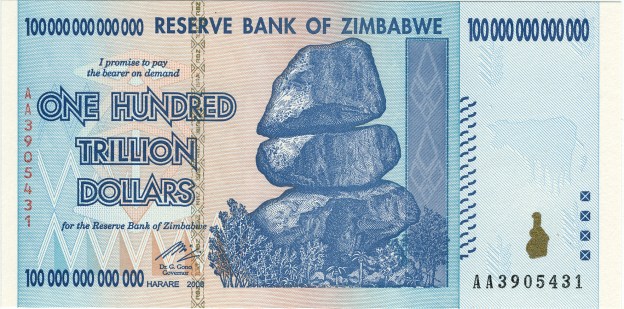
The Reserve Bank of Zimbabwe, which gained global notoriety in 2008 for printing one-hundred-trillion-dollar notes, said in April 2024 that it was launching a new national currency, promising, once again, to end years of monetary turbulence. John Mushayavanhu, who took over as the central bank’s new governor in April 2024 said the new unit, Zimbabwe Gold, or ZiG, will replace the current Zimbabwe dollar, which has lost around three-fourths of its value this year.

The currency most recently traded at more than 30,674 Zimbabwean dollars to the U.S. dollar, according to the central bank. When the bank relaunched the local unit in 2019, $1 bought 2.50 Zimbabwean dollars. Mushayavanhu said the new currency would initially be valued at 13.56 ZiGs for $1 and later at a rate determined by the market.

To shore up confidence in the currency, Mushayavanhu said it would be fully backed by Zimbabwe’s reserves of U.S. dollars and precious metals, particularly gold. He also pledged to end a long-running practice of the bank issuing more money to finance government spending…

Zimbabwe abolished the Zimbabwe dollar in 2009, after a bout of hyperinflation that, by some estimates, saw prices rise by 500 billion percent. For nearly a decade, the country then operated on U.S. dollars and other foreign currencies. When the central bank was no longer able to pay out savings in cash dollars, it reintroduced the Zimbabwe dollar in 2019.

Excerpt from Gabriele Steinhauser, Zimbabwe Launches a New Currency…Again, WSJ, April 5, 2024
The Biggest Flaw of Africa

Investors are yanking their cash from African assets, until recently a popular play for the adventurous, as a toxic confluence of factors overhangs the continent.Crashing commodity prices, a Chinese slowdown and a string of policy failures are forcing investors to reassess the risk of investing in Africa after years of optimism about its growth prospects.Stock markets and currencies have been selling off across the continent, especially in commodity-dependent economies. Nigeria, the continent’s largest economy and longtime investor darling, has one of the world’s worst-performing stock indexes this year, down by 14% since the start of 2016. The S&P Zambia Index has fared even worse over the past year, plunging 45% as the country’s copper exports tumbled on softening Chinese demand. President Edgar Lungu last September called for a day of national prayer to petition God to shore up Zambia’s currency, the kwacha. At the time, the kwacha had lost 45% of its value against the dollar in 2015.  The declines mean African equities are performing worse than any other frontier markets. The MSCI Africa index tumbled 19% last year, significantly more than the overall MSCI Frontier Markets index….The upshot is that frontier investors are moving their money from Africa to Asian countries like Pakistan, Bangladesh and Vietnam; net energy and commodity importers which have shown more commitment to industrialization….

The shift has also pushed up the costs of sovereign borrowing, even as African countries slow down their issuance of bonds in international capital markets. In 2014, African sovereigns issued $12 billion worth of bonds in international capital markets; last year it was half that, according to Deutsche Bank.Ghana, mired in an economic crisis, issued the most expensive African Eurobond in history late last year, paying a whopping 10.75% for $1 billion; far higher than the single-digit interest rates the government had become accustomed to paying for international bonds in recent years….

[T]here are important exceptions to the rule: Kenya, which has a more diversified economy, and Ivory Coast, the world’s top producer of cocoa, are still attracting frontier investors…..

“One of the biggest flaws when investors look at Africa is that they think of it as a country and not a continent composed of very unique countries and companies,” says Laura Geritz, who runs U.S.-based Wasatch Frontier Emerging Small Countries with $1.1 billion under management.

Excerpts from  Africa Bruised by Investor Exodus, Wall Street Journal, Feb. 26, 2016