Tag Archives: China Shipping

While United States Sleeping, China Made Ships

A $16 billion merger of two state-controlled shipbuilders in China was set for completion the week of August 11, 2025 creating the world’s biggest shipbuilder while the U.S. searches for a path back into the business.  American shipbuilders are playing catch-up after decades of maritime-industry decline…but Trump’s threat to impose higher fees on ships made in China is giving South Korean and Japanese rivals an opening to win back market share.

The Chinese champion is called China State Shipbuilding, or CSSC. In August 2025, it is scheduled to absorb its merger partner, China Shipbuilding Industry, and take the sole listing on the Shanghai Stock Exchange… Beijing is currently looking to consolidate state-led companies in sensitive industries, particularly those connected with the military. CSSC’s main business is commercial, but it is also an important contractor for the Chinese navy. China Shipbuilding Industry designed and built China’s first homegrown aircraft carrier, the Shandong.

Beijing set its sights on dominating the shipbuilding industry decades ago, and now Chinese shipbuilders make up more than half of the global market. China-built ships accounted for about 55% of global tonnage in 2024, compared with less than 0.05% for the U.S. China possesses 232 times the shipbuilding capacity of the U.S., according to the U.S. Navy…


Meanwhile, smaller rivals in Japan are looking to reclaim market share after decades of being pushed into a corner by lower-cost Chinese and South Korean rivals. A proposal in June in 2025 from Japan’s ruling Liberal Democratic Party calls for extensive subsidies for local shipyards to protect national security, including a $6.7 billion public-private fund. “If we fail to act now, Japan risks losing its shipbuilding industry entirely, as Europe and the United States did,” the party said.

Excerpt from China Creates World’s No. 1 Shipbuilder, Driven by Rivalry With U.S., WSJ, Aug. 11, 2025

Crossing the Pacific: the Logistics of War

Every two weeks since 2023, US officers convene a classified intelligence briefing about fighting in the Red Sea. The attendees aren’t politicians, policymakers or spies. They are private shipping executives. The meetings are part of a push by the Pentagon’s Transportation Command, or Transcom, to integrate shipping lines as crisis supply lines. The policy stems from a dire need in an unloved but vital corner of America’s military behemoth. A House select committee in February 2024 called Transcom’s sea-cargo capacity “woefully inadequate.” The U.S. is investing heavily in new weapons systems, but missiles, warships and jet fighters are only a fraction of what the military worries about. Troops sent to battle also need food and water. Their equipment devours fuel and spare parts. Guns without ammunition are dead weight. Wounded fighters require evacuation.

Moving all of that—and keeping supplies flowing for months or years—demands vast and complex support infrastructure, broadly termed logistics. If it doesn’t function, even a battle-proven force will grind to a halt…China’s rise has exposed America’s shipping weakness. Beijing isn’t just Washington’s biggest military rival. It is also by far the world’s biggest logistics operation. Within China’s centrally directed economy, the government controls commercial shippers, foreign port facilities and a globe-spanning cargo-data network that in a conflict could be repurposed for military aims or to undermine the U.S., including on home soil. Transcom’s fleet of planes and cargo ships, meanwhile, is aging and insufficient.

In conflict with China, the Pentagon would send roughly 90% of its provisions by sea. Among 44 government-owned ships for moving vehicles that Transcom can tap, 28 will retire within eight years. Replacements have faced repeated delays. But military logistics isn’t “just logistics” because in wartime, supply lines are prime targets. During Russia’s assault on Kyiv in 2022, Ukrainians crippled Moscow’s forces by destroying their provisions.

Robust logistics, in contrast, can deter attacks. If adversaries believe the U.S. can quickly mobilize a massive response, they are less likely to initiate hostilities. During the Cold War, North Atlantic Treaty Organization allies routinely made a show of flooding Europe with American troops and gear before exercises.

The U.S. has decades of experience working with NATO allies to send military supplies to Europe for a potential conflict with Russia. Cargo ships generally need about two weeks to cross the Atlantic. For a conflict with China, logistics would be more complicated because distances are far greater. Crossing the Pacific takes much longer than the Atlantic, and shipping routes could face greater danger of attack.

In 1990, at the Cold War’s end, the U.S. had roughly 600 available merchant ships. In 1960, it had more than 3,000. China today has more than 7,000 commercial ships. Chinese entities own every sixth commercial vessel on the seas—including ships flying other countries’ flags—a share comparable only to Greece.

Excerpts from Daniel Michaels and Nancy A. Youssef, Pentagon’s limited capacity to support a potential China conflict forces planners to tap private cargo companies, WSJ, Nov. 1, 2024

Ports for Sale – China Buys

The old port of Colombo, Sri Lanka took centuries to reach its present capacity. China will have almost doubled it in under 30 months. Operated at full capacity, it would make Colombo one of the world’s 20 biggest container ports.  In the eyes of some Indians, Colombo is part of a “string of pearls”—an American-coined phrase that suggests the deliberate construction of a network of Chinese built, owned or influenced ports that could threaten India. These include a facility in Gwadar and a port in Karachi (both in Pakistan); a container facility in Chittagong (Bangladesh); and ports in Myanmar.

Is this string theory convincing? Even if the policy exists, it might not work. Were China able to somehow turn ports into naval bases, it might struggle to keep control of a series of Gibraltars so far from home. And host countries have mood swings. Since Myanmar opened up in 2012, China’s influence there has decreased. China love-bombed the Seychelles and Mauritius with presidential visits in 2007 and 2009 respectively. But since then India has successfully buttered up these island states and reasserted its role in the Maldives. Besides, China’s main motive may be commerce. C. Raja Mohan, the author of “Samudra Manthan”, a book on Sino-Indian rivalry in the Indian and Pacific Oceans, argues that China’s port bases partly reflect a desire to get easier sea access for trade to and from west China.

State-owned firms are in charge of most of China’s maritime activity, and their motives are at least partly commercial…China’s maritime interests already reflect its status as the world’s largest exporter and second-largest importer. Many of the world’s biggest container ports are in China. It controls a fifth of the world’s container fleet mainly through giant state-owned lines. By weight, 41% of ships built in 2012 were made in China.

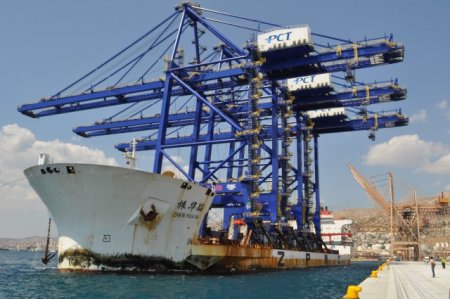
The next step is to own and run ports. Hutchison Whampoa, a buccaneering, privately owned Hong Kong conglomerate, has long had a global network of ports. The pioneer among mainland firms was Cosco Pacific, an affiliate of state-owned Cosco, China’s biggest shipping line. In 2003-07 it took minority stakes in terminals in Antwerp, Suez and Singapore. In 2009 it took charge of half of Piraeus Port in Greece. It has invested about $1 billion abroad. China Merchants Holdings International, a newcomer, has spent double that. It invested in Nigeria, as well as Colombo, in 2010. Last year it took stakes in ports in Togo and Djibouti. In January it bought 49% of Terminal Link, a global portfolio of terminals run by CMA CGM, an indebted French container line.

The pace is quickening. In March another firm, China Shipping Terminal, bought a stake in a terminal in Zeebrugge in Belgium. On May 30th China Merchants struck a multi-billion deal to create a port in Tanzania. Even the more cautious Cosco Pacific is thinking about deals in South-East Asia and investing more in Greece.

China Shipping Terminal has small stakes in facilities in Seattle and Los Angeles, according to Drewry, a consultancy. But the experience of Dubai’s DP World suggests that America would not roll out a red carpet. In 2006 DP abandoned plans to buy American ports after a political backlash. Some Americans worry that China wants to take over the Panama canal.

Chinese firms may also subscribe to a supersized vision of the industry in which an elite group of ports caters to a new generation of mega-vessels. These will be more fuel-efficient and link Asia and Europe (they can just squeeze through the Suez Canal). After a decade of hype these behemoths are now afloat. In May CMA CGM received the Jules Verne, the world’s largest container ship. It can handle 16,000 containers and has a 16-metre (52-feet) draft. In July Maersk, a Danish line, will launch an 18,000-container monster. It has ordered 20 from Daewoo, in Korea. China Shipping Container Lines, the country’s second biggest firm, has just ordered five 18,400-container vessels from Hyundai.  Some ports may struggle to cater to these ships. Some of China’s new terminals may try to exploit that. Cosco Pacific is building a dock at Piraeus that can handle mega-ships. Colombo is deep enough for ships with an 18-metre draft. Its cranes can cope with ships 24 containers wide. Nothing in India compares with that…

After political tensions in the South China Sea, China Merchants has withdrawn from a port project in Vietnam. But Cosco’s Piraeus investment, once controversial, is a success, with profits rising and the firm winning plaudits for investing and creating jobs for Greeks.

China’s port strategy is mainly motivated by commercial impulses. It is natural that a country of its clout has a global shipping and ports industry. But it could become a flashpoint for diplomatic tensions. That is the pessimistic view. The optimistic one is that the more it invests, the more incentive China has to rub along better with its trading partners. This, not deliberate expansionism, is what the locals are betting on in Colombo.

China’s foreign ports: The new masters and commanders, Economist,  June 8, 2013