Tag Archives: China Telecom and SSB undersea cables

The Undeclared War in the Baltic

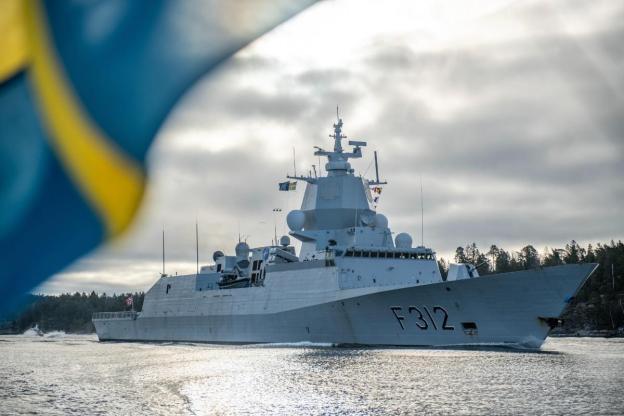
In January 2025, NATO launched the operation, dubbed Baltic Sentry, after a string of undersea cables and pipelines were damaged by ships—many with links to Russia—that had dragged their anchors.  “We are functioning as security cameras at sea,” said Kockx, the Belgian commander, whose usual duty is clearing unexploded mines from the busy waterway… New undersea drones are keeping a watchful eye on pipes and cables. NATO surveillance planes from the U.S., France, Germany and occasionally the U.K. take turns scanning the seaway from high above. NATO has also strengthened its military presence on the Baltic…NATO’s goal is to prevent more damage to subsea infrastructure and respond faster if something occurs…

The Baltic, a central theater in two world wars, is littered with wrecks and explosives that still pose danger. Surrounding NATO members are world leaders in finding and disposing of sea mines, officials say….Commercial traffic on the Baltic ranks among the world’s densest, with more than 1,500 ships plying its waves on any day, so policing it all is difficult. Further complicating NATO’s sentry duty initially was a lack of comprehensive information about all the critical infrastructure snaking across the sea’s muddy bottom. Details of pipes and cables have traditionally been kept by national governments or private companies. Nobody had a picture of everything...NATO’s new undersea infrastructure center in 2024 assembled the first unified map of the Baltic’s floor.

Excerpt from Daniel Michaels, How NATO Patrols the Sea for Suspected Russian Sabotage, Mar. 31, 2025

The Shadow War: Cutting Underwater Data Cables

The North Atlantic Treaty Organization (NATO) mounted its first coordinated response to the suspected sabotage campaign against critical infrastructure, after another underwater data cable was severed in the Baltic Sea in 2025. NATO vessels raced to the site of a damaged fiber-optic cable in Swedish waters on January 26, 2025 where a trio of ships carrying Russian cargo, including one recently sanctioned by the U.S., were nearby. All three vessels are now being investigated as part of a probe into suspected sabotage of the fiber optic cable.

The incident is the latest in a string of alleged underwater attacks in the region that prompted NATO to announce earlier this month the formation of a surveillance mission called Baltic Sentry. It includes regular naval patrols, as well as enhanced drone, satellite and electronic surveillance of Baltic areas that are crisscrossed by critical infrastructure such as data and power cables, along with gas pipelines and offshore wind farms…Under international maritime law, a ship in international waters is under the jurisdiction of the country of its registration and can be boarded by foreign enforcement officials only with explicit permission of its owner or flag country. The captain of the Pskov, one of the ships suspected to have cut the undersea cables, cited the international law of the sea when he argued against an official request to steer his ship into a port in Finland…

In December 2024, Finland detained a vessel called Eagle S, an oil tanker belonging to Russia’s shadow fleet that is registered in the Cook Islands, on suspicion that it had deliberately used its anchor to cut a power cable connecting Finland and Estonia. In a midnight raid, Finnish special forces dropped from a helicopter onto the deck of Eagle S and captured the ship and its crew, which have since been detained in a Finnish port. 

In November 2024, an investigation was launched against a Chinese bulk carrier called Yi Peng 3, which cut two data cables in the Baltic after dragging its anchor for several hours, according to investigators. The vessel was loaded with Russian fertilizer. The probe continues. 

Excerpt from Bojan Pancevski, Suspected Sabotage of Deep-Sea Cable Triggers First NATO-Led Response, WSJ, Jan. 27, 2025

Crossing the Pacific: the Logistics of War

Every two weeks since 2023, US officers convene a classified intelligence briefing about fighting in the Red Sea. The attendees aren’t politicians, policymakers or spies. They are private shipping executives. The meetings are part of a push by the Pentagon’s Transportation Command, or Transcom, to integrate shipping lines as crisis supply lines. The policy stems from a dire need in an unloved but vital corner of America’s military behemoth. A House select committee in February 2024 called Transcom’s sea-cargo capacity “woefully inadequate.” The U.S. is investing heavily in new weapons systems, but missiles, warships and jet fighters are only a fraction of what the military worries about. Troops sent to battle also need food and water. Their equipment devours fuel and spare parts. Guns without ammunition are dead weight. Wounded fighters require evacuation.

Moving all of that—and keeping supplies flowing for months or years—demands vast and complex support infrastructure, broadly termed logistics. If it doesn’t function, even a battle-proven force will grind to a halt…China’s rise has exposed America’s shipping weakness. Beijing isn’t just Washington’s biggest military rival. It is also by far the world’s biggest logistics operation. Within China’s centrally directed economy, the government controls commercial shippers, foreign port facilities and a globe-spanning cargo-data network that in a conflict could be repurposed for military aims or to undermine the U.S., including on home soil. Transcom’s fleet of planes and cargo ships, meanwhile, is aging and insufficient.

In conflict with China, the Pentagon would send roughly 90% of its provisions by sea. Among 44 government-owned ships for moving vehicles that Transcom can tap, 28 will retire within eight years. Replacements have faced repeated delays. But military logistics isn’t “just logistics” because in wartime, supply lines are prime targets. During Russia’s assault on Kyiv in 2022, Ukrainians crippled Moscow’s forces by destroying their provisions.

Robust logistics, in contrast, can deter attacks. If adversaries believe the U.S. can quickly mobilize a massive response, they are less likely to initiate hostilities. During the Cold War, North Atlantic Treaty Organization allies routinely made a show of flooding Europe with American troops and gear before exercises.

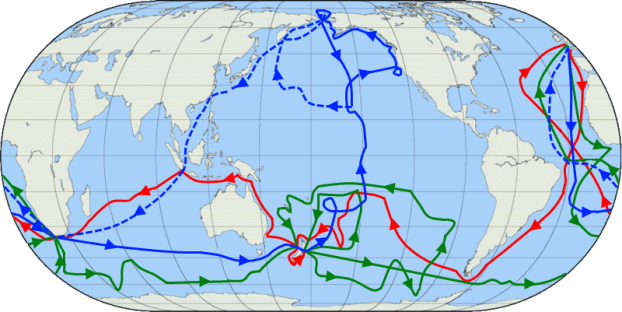
The U.S. has decades of experience working with NATO allies to send military supplies to Europe for a potential conflict with Russia. Cargo ships generally need about two weeks to cross the Atlantic. For a conflict with China, logistics would be more complicated because distances are far greater. Crossing the Pacific takes much longer than the Atlantic, and shipping routes could face greater danger of attack.

In 1990, at the Cold War’s end, the U.S. had roughly 600 available merchant ships. In 1960, it had more than 3,000. China today has more than 7,000 commercial ships. Chinese entities own every sixth commercial vessel on the seas—including ships flying other countries’ flags—a share comparable only to Greece.

Excerpts from Daniel Michaels and Nancy A. Youssef, Pentagon’s limited capacity to support a potential China conflict forces planners to tap private cargo companies, WSJ, Nov. 1, 2024
A Spy in Plain Sight: Internet Cables

U.S. officials are privately delivering an unusual warning to telecommunications companies: Undersea cables that ferry internet traffic across the Pacific Ocean could be vulnerable to tampering by Chinese repair ships. State Department officials said a state-controlled Chinese company that helps repair international cables, S.B. Submarine Systems (SSB), appeared to be hiding its vessels’ locations from radio and satellite tracking services, which the officials and others said defied easy explanation.

The warnings highlight an overlooked security risk to undersea fiber-optic cables, according to these officials: Silicon Valley giants, such as Google and Meta Platforms, partially own many cables and are investing in more. But they rely on specialized construction and repair companies, including some with foreign ownership that U.S. officials fear could endanger the security of commercial and military data.

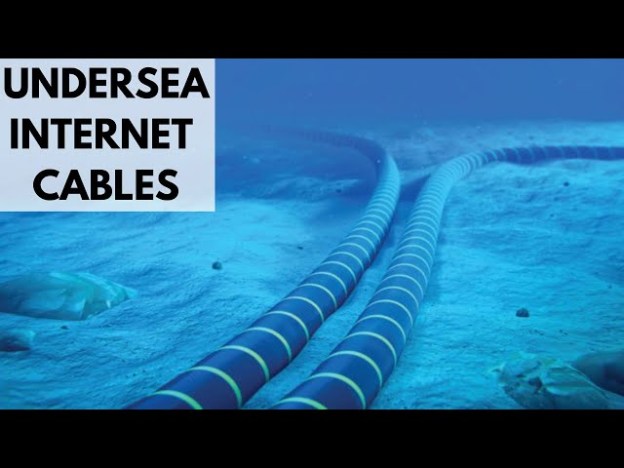
Hundreds of thousands of miles of underwater fiber-optic cables carry almost all the world’s international internet traffic. Dozens of lines lace the Pacific Ocean floor, shuttling data between the Americas, Asia and many island chains. SBSS is part of a regional consortium of companies that provides ships to fix undersea cables, including some belonging to major U.S. companies, by winching them to the surface, resplicing broken fibers that carry internet data and returning the lines to the sea floor… Underwater cables are vulnerable to tampering when they are brought to the surface for repairs, U.S. officials say. Tapping global data flows is still far easier on land, industry experts say. But at-sea repair could still offer an opportunity to install a device to remotely disable a cable or to study the technology in advanced signal repeaters installed by other companies.

SBSS was formed in 1995 as a Chinese-British joint venture. State-owned China Telecom has long held 51% of the business and is in the process of buying the remainder from U.K.-based Global Marine Systems, according to people familiar with the matter. A member of the Chinese Communist Party serves on the SBSS management team, according to the company’s website.

Safeguarding underwater cables has been a focus of U.S. national-security officials since the Cold War, when fears of Soviet espionage were paramount. In the 1970s, the U.S. secretly placed wiretaps on underwater Soviet lines in an intelligence coup known as Operation Ivy Bells….

SubCom, a U.S. cable ship company owned by private-equity giant Cerberus Capital Management, receives $10 million in annual U.S. government payments for participating in the Cable Security Fleet, a program partly overseen by the Pentagon…

Overall, cable owners have few choices with regard to repairing damaged undersea cables, as most repairing is done by an aging fleet of roughly 50 ships around the world…


Excerpts from U.S. Fears Undersea Cables Are Vulnerable to Espionage From Chinese Repair Ships, WSJ, May 19, 2024