Tag Archives: cocaine

The New Underworld Order: Invincible Cartels

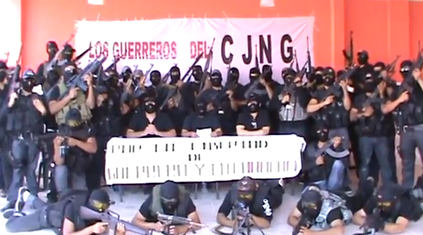
Nemesio “Mencho” Oseguera spent decades building his Jalisco New Generation Cartel into a transnational criminal organization fierce enough to forge a new underworld order in Mexico, displacing the Sinaloa cartel, torn by warring factions, as the world’s biggest drug pusher. The Sinaloans, Mexico’s top fentanyl traffickers, got caught in the crosshairs of the Trump administration, which promised to eradicate the synthetic opioid. The crackdown has left an open field for Jalisco and its lucrative cocaine trade, elevating Oseguera to No. 1.

The Jalisco cartel transports the cocaine by the ton from Colombia to Ecuador and then north to Mexico’s Pacific coast via speedboats and so-called narco subs…The U.S. has a $15 million bounty on Oseguera, but he rarely leaves his mountain compound, according to authorities. Few photos of him circulate. The cadre of men protecting Oseguera, known as the Special Force of the High Command, carry RPG 7 heat-seeking, shoulder-fired rocket launchers capable of piercing a tank, people familiar with cartel operations said. Visitors to the drug lord’s stronghold are hooded before they embark on the six-hour car trip through terrain sown with land mines, those people said. Locations of the pressure-activated explosives are known only by members of Oseguera’s inner circle.

The Jalisco cartel, which controls ports on Mexico’s Pacific coast, now uses routes and tunnels into the U.S. that are controlled by the sons of imprisoned drug kingpin Joaquín “El Chapo” Guzmán….
 
The cartel acts as a parallel government in the southwestern state of Jalisco and other parts of Mexico, taxing such goods as tortillas, chicken, cigarettes and beer, security experts said. It controls construction companies that build roads, schools and sewers for the municipal governments under cartel control.  A booming black market for fuel is another cash cow. Gasoline and diesel stolen from Mexican refineries and pipelines—or smuggled into Mexico from the U.S. without paying taxes—is sold at below market prices to small and large businesses.. The head of the Jalisco cartel’s fuel division is nicknamed “Tank” for his prowess at stealing and storing millions of gallons of fuel. 

Excerpst from Steve Fisher et al., America Loves Cocaine Again—Mexico’s New Drug King Cashes In, WSJ, Sept. 16, 2025
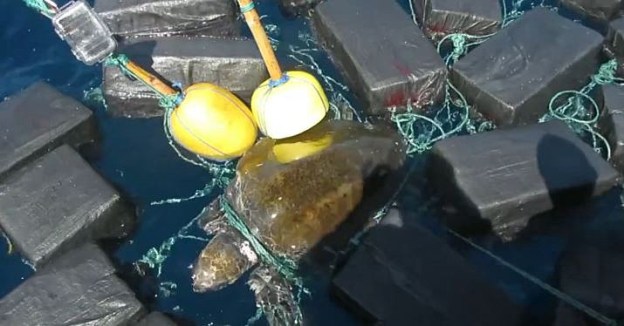
Sea Turtle Trapped in Floating Cocaine Bales

Some Things Are Always the Same: Drug Trafficking from Netherlands to East Africa

Having fallen during the global financial crisis, production of hard drugs is now as high as it has ever been… In the rich world, too, drug use is climbing again… And in countries from eastern Europe to Asia, demand for recreational drugs is growing with incomes.  Most of these drugs have to be smuggled from places such as Afghanistan and Colombia to users, mostly in America and Europe.

Police from Britain and the Netherlands have cracked down on shipments through the Caribbean, so traffickers are moving their product through west Africa instead. That means that the violence and corruption that has long afflicted Latin America is spreading….The increase in production of drugs “probably affects Africa more than anywhere else”, says Mark Shaw of the Global Initiative against Transnational Organised Crime, a think-tank, because many African states are fragile. Smugglers easily bypass or co-opt their institutions and officials. Drug markets, like other forms of organised crime, thrive best in places where the governments cannot or will not resist them. Trafficking then makes weak, dirty institutions even weaker and dirtier.

Guinea-Bissau’s appeal is partly geographic. The country is a mere 3,000km from Brazil—about as close as Africa and South America get—and reachable by small aircraft fitted with fuel bladders. With over 80 islands, most uninhabited, it is easy to drop off drugs undetected, or to smuggle them in from boats. In the early days of the trade, when cocaine washed up on beaches, locals did not know what it was and used it as detergent or make-up. Now they know.  Guinea-Bissau’s politics are ideal for drug barons. Politicians need money and violence to gain and hold high office. Cocaine can pay for both.  Electoral campaigns involve hundreds of cars, huge wodges of cash and even helicopters, none of which is readily available in a poor country. 

Guinea-Bissau is not the only place in west Africa to be afflicted by cocaine. In February 2019,  nine tonnes were found in a ship in Cape Verde. In June police in Senegal seized 800kg hidden in cars on a boat from Brazil.  East Africa is plagued by heroin.

What are the consequences of the shift in smuggling routes? Drugs need not cause wars—if they did, the Netherlands, which produces much of the world’s ecstasy, would be a hellhole. But they do give people something to fight over, and bankroll armed groups that were already fighting for other reasons….Being a transit country has other downsides. Smugglers often pay their contacts in drugs to sell locally. The world’s second-biggest market for cocaine is Brazil, a major transit country. Heroin is a scourge in east Africa; crack cocaine bedevils west Africa….Mexico offers a glimpse of how drug-trafficking may further evolve. As demand in the United States has changed, due to the partial legalisation of cannabis and a surge in opioid use, traffickers have diversified. Tighter security on the border also favours heroin and fentanyl, which are less bulky. A truckload of marijuana is worth about $10m, says Everard Meade of the University of San Diego. $10m of cocaine would fill the boots of several cars. But $10m of heroin can be smuggled inside two briefcases.

So long as drugs are illegal, criminals will profit from them. Whatever the police do, cartels will adapt…In Britain some Colombians now run vertically integrated businesses—controlling supply at every level from production in the Amazon down to distribution in British cities… Italian traffickers have hired divers in Brazil to attach magnetic boxes filled with drugs to the bottom of ships, to be removed by a second set of divers when the ships arrive in Europe.

Excerpts from Drug Trafficking: Changing Gear, Economist, Nov. 23, 2019