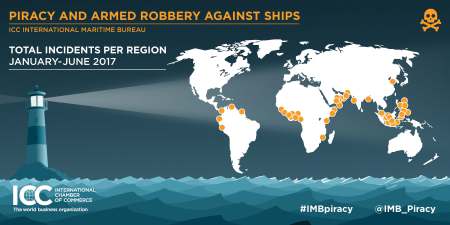
Continuing decline in the number of reported incidents of maritime piracy and armed robbery against ships has been revealed in the second quarter piracy report of the International Chamber of Commerce (ICC) International Maritime Bureau (IMB), published today. According to the report, the first half of 2017 saw a total of 87 incidents reported to the IMB Piracy Reporting Centre compared with 97 for the same period in 2016…
[I]n the first six-months of 2017, 63 vessels were boarded, 12 fired upon, four were hijacked and attacks were attempted on another eight vessels. A total of 63 crew have been taken hostage so far, this year while 41 have been kidnapped from their vessels, three injured and two killed.
The encouraging downward trend has been marred however by the hijacking of a small Thai product tanker en route from Singapore to Songkhla, Thailand. The hijacking, at the end of June 2017, was conducted by six heavily armed pirates who transferred 1,500 MT of gas oil to another vessel. The incident followed a similar pattern to a series of product tanker hijackings in the region which occurred approximately every two weeks between April 2014 and August 2015….
Cooperation between Indonesia, Malaysia and Philippines has been recognised as the fundamental reason for the overall decline in the number of reported incidents in and around the Philippines…
Somali pirates still retain the skills and capacity to attack merchant ships far from coastal waters. Pirates in Nigeria continue to dominate when it comes to reports of kidnappings…
Excerpts from Second quarter report reveals 87 incidents of maritime piracy in first half of year, ICC Commercial Crime Services, Press Release, July 4, 2017.
 Law-In-Action