Tag Archives: Gulf of Guinea piracy

Piracy Alive and Well

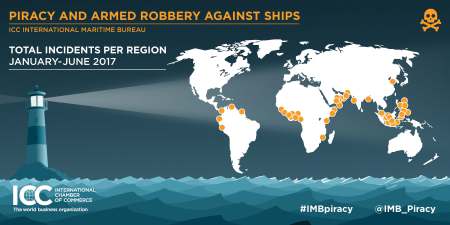
Continuing decline in the number of reported incidents of maritime piracy and armed robbery against ships has been revealed in the second quarter piracy report of the International Chamber of Commerce (ICC) International Maritime Bureau (IMB), published today. According to the report, the first half of 2017 saw a total of 87 incidents reported to the IMB Piracy Reporting Centre compared with 97 for the same period in 2016…

[I]n the first six-months of 2017, 63 vessels were boarded, 12 fired upon, four were hijacked and attacks were attempted on another eight vessels. A total of 63 crew have been taken hostage so far, this year while 41 have been kidnapped from their vessels, three injured and two killed.

The encouraging downward trend has been marred however by the hijacking of a small Thai product tanker en route from Singapore to Songkhla, Thailand. The hijacking, at the end of June 2017, was conducted by six heavily armed pirates who transferred 1,500 MT of gas oil to another vessel. The incident followed a similar pattern to a series of product tanker hijackings in the region which occurred approximately every two weeks between April 2014 and August 2015….

Cooperation between Indonesia, Malaysia and Philippines has been recognised as the fundamental reason for the overall decline in the number of reported incidents in and around the Philippines…

Somali pirates still retain the skills and capacity to attack merchant ships far from coastal waters. Pirates in Nigeria continue to dominate when it comes to reports of kidnappings

Excerpts from Second quarter report reveals 87 incidents of maritime piracy in first half of year,  ICC Commercial Crime Services, Press Release, July 4, 2017.
Feudal System of Piracy in Africa

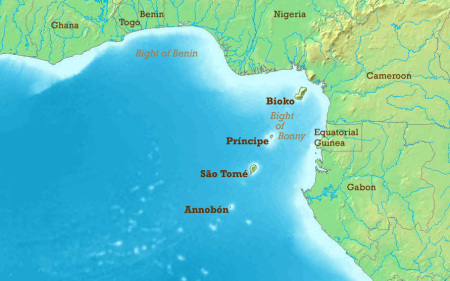
Just a few years ago the most dangerous waters in the world were off the coast of Somalia. But piracy there has fallen dramatically. It is more than two years since Somali pirates last successfully boarded a ship. At their peak in 2011, attacks were taking place almost daily. The number of attempts has fallen to a handful every month. Now it is the Gulf of Guinea that is the worst piracy hotspot, accounting for 19% of attacks worldwide, as recorded by the International Maritime Bureau. It registers an attack nearly every week  The numbers are probably underestimates. America’s Office of Naval Intelligence reckons the real figure is more than twice as large—and growing.

The nature of piracy is quite different on the two sides of the continent. Around the Horn of Africa in the east, Somali pirates seek to seize ships and crews for ransom, and have ventured deep into the Indian Ocean. In the Gulf of Guinea in the west, attackers are more intent on stealing cash and cargoes of fuel, such as diesel, from ships coming in to port. Crews are sometimes kidnapped.

It is a quicker hit than the Somali hostage-taking. It also tends to be more violent because the attackers have little incentive to keep the crews safe. Armed resistance is often met with heavy machine guns and military tactics, says Haakon Svane, of the Norwegian shipowners’ association. Ships are seized for a few days, anchored quietly and cargoes are siphoned off into smaller vessels. The gangs also appear to have good intelligence, security sources say: they often know which ships to attack and they recruit the skilled crewmen needed to operate the equipment.

Frequently the targets are themselves involved in regional smuggling, so they switch off transponders or assume false identities, making it hard for rudimentary anti-piracy forces to keep track of them. Moreover, they do not report attacks.

Incidents have stretched all the way from the Ivory Coast to Angola, but the root of the problem lies in Nigeria. Most acts of piracy are committed in Nigerian seas, by Nigerian criminals. The trouble at sea is ultimately tied to the country’s dysfunctional oil industry and the violent politics of the Niger Delta, where most of the oil is produced. Nigeria is the world’s eighth-largest oil producer; nevertheless, it suffers from shortages of refined fuels.

Widespread “bunkering” (the term Nigerians use for the theft of oil) and a violent insurgency created the conditions for piracy to flourish. Analysts say there tend to be spikes in both bunkering and maritime criminality before elections, which may mean that politicians are using illicit means to finance themselves. If so, expect pilfering to rise as Nigeria’s presidential vote nears in February. “The ransoms are used for the elections,” says Hans Tino Hansen, managing director of the Risk Intelligence consultancy. He points to a “feudal system” in which politicians protect pirates in return for a cut of their profits. An added problem is that elections may divert the attention of the security agencies…Te worry is that piracy, itself, is becoming enmeshed with drugs- and arms-smuggling networks linked to violent jihadist groups in the Sahel.

Piracy in Africa: The ungoverned seas, Economist, Nov 29, 2014, at 44