Tag Archives: insider attacks

Afghanistan: 2012 Report of US Department of Defense

From the Executive summary of 2012 Report

During the period of April 1 to September 30, 2012, the Coalition and our Afghan partners blunted the insurgent summer offensive, continued to transition the Afghan National Security Forces (ANSF) into security lead, pushed violence out of most populated areas, and coalition member nations signed several international agreements to support the long-term stability and security of Afghanistan…

Despite these and other positive trends during the reporting period, the campaign continued to face challenges, including a rise in insider attacks. The rise in insider attacks has the potential to adversely affect the Coalition’s political landscape, but mitigation policies and a collective ISAF-ANSF approach are helping to reduce risks to coalition personnel, and to sustain confidence in the campaign. The cause of and eventual solution to this joint ISAF and ANSF problem will require continuous assessment; it remains clear that the insider threat is both an enemy tactic and has a cultural component. The many mitigation policies recently put in place will require additional time to assess their effects, although the number of insider attacks has dropped off sharply from the peak in August.

The insurgency’s safe havens in Pakistan, the limited institutional capacity of the Afghan  government, and endemic corruption remain the greatest risks to long-term stability and sustainable security in Afghanistan. The Taliban-led insurgency and its al-Qaida affiliates still operate from sanctuaries in Pakistan, however, the insurgency and al-Qaida continue to face U.S. counterterrorism pressure within the safe havens. U.S. relations with Pakistan have begun to improve following the re-opening of Pakistani Ground Lines of Communication (GLOCs), and  there has been nascent improvement with respect to cross-border cooperation between Pakistan and Afghanistan.

Although the insurgency’s kinetic capabilities have declined from their peak in 2010, the insurgents remain resilient and determined, and will likely attempt to regain lost ground and  influence through continued assassinations, intimidation, high-profile attacks, and the  emplacement of improvised explosive devices (IEDs). Widespread corruption continues to limit  the effectiveness and legitimacy of the Afghan government. Despite these challenges, the  Coalition continued to make measured progress toward achieving its strategic goals during the  reporting period.

Excerpt from Report on Progress Toward Security and Stability in Afghanistan, (DOD,  Dec. 2012)
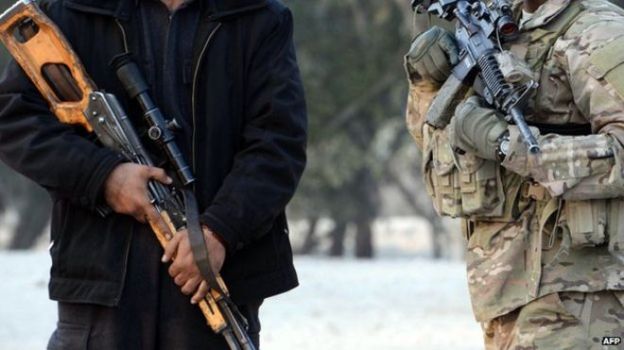
Foreign Soldiers who Die in Afghanistan: the insider attacks

At the height of this dusty summer, American troops are dying at unprecedented rates at the hands of their Afghan allies. And both sides are struggling to explain why, even as they search for ways to stem what are known in military parlance as “insider” attacks.  This month, at least 10 U.S. troops — including a U.S. service member shot Sunday and five members of America’s elite special-operations forces slain earlier — have been killed by Afghan police, soldiers or civilian workers at military installations. As of Sunday, that accounted for a stunning 32% of the 31 American military fatalities in Afghanistan reported thus far in August by the monitoring website icasualties.org.  [I]nsider shootings have wider-ranging repercussions. They have provided a propaganda bonanza to the Taliban, and could threaten a linchpin of the Western exit strategy: training Afghan security forces in preparation for handing over most fighting duties to them by 2014.

The military says only a very small share of insider attacks is carried out by Taliban “sleepers” in the police or army. But that opens the way to perhaps an even more alarming conclusion: that the majority of the assailants are undertaking what are in effect spontaneous, self-assigned suicide missions, because many insider shooters are killed on the spot in return fire.

The military says it is working to address the threat. Changes in recent months have included the posting of armed Western troops — so-called guardian angels — to watch over others in mess halls, sleeping tents and gyms. Last week, the American commander of the NATO force, Gen. John Allen, ordered that NATO troops across Afghanistan keep a loaded magazine in their weapons, even when on base.  This year, an Army captain described an informal buddy system at his base of troops signaling each other to keep a close watch on armed Afghans nearby, especially if one of their comrades was diverted by some task.  “‘Shona-ba-shona,’ OK,” the captain said, invoking the “shoulder-to-shoulder” slogan of the NATO force and its Afghan partners. “But also: ‘Eyes on, all times.'”…..

How to guard against such attacks is the subject of considerable debate in military leadership circles, because overtly heavy-handed measures can send a signal to the Afghans that they are not trusted, which can be taken as an insult. And in traditional Afghan culture, perceived insult can swiftly lead to exactly the sort of violence the attacks represent…The phenomenon is so pervasive that the killings have their own evolving nomenclature. Previously, the military called them green-on-blue attacks, a color-coded reference to Afghan and Western forces. Now the preferred, more encompassing term is “insider threat,” stemming from the fact that assailants have included not only uniformed police and soldiers, but also civilian members of the Afghan security apparatus, or simply someone with access to a coalition base, even in a low-level capacity.

The Taliban movement has noted the rising number of insider shootings with ill-concealed delight, boasting of having infiltrated all branches of the Afghan security forces. In the past, the Taliban leadership claimed responsibility for virtually every such attack, but lately the group’s publicity machine often cites individual initiative by those without links to the insurgency.  “Our fighters are in the ranks of the police, army and intelligence service, but there are also some who carry out attacks on foreign troops only because they are Afghans and Muslims and act on their religious obligation to protect their country from invading forces,” said Zabiullah Mujahid, a spokesman for the group. “It is an indication of utter hatred against the foreigners.”…….

Some analysts believe part of the problem is the sheer longevity of the war, now in its 11th year. In the conflict’s early stages, such attacks were an extreme rarity.  “I wouldn’t say it’s normal, but I think it’s understandable in a war situation which is lasting for more than a decade,” said Fabrizio Foshini of the Afghan Analysts Network. “The conflict has been becoming worse, nastier — and the presence of foreign troops doesn’t seem in the eyes of many Afghans to have brought positive changes.”

Laura King, Afghanistan ‘insider’ attacks pose threat to West’s exit strategy, LA Times, August 20, 2012