Tag Archives: islamic

How to Celebrate a Kid’s Birthday: the ISIS approach

In Syria, in 2024, American commandos are scrambling to contain a resurgence of Islamic State where the militant group once imposed its violent religious fervor on vast territories and millions of people. Islamic State is mustering forces in Syria’s Badiya desert, training young recruits to become suicide bombers, directing attacks on allied troops and preparing to resurrect its dream of ruling an Islamist caliphate, according to officers from the U.S. and the Syrian Democratic Forces (SDF), Kurdish-led troops whom the U.S. helped to defeat the militant group five years ago.

Militant fighters have doubled their pace of attacks in Syria and Iraq in 2024. They have targeted security checkpoints, detonated car bombs and plotted to free thousands of comrades jailed since the SDF and a U.S.-headed Western coalition recaptured the last Islamic State-held town. In a little-publicized campaign, American aircraft conduct airstrikes and provide live aerial surveillance to SDF ground forces who conduct raids on suspected Islamic State cells. While they usually stay a safe distance from the fighting, elite U.S. troops sometimes conduct missions on their own to kill or capture senior Islamic State leaders…

During the first six months of 2024, Islamic State claimed responsibility for 153 attacks in Syria and Iraq. It is building its ranks by surreptitiously indoctrinating youngsters in camps that hold thousands of wives and children of detained Islamic State fighters…

Some 9,000 Islamic State fighters remain in jails across northeastern Syria, however, and the group has made no secret of its intention to free its comrades so they can return to the battlefield…There are also some 43,000 Syrian, Iraqi and other displaced people living in camps in northeastern Syria, including many wives and children of jailed Islamic State fighters whom the SDF and U.S. see as potential recruits for the next generation of militants.

At the al-Hol camp, children draw in coloring books with images of hand grenades, AK-47 rifles and explosive suicide vests. U.S. soldiers have obtained photos of Islamic State-themed children’s birthday parties, the militants’ black-and-white flag hung on the wall amid the balloons. 

Excerpt from Michael M. Phillips, In Syria’s Hinterlands, the U.S. Wages a Hidden Campaign Against a Resurgent Islamic State, WSJ, Aug. 13, 2024

A Sinkhole Sucking in Failed States: jihad in Africa

The number of violent incidents involving jihadist groups in Africa has increased by more than 300% between 2010 and 2017… Many Western officers are despondent. Without more troops “there is no question we will lose”, says a senior French officer.

In the potpourri of jihadist groups, many pledge their loyalties to al-Qaeda or IS. They include al-Shabab in Somalia, Boko Haram and its factions in Nigeria, and Jama’a Nusrat al-Islam wal-Muslimin in Mali. In each country, conflict may be fuelled largely by local grievances. But the insurgents share some ideological traits. Many have been strengthened by the breakdown of Libya after the downfall of Muammar Qaddafi’s regime in 2011. Weapons spilled out of Libya’s armouries, and smuggling networks for everything from people to drugs developed across the Sahara. There are signs that the jihadists are learning from one another and sucking money and support from militant groups in the Middle East

The most important of the battles is Nigeria’s campaign against Boko Haram. ..A retired general who once held a senior post at AFRICOM, America’s military command for Africa, puts it thus: “If Nigeria goes down it would make a giant sinkhole that would suck in six or seven other countries.” Nigeria’s difficulties, moreover, offer sobering lessons to many other African countries, and their Western allies.

Maiduguri (Nigeria) was the birthplace of Boko Haram, whose factions make up the world’s deadliest terrorist group. It is so extreme that it sickens even IS and al-Qaeda. The group was founded by the followers of a charismatic Islamic preacher, Mohammed Yusuf, who had started a religious school and mosque in Maiduguri in 2002… Among his demands was a ban on secular schooling (the group’s name, Boko Haram, means “Western education is a sin” in Hausa).

The Nigerian police arrested and then killed Yusuf in front of a crowd outside the police headquarters in Maiduguri (the government insisted he was shot while trying to escape). Yusuf’s followers went into hiding before emerging under the command of Abubakar Shekau. In 2011 they blew up the headquarters of the Nigerian police and a UN building in Abuja, Nigeria’s capital. By the end of 2014 they had overrun large parts of three states in north-eastern Nigeria, gained international notoriety after kidnapping almost 300 schoolgirls from Chibok and were fighting their way into Maiduguri. Nigeria’s army, hollowed out by corruption, was in disarray. Units were filled by ghost soldiers whose pay was being pocketed by their commanders. One Western officer recalls how a company that should have had 100-150 soldiers consisted of just 20 men.

Boko Haram did not at first try to govern…. It preferred chaos. It bombed mosques and markets, massacred villagers and abducted women and children. Some girls were enslaved and sold. Others were pressed into being human bombs. A study by the Combating Terrorism Centre at West Point, a military academy, found that more than half of 434 such human bombs the group used between April 2011 and June 2017 were female.UNICEF, the UN children’s agency, says that last year Boko Haram strapped bombs to at least 135 children.

Mr Shekau’s brutality proved too much even for IS, to which he had sworn allegiance in 2015, changing Boko Haram’s name to Islamic State West Africa Province (ISWAP). In 2016 IS named Abu Musab al-Barnawi the leader of ISWAP, splintering the group into two factions.  Meanwhile, thousands of villagers and residents of Maiduguri took up machetes or handmade muskets and joined a self-defence militia, the Civilian Joint Task Force (CJTF), that held the gates of the city. The new president of Nigeria, Muhammadu Buhari, a northerner and former military dictator, ordered his generals to move their headquarters to Maiduguri. Neighbouring states such as Chad, Niger and Cameroon contributed troops to a multinational force. Within months the army had recaptured most big towns, pushing the insurgents into forests or Lake Chad, a mass of swamps where the borders of four countries meet.

Since then, though, stalemate has set in…The ISWAP has learned how to make roadside bombs and has become more skilled in conducting attacks.  …It levies “taxes” on locals and erects roadblocks to extort money from passing traffic… It is building a proto-caliphate. 

Nigeria’s generals talk about “winning hearts and minds” but they are doing the opposite. The army has systematically cleared people from the countryside, burning their villages and packing them into squalid camps in Maiduguri and other “garrison towns”. In all, some 2.4m people have been displaced by the fighting in Nigeria and neighbouring countries. T  Most observers think that indiscriminate killings by the army and the forcing of people into garrison towns are fuelling the insurgency. There are almost no jobs in the camps. Access is through checkpoints manned by the army and CJTF, who demand bribes. Amnesty International, a human-rights group, says many women and girls have been raped in the camps and that hundreds if not thousands of people confined in them have died of starvation or a lack of medical care. … “It is like a factory for jihadis.”

The Nigerian state’s failure extends far beyond the camps. In  In effect, Nigeria’s north-east is a failed state within a dysfunctional one.

Excerpts from Jihad’s Next Battleground,  Economist, July 14, 2018, at 41
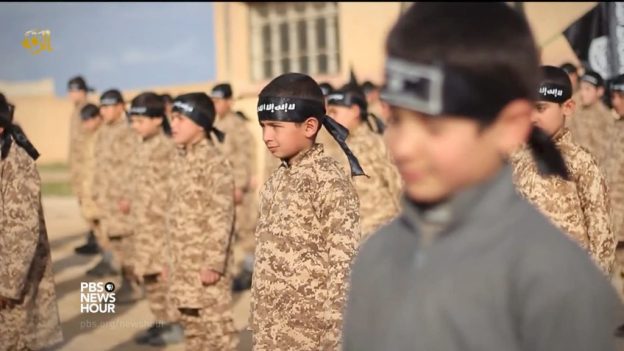
War against the Islamic State – All Out

Excerpts from David A. Deptula,  How to Defeat the Islamic State, Washington Post

From the U.S. perspective, the most important goal is not the maintenance of the Iraqi government but the destruction of the Islamic State.  The current U.S.-led coalition is following the counterinsurgency model used in Iraq and Afghanistan for more than a decade, but the Islamic State is not an insurgency. The Islamic State is a self-declared sovereign government. We must stop trying to fight the last war and develop a new strategy.

The Islamic State can be decomposed through a comprehensive and robust air campaign designed to: (1) terminate its expansion; (2) paralyze and isolate its command-and-control capability; (3) undermine its ability to control the territory it occupies; and (4) eliminate its ability to export ­terror.

But to do these things, air power has to be applied like a thunderstorm, not a drizzle. In the campaign against the Islamic State, we are averaging 12 strike sorties per day. During Operation Desert Storm in Iraq and Kuwait in 1991, the average was 1,241; in Operation Allied Force in Kosovo in 1999, it was 298; in the first 30 days of Operation Iraqi Freedom in 2003, 691; during Operation Enduring Freedom in Afghanistan in 2001, 86.

In the past two decades, several strategic victories were brought about by air power operating in conjunction with indigenous ground forces — none of which were better than the Iraqi army. Robust air power, along with a few air controllers, carried the Northern Alliance to victory over the Taliban, at minimal cost in blood and treasure to the United States. Bosnia, Kosovo and Libya similarly involved airstrikes well in excess of those being used against the Islamic State.

Complicating the effort to defeat the Islamic State is an excessive focus on the avoidance of collateral damage and casualties. In an armed conflict, the military establishes rules of engagement designed to balance the moral imperative to minimize damage and unintentional casualties against what’s required to accomplish the mission. Recently reported by pilots actually fighting the Islamic State is that the current rules — which far exceed accepted “Law of War” standards — impose excessive restrictions that work to the advantage of the enemy. The ponderous and unnecessary set of procedures in place is allowing the Islamic State to exploit our desire to avoid civilian causalities to commit atrocities on the ground…

The best way to improve our force effectiveness while still minimizing collateral damage and casualties is to allow them to use their judgment. This is called “mission command,” and the Pentagon should empower our aviators to employ it.

The fastest way to end the inhumanity of war is to eliminate its source — in this case, the Islamic State — as quickly as possible. Gradualism doomed the effectiveness of air power in the “Rolling Thunder” air campaign from 1965 to 1968 during the Vietnam War. The current gradualist approach is worsening the suffering and increasing the loss of innocent life. While unintended casualties of war are regrettable, those associated with airstrikes pale in comparison with the savage acts being carried out by the Islamic State. What is the logic of a policy that restricts the use of air power to avoid the possibility of collateral damage while allowing the certainty of the Islamic State’s crimes against humanity?

This does not have to be a “long war,” as has been claimed by those whose politics benefit from that assertion, as well as those whose experience is rooted in counterinsurgency. The counterinsurgency operations in Iraq and Afghanistan went on for eight and 14 years, respectively. Desert Storm took 43 days; Bosnia’s Operation Deliberate Force, 22 days; Allied Force, 78 days; the decisive phase of Enduring Freedom took 60 days. A robust air campaign can devastate the Islamic State to the point where Iraqi and Kurdish forces can end the occupation.

Excerpts from David A. Deptula How to defeat the Islamic State, Washington Post, June 5, 2015