Tag Archives: CIA and Kurdistan

US Military Leaves but CIA Remains: Syria

Is there a way for the United States and its allies to remain in northeastern Syria, even after President Trump pledged in December 2018 to withdraw U.S. military forces there? Officials are struggling to devise such a “workaround” strategy…One possibility, according to U.S. and foreign officials, would be to have paramilitary officers from the Central Intelligence Agency take over the training and advising of the Kurdish-led Syrian Democratic Forces (SDF). Since 2015, those duties have been carried out by U.S. Special Operations forces.  This approach, still in the discussion stage, would allow Trump to claim he is delivering on his pledge to withdraw troops from Syria, without creating a vacuum in the northeast that would be exploited by Turkey, Iran, Russia and the Syrian regime…

This new option, in the language of government lawyers, would mix Title 10 overt military operations and Title 50 covert action. Reduced military activity could continue under Title 10 authority, to provide air cover and logistical support for U.S. and allied troops on the ground, but the SDF’s advisers might be CIA officers. The CIA operatives, like existing Special Forces personnel, wouldn’t be involved directly in ground combat…

A paramilitary advisory force, operating under Title 50, would have some significant disadvantages…. Current U.S. military forces in Syria can deter adversaries because they carry the U.S. flag, literally and figuratively. A paramilitary force wouldn’t have that same deterrent capability, or the ability to deconflict operations with other forces in the area, such as Russia and Turkey. ..

Given the U.S. and European policy muddle, SDF commanders must weigh whether to make their own accommodation with Russia and the Syrian regime. The United Arab Emirates is said to favor such an approach, and some longtime SDF supporters say a deal with the regime would be safer for the Kurds than depending on a fickle United States and a gun-shy Europe.

Excerpts from David Ignatius, How the U.S. might stay in Syria, and leave at the same time, Washington Post, Feb. 16, 2019
CIA in the New Kurdistan

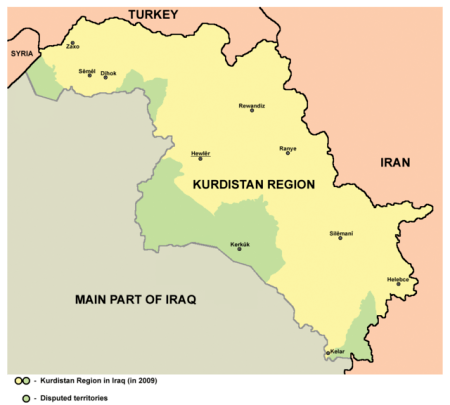
Western contractors hired to expand the facility and a local intelligence official confirmed the construction project, which is visible from the main highway linking Erbil/Irbil to Mosul, the city whose fall June 10, 2014 triggered the Islamic State’s sweep through northern and central Iraq. Residents around the airport say they can hear daily what they suspect are U.S. drones taking off and landing at the facility.  Expansion of the facility comes as it seems all but certain that the autonomous Kurdish regional government and the central government in Baghdad, never easy partners, are headed for an irrevocable split — complicating any U.S. military hopes of coordinating the two entities’ efforts against the Islamic State…

The peshmerga Kurds has worked closely over the years with the CIA, U.S. Special Forces and the Joint Special Operations Command, the military’s most secretive task force, which has become a bulwark of counterterrorism operations. Peshmerga forces already are staffing checkpoints and bunkers to protect the CIA station, which sits a few hundred yards from the highway.

“Within a week of the fall of Mosul we were being told to double or even triple our capacities,” said one Western logistics contractor who spoke on condition of anonymity because he’d signed nondisclosure agreements with the U.S. government on the matter.  “They needed everything from warehouse space to refrigeration capacity, because they operate under a different logistics command than the normal military or embassy structures,” the contractor said. “The expansion was aggressive and immediate.”…The local Kurdish intelligence official described what was taking place as a “long-term relationship with the Americans.”

U.S. Secretary of Defense Chuck Hagel said July 3, 2014 that Irbil would host such a center, in addition to one being set up in Baghdad, and suggested it had already begun operating. “We have personnel on the ground in Irbil, where our second joint operations center has achieved initial operating capability,” he said then.

The Kurdish official, who spoke on condition of anonymity, said: “It’s no secret that the American special forces and CIA have a close relationship with the peshmerga.” He added that the facility had operated even “after the Americans were forced out of Iraq by al-Maliki,” a reference to the 2011 U.S. troop withdrawal after the Obama administration and the Iraqi government couldn’t agree on a framework for U.S. forces to remain in the country.

The official refused to directly identify the location of the facility but when he was shown the blurred-out location on an online satellite-mapping service he joked: “The peshmerga do not have the influence to make Google blur an area on these maps. I will leave the rest to your conclusions.

Expansion of ‘secret’ CIA post suggests closer U.S.-Kurd ties, Seattle Times, July 11, 2014