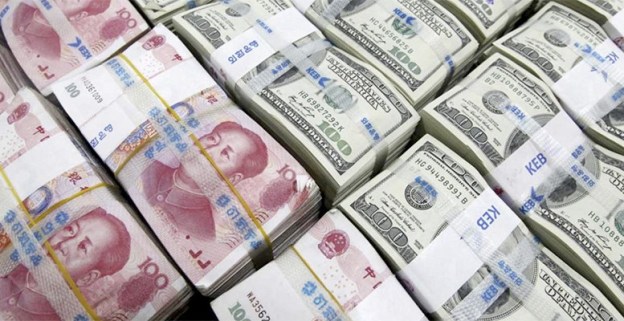
A handful of mainly U.S.-based macro hedge funds have led bets against China’s yuan since late last year (2015) and the coming weeks should tell how right they are in predicting a devaluation of between 20 and 50 percent. Texas-based Corriente Partners… [bets against the yuan].The firm reckons rush by domestic savers and businesses to withdraw money from China will prove too strong for authorities to resist and control, even with $3.3 trillion in FX reserves, the biggest ever accumulated. London-based Omni Macro Fund has been betting against the yuan since the start of 2014. Several London-based traders said U.S. funds, including the $4.6 billion Moore Capital Macro Fund, have also swung behind the move. Data from Citi, meanwhile, shows leveraged funds have taken money off the table since offshore rates hit 6.76 yuan per dollar three weeks ago…
That has prompted comparisons with the victories of George Soros-led funds over European governments in the early 1990s. Chinese state media on Tuesday warned Soros and other “vicious” speculators against betting on yuan falls.
“China has an opportunity now to allow a very sharp devaluation. The wise move would be to do it quickly,” Corriente chief Mark Hart said on Real Vision TV this month.”If they wait to see if things change, they will be doing it increasingly from a position of weakness. That’s how you invite the speculators. Every month that they hemorrhage cash, people look at it and say, ‘well now if they weren’t able to defend the currency last month, now they’re even weaker’.”
“It’s a popular trade. I can’t imagine a single western hedge fund has got short dollar-(yuan),” Omni’s Chris Morrison said.Derivatives traders say large bets have been placed in the options market on the yuan reaching 8.0 per dollar and data shows a raft of strikes between 7.20 and 7.60. The big division is over pace and scale. Corriente and Omni both say if China continues to resist, it may be forced this year into a large one-off devaluation as reserves dwindle….
China’s response to yuan pressure has underlined a difference with earlier currency crises: Beijing has an offshore market separate from “onshore” China into which it can pump up interest rates at minimal harm to the mainland economy. Earlier this month, it raised offshore interest rates, making it prohibitively expensive for funds to leverage overnight positions against the yuan. That sent many reaching for China proxies, including for the first time in years, the Hong Kong dollar.“We have a direct position in the (yuan) but it’s much easier to trade second-round effects of China,” said Mark Farrington, portfolio manager with Macro Currency Group in London. “The Korean won, Malaysia, Taiwan, are all easier plays.” … [Hedge funds] say Beijing may have spent another $200 billion of its reserves in January 2015; at that rate, most of its war chest would evaporate this year and the yuan weaken by a further 18-20 percent. Omni’s Morrison states “That is a fundamental misconception [to believe that Chinese authorities control the yuan]. They’re not making the tide, they’re just desperately holding it back.”
Excerpts from PATRICK GRAHAM, Hedge funds betting against China eye ‘Soros moment, Reuters, Jan. 26, 2016
 Law-In-Action