Tag Archives: mobile networks

Restitching the Internet

Is the internet becoming obsolete?
The government agency that invented the network that runs the world seems to think so. So the Defense Advanced Research Projects Agency (DARPA) has launched a program aimed at “completely rethinking how to network and compute” … DARPA’s Dispersed Computing program (or DCOMP, as it’s known) adds another moniker to the set of emerging technologies that includes fog computing, edge computing, and distributed computing. DCOMP takes these paradigms one step further, however, and envisions a network that is able to borrow processing and communications resources from its many nodes as and when needed to accomplish whatever task its users might throw at it.

“Today’s network is pretty static,” says Petros Mouchtaris, CEO of Vencore Labs….“The computing capabilities we have in our hands, at what we call the edge of the network, have really changed dramatically since the internet was invented. At same time, the core technology of the internet hasn’t really changed at all.”…Updating that core technology, according to DARPA, will require overhauling the very stuff that knits the internet together: its protocols. …The TCP/IP protocols, in use since the early 1980s, are good for getting information from one place to another, but that’s no longer enough…

DCOMP envisions is “the opportunistic use of network-embedded computing resources,”… Rather than thinking of the devices on the networks as nothing more than nodes that pass information from source to destination, DCOMP sees them also as distributed computing resources that can be dynamically reallocated in real time, depending on the changing needs of the current mission set. Imagine every cell phone, smart thermostat, fitness tracker, and game console in your house contributing their spare cycles to help process the video you’re trying to upload, or educate the machine learning algorithm that runs your AI personal assistant.

To understand how and when to allocate all those devices’ computing and communications power, the network will need to be able to examine itself, to a certain extent. “We’re working on creating a network which can sense very quickly what’s going on in the network, and can react very quickly because it’s programmable,” he continues. Though the work is still in the design phase, Mouchtaris envisions a set of protocols that will change on the fly to better support current needs and conditions in the field….

“That generates a lot of overhead. You want to very quickly find out about what’s changing in the network and adapt quickly, but you don’t want to flood the network with requests for information about what’s going on.”

Excerpts from MARK WALLACE DARPA, The Secretive Agency That Invented The Internet, Is Working To Reinvent It, Fast Magazine, Nov. 7, 2017
Mobile Networks on Drones

From the DARPA Website

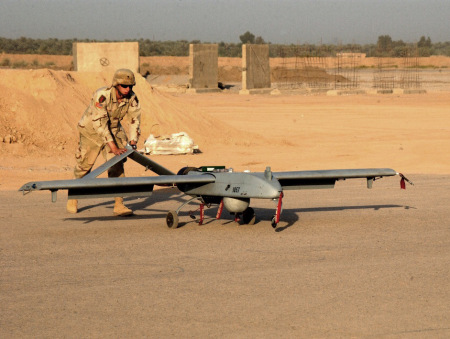
Missions in remote, forward operating locations often suffer from a lack of connectivity to tactical operation centers and access to valuable intelligence, surveillance, and reconnaissance (ISR) data. The assets needed for long-range, high-bandwidth communications capabilities are often unavailable to lower echelons due to theater-wide mission priorities. DARPA’s Mobile Hotspots program aims to help overcome this challenge by developing a reliable, on-demand capability for establishing long-range, high-capacity reachback that is organic to tactical units. The program is building and demonstrating a scalable, mobile millimeter-wave communications backhaul network mounted on small unmanned aerial vehicles (UAVs) and providing a 1 Gb/s capacity. DARPA performers recently completed the first of three phases in which they developed and tested key technologies to be integrated into a complete system and flight tested in subsequent phases…

Smaller, steerable millimeter-wave antennas: During field testing, the program successfully demonstrated steerable, compact millimeter-wave antennas that rapidly acquire, track, and establish a communications link between moving platforms. Steerable millimeter-wave antennas will enable the formation of a high-capacity backhaul network between aerial and ground platforms.

Low-noise amplifiers: Performers also demonstrated an advanced low-noise amplifier (LNA), which boosts the desired communications signal while minimizing unwanted noise. The prototype achieved the record for the world’s lowest noise millimeter-wave LNA at about half the noise figure of a typical LNA.

More efficient and capable power amplifiers: Efficient millimeter-wave amplification is required to achieve the long ranges (> 50 km) desired in the Mobile Hotspots program….

New approaches for robust airborne networking: Mobile ad-hoc networking approaches were developed to maintain the high-capacity backhaul network among mobile air and ground platforms. Phase 1 performers developed unique solutions to overcome connectivity and network topology challenges associated with mobility and signal blockages due to terrain and platform shadowing.

Low-Size, Weight, and Power (SWAP) pod design to carry it all: Performers created engineering designs for small, lightweight pods to be mounted on an RQ-7 Shadow UAV. The pods, with all of the Mobile Hotspots components inside, are designed to meet the challenging program goals of widths no more than 8 inches, weight less than 20 pounds, and power consumption less than 150 watts.

Phase 2 of the program began March 2014. Two performers, L-3 Communications and FIRST RF, were chosen to lead teams comprising several Phase 1 performers…A planned third phase will encompass field testing of the Mobile Hotspot systems on networks of multiple SRQ-7 Shadow UAVs and mobile ground vehicles.