
Tag Archives: rockets

Rockets Create Holes in Earth’s Ionosphere

A rocket launch has ripped a hole in the Earth’s ionosphere as it accelerated into space. The rocket, belonging to Firefly Aerospace, was carrying the Space Force Victus Nox satellite into orbit as it launched on September 14, 2024 from Vandenberg Space Force Base in California…The ionosphere is a layer of the atmosphere around 50 to 400 miles above, filled with charged atoms (ions). These ions reflect and refract radio signals, making the ionosphere essential to radio communications, which is why radio blackouts occur during solar flares, as the ionosphere is disrupted.

Rockets release exhaust as they ascend, mostly containing water and carbon dioxide, which reacts with the ions in the ionosphere. If the chemistry of the upper atmosphere is disturbed, such as when a rocket flies through it, the carbon dioxide and water molecules from the rocket exhaust change the chemical balance in the atmosphere. This temporarily makes it much easier for the ionization to recombine into neutral atoms, weakening the ionosphere and causing the red glow to be seen…This can lead to a 70 percent drop in ionization in the area that the rocket passes through, particularly in the F-layer at the top of the ionosphere. The red glow in particular comes from oxygen ions, which also glow during the northern and southern lights.

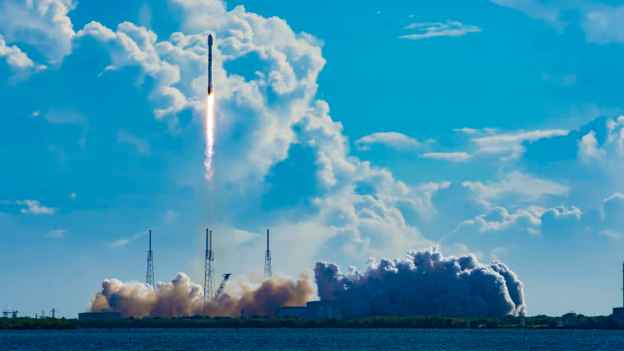
Several recent rocket launches have resulted in a similar phenomenon, including two SpaceX rockets in July and August 2024. The consequences of these holes in the ionosphere are disruptions to radio communication and satellite navigation systems.

The ionosphere absorbs ultraviolet and X-rays from the sun, which is what ionizes the gas atoms in the layer. This prevents these harmful rays from reaching the ground. The holes made by rocket launches do not affect the ionosphere’s ability to filter out this radiation. “While the number of rocket launches is increasing dramatically in recent years, this still constitutes a small amount of gas in comparison with the volume of the upper atmosphere. But if the rate at which rocket exhausts transport water to the upper atmosphere exceeds the rate at which it is removed then the cumulative effect will be a weaker ionosphere.”

Excerpts from Jess Thomson, Rocket Carrying Space Force Satellite Punches Hole In Ionosphere, Newsweek, Sept. 22, 2024
Planning for the Invasion: Taiwan

If China were to invade Taiwan, it might start by severing the 14 undersea internet cables that keep the island connected to the world. Taiwan is adding cables and planning how to defend their landing points. But it is also testing antennae in 700 locations, including some outside Taiwan. These would be able to send and receive signals by means of satellites in low orbit, like the ones Starlink uses. The goal is to make the antennae “as mobile as possible” to survive an attack…China has the capability to shoot down satellites. But Starlink developed by SpaceX (Elon Musk) is made up of over 4,000 of them and aims eventually to have tens of thousands…Unsurprisingly, Taiwan is looking to reduce its dependence on others including Starlink. Its space agency is developing its own low-orbit communication satellites. The first is expected to be launched in 2025.

China’s low-orbit ambitions are much larger. In 2020 the government filed papers with the International Telecommunication Union, a UN body, for a 12,992-satellite constellation. A year later the government established China Satellite Networks Group Limited and tasked it with developing satellite internet. At least seven state-owned and private Chinese companies are building satellite factories, with the expectation that they will soon be able to produce several hundred small communications satellites per year.

Officials in Beijing have developed a space-race mentality. Specific orbits and radio frequencies are “rare strategic resources” that Starlink wants to “monopolize”, warned the Liberation Army Daily in 2022….The Liberation Army Daily complains that there is only room for 50,000 satellites in low-Earth orbit and that Starlink may eventually take up more than 80% of that space. But the calculation is not that straightforward, says Juliana Suess of the Royal United Services Institute, a think-tank in Britain. Imagine low orbit as a highway, she says. What needs to be calculated is how many moving cars that highway can safely accommodate. Much will depend on the size of satellites and their trajectories.” But at this moment, there is lack of norms surrounding traffic in low orbit.

Spacex has an important advantage. Satellites in low orbit don’t last very long, so the company replaces them on a regular basis. That entails a large number of rocket launches. Spacex has the world’s best system for that, the partially reusable Falcon 9 rocket. Now it is working on a much larger, fully reusable spacecraft called Starship which could launch hundreds of satellites at a time. Some Chinese companies appear to be trying to build knock-offs.

Excerpts from China in Space: A New Mandate in the Heavens, Economist, May 20, 2023