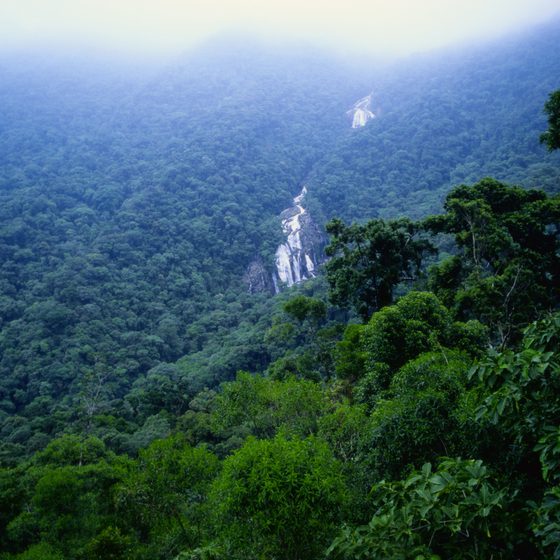
Amazon generates approximately half of its own rainfall by recycling moisture 5 to 6 times as airmasses move from the Atlantic across the basin to the west. From the start, the demonstration of the hydrological cycle of the Amazon raised the question of how much deforestation would be required to cause this hydrolological cycle to degrade to the point of being unable to support rain forest ecosystems.
High levels of evaporation and transpiration that forests produce throughout the year contribute to a wetter atmospheric boundary layer than would be the case with non-forest.This surface-atmosphere coupling is more important where large-scale factors for rainfall formation are weaker, such as in central and eastern Amazonia. Near the Andes, the impact of at least modest deforestation is less dramatic because the general ascending motion of airmasses in this area induces high levels of rainfall in addition to that expected from local evaporation and transpiration.
Where might the tipping point be for deforestation-generated degradation of the hydrological cycle? The very first model to examine this question showed that at about 40% deforestation, central, southern and eastern Amazonia would experience diminished rainfall and a lengthier dry season, predicting a shift to savanna vegetation to the east.
Moisture from the Amazon is important to rainfall and human wellbeing because it contributes to winter rainfall for parts of the La Plata basin, especially southern Paraguay, southern Brazil, Uruguay and central-eastern Argentina; in other regions, the moisture passes over the area, but does not precipitate out. Although the amount contributing to rainfall in southeastern Brazil is smaller than in other areas, even small amounts can be a welcome addition to urban reservoirs…
In recent decades, new forcing factors have impinged on the hydrological cycle: climate change and widespread use of fire to eliminate felled trees and clear weedy vegetation. Many studies show that in the absence of other contributing factors, 4° Celsius of global warming would be the tipping point to degraded savannas in most of the central, southern, and eastern Amazon. Widespread use of fire leads to drying of surrounding forest and greater vulnerability to fire in the subsequent year.
We believe that negative synergies between deforestation, climate change, and widespread use of fire indicate a tipping point for the Amazon system to flip to non-forest ecosystems in eastern, southern and central Amazonia at 20-25% deforestation.
We believe that the sensible course is not only to strictly curb further deforestation, but also to build back a margin of safety against the Amazon tipping point, by reducing the deforested area to less than 20%, for the commonsense reason that there is no point in discovering the precise tipping point by tipping it. At the 2015 Paris Conference of the Parties, Brazil committed to 12 million ha of reforestation by 2030. Much or most of this reforestation should be in southern and eastern Amazonia.
Excerpts from Amazon Tipping Point by Thomas E. Lovejoy and Carlos Nobre, Sciences Advances, Feb. 21, 2018

 Law-In-Action