Tag Archives: Syria

The Deadly Combination

Two North Korean shipments to a Syrian government agency responsible for the country’s chemical weapons program were intercepted in mid-2017 according to a confidential United Nations report on North Korea sanctions violations.  The report by a panel of independent U.N. experts, which was submitted to the U.N. Security Council in August 2017 and seen by Reuters gave no details on when or where the interdictions occurred or what the shipments contained.  “The panel is investigating reported prohibited chemical, ballistic missile and conventional arms cooperation between Syria and the DPRK (North Korea),” the experts wrote in the 37-page report.

“Two member states interdicted shipments destined for Syria. Another Member state informed the panel that it had reasons to believe that the goods were part of a KOMID contract with Syria,” according to the report.

KOMID is the Korea Mining Development Trading Corporation.  It was blacklisted by the Security Council in 2009 and described as Pyongyang’s key arms dealer and exporter of equipment related to ballistic missiles and conventional weapons. In March 2016 the council also blacklisted two KOMID representatives in Syria.  “The consignees were Syrian entities designated by the European Union and the United States as front companies for Syria’s Scientific Studies and Research Centre (SSRC), a Syrian entity identified by the Panel as cooperating with KOMID in previous prohibited item transfers,” the U.N. experts wrote.  SSRC has overseen the country’s chemical weapons program since the 1970s.

The U.N. experts said activities between Syria and North Korea they were investigating included cooperation on Syrian Scud missile programs and maintenance and repair of Syrian surface-to-air missiles air defense systems….The experts said they were also investigating the use of the VX nerve agent in Malaysia to kill the estranged half-brother of North Korea’s leader Kim Jong Un in February.
North Korea has been under U.N. sanctions since 2006 over its ballistic missile and nuclear programs…Syria agreed to destroy its chemical weapons in 2013 under a deal brokered by Russia and the United States. However, diplomats and weapons inspectors suspect Syria may have secretly maintained or developed a new chemical weapons capability.

During the country’s more than six-year long civil war the Organisation for the Prohibition of Chemical Weapons has said the banned nerve agent sarin has been used at least twice, while the use of chlorine as a weapon has been widespread. The Syrian government has repeatedly denied using chemical weapons.

On September 7, Israel targeted and heavily damaged a SSRC weapons factory in Masyaf Syria.

Excerpts from Michelle Nichols North Korea shipments to Syria chemical arms agency intercepted: U.N. report, Reuters, Aug. 21, 2017
Excerpts from Israel Hits Syrian Site Said to be Linked to Nuclear Weapons, Reuters, Sept. 7, 2017
Weapons Supply to Syria: CIA & Co.

Qatar, which has taken a lead in arming the Syrian opposition, is coordinating with the CIA and has tightened control of the arms flow to keep weapons out of the hands of al Qaeda-linked Islamist fighters, according to rebels and officials familiar with the operation.  With Britain and France discussing lifting an EU ban on arming the rebels fighting President Bashar al-Assad, Western countries are concerned about making sure no arms end up in the hands of groups like Jabhat al-Nusra, which has pledged support for al Qaeda and which Washington considers a terrorist group.

Rebel fighters in Syria say that in recent months the system for distributing arms has become more centralized, with arms being delivered through opposition National Coalition’s General Command, led by Selim Idriss, a general who defected to the opposition and is a favorite of Washington.

Qatar mostly sends arms to rebels operating in the north of Syria, while Saudi Arabia, another rich Gulf Arab kingdom, sends weapons to fighters operating in the south, several rebel commanders said….”Before the Coalition was formed they were going through liaison offices and other military and civil formations. That was at the beginning. Now it is different – it is all going through the Coalition and the military command.”  Shipments of weapons to Syrian rebels were curbed last year when Washington raised concerns that arms were falling into the hands of groups like Jabhat al-Nusra.

Today, Qatari shipments have resumed with tighter controls exerted from the palace of Qatar’s emir, Sheikh Hamad bin Khalifa al-Thani, in consultation with the U.S. Central Intelligence Agency, said a senior Qatari security official. “There’s an operations room in the Emir’s diwan (office complex), with representatives from every ministry sitting in that room, deciding how much money to allocate for Syria’s aid,” the Qatari official said.  “There’s a lot of consultation with the CIA, and they help Qatar with buying and moving the weapons into Syria, but just as consultants,” he said. The CIA declined to comment.  Rebel commanders contacted by Reuters said they submit their lists of needs to the General Command led by Idriss, which forwards the requests to Qatar or Saudi Arabia.

One Western source involved in the process said the new system of control is not foolproof: sometimes weapons sent in by Qatar do in fact reach hardline groups.Several rebel commanders said they believed wealthy Kuwaiti and Saudi individuals were also sending weapons and money to rebel fighters outside the National Coalition’s distribution channel.  “They usually ask for a video proving that an attack took place with the name of the brigade that did it. Sometimes they ask for a statement expressing gratitude,” said a rebel commander in Damascus.  He said the Saudis and Qataris also occasionally send weapons into each other’s territory, bypassing normal controls. “Sometimes the Qataris manage to send stuff to the southern part and the Saudis to the northern side. When they do so, they send it to brigades that are not part of the military command.”

According to the Qatari official, weapons supplied included small arms including AK-47 rifles, rocket propelled grenades, hand grenades and ammunition. Qatar also provides instructions on battlefield techniques such as how to rig weapons on vehicles.

[How?]

The weapons are purchased mainly from eastern Europe by arms brokers based in Britain and France, and are flown from Qatar to Ankara and then trucked to Syria, the Qatari source added.

[Timeframe]

Hugh Griffiths, a researcher on arms transfers at the Stockholm International Peace Research Institute, said 90 Qatari military air cargo flights were made to Turkey between 3 January 2012 and the end of April 2013.He suggested the Qataris had made no particular effort to disguise the nature of the cargo.  “The Qataris never announced the cargo as ‘humanitarian aid’ as pretence, they’ve always been more forthright in terms of their support in the form of military aid,” he said.

[Military Bases and Mercenaries]

The planes were Qatari air force aircraft flying from Al Udeid, a big air force base shared with the U.S. military.”This is quite unusual for arms deliveries intended for non-state actors in conflict zones, in the last 20 years or so the pattern has been to use private, commercial companies,” he said.

By Amena Bakr and Mariam Karouny, Qatar, allies tighten coordination of arms flows to Syria, Reuters, May 14, 2013

US Special Forces in Iraq to Stop Russia

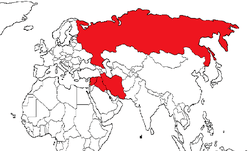
The civil war in Syria is testing Iraq’s fragile society and fledgling democracy, worsening sectarian tensions, pushing Iraq closer to Iran… just nine months after American forces ended their long and costly occupation here.  Fearing that Iraq’s insurgents will unite with extremists in Syria to wage a two-front battle for Sunni dominance, Prime Minister Nuri Kamal al-Maliki recently ordered guards at the western border to block adult men…along with thousands of refugees seeking to escape the grinding war next door.  Farther north, Iraqi officials have another concern, also related to the fighting across the border. Turkish warplanes have stepped up attacks on the mountain hide-outs of Kurdish insurgents galvanized by the war in Syria, underscoring Iraq’s inability to control its own airspace.

The hardening of the antagonists’ positions in Syria — reverberating across Iraq — was made clear Monday at the United Nations when the new special envoy for Syria, Lakhdar Brahimi, gave a bleak appraisal of the conflict to the Security Council and said he saw no prospect for a breakthrough anytime soon.

The Syrian war’s spillover has called attention to uncomfortable realities for American officials: despite nearly nine years of military engagement, an effort that continues today with a $19 billion weapons sales program, Iraq’s security is uncertain and its alliance with the theocratic government in Tehran is growing. Iraq’s Shiite-dominated leadership is so worried about a victory by Sunni radicals in Syria that it has moved closer to Iran, which shares a similar interest in supporting the Syrian president, Bashar al-Assad.,,,

In response, the United States has tried to secure its interests in Iraq. It has unsuccessfully pressed Iraq to halt flights from Iran that traverse Iraqi airspace to ferry weapons and fighters to the Assad government, although The Associated Press reported that over the weekend a government spokesman said Iraq would begin random searches of Iranian aircraft.  While some Congressional leaders have threatened to cut off aid to Iraq if the flights do not stop, the United States is trying to speed up weapons sales to Iraq to secure it as an ally, said Lt. Gen. Robert L. Caslen Jr., the American commander in charge of that effort. As regional security deteriorates, the United States is finding it hard to deliver the weapons — especially antiaircraft systems — quickly enough to satisfy the Iraqis, who in some cases are looking elsewhere, including Russia.

“Although they want a strategic partnership with the United States, they recognize the vulnerability, and they are interested in going with the nation that will be able to provide them, and meet their need, their capabilities gap, as quickly as possible,” said General Caslen, who oversees a Pentagon office here, under the authority of the American Embassy, that brokers weapons sales to Iraq.  The United States is providing Iraq with refurbished antiaircraft guns, free of charge, but they will not arrive until June. In the meantime, the Iraqis have collected cold war-era missiles found in a junkyard on an air base north of Baghdad, and they are trying to get them in working order. Iraq is negotiating with Russia to buy air defense systems that could be delivered much more quickly than those bought from the United States.

“Iraq recognizes they don’t control their airspace, and they are very sensitive to that,” General Caslen said. Each time Turkish fighter jets enter Iraq’s airspace to bomb Kurdish targets, he said, Iraqi officials “see it, they know it and they resent it.”  Iskander Witwit, a former Iraqi Air Force officer and member of Parliament’s security committee, said, “God willing, we will be arming Iraq with weapons to be able to shoot down those planes.”

The American military withdrew at the end of last year after negotiations for an extended troop presence collapsed because the Iraqis would not agree to extend legal immunities to any remaining force. Once the Americans left, Iraq celebrated its sovereignty, even as military officials in both countries fretted about the deficiencies of Iraq’s military and sought ways to work together that would not require a public debate about immunities.  Iraq and the United States are negotiating an agreement that could result in the return of small units of American soldiers to Iraq on training missions. At the request of the Iraqi government, according to General Caslen, a unit of Army Special Operations soldiers was recently deployed to Iraq to advise on counterterrorism and help with intelligence.

Excerpts from TIM ARANGO, Syrian War’s Spillover Threatens a Fragile Iraq, NY Times, Sept. 24, 2012