Tag Archives: cartels

The New Underworld Order: Invincible Cartels

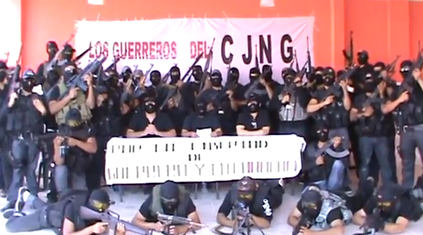
Nemesio “Mencho” Oseguera spent decades building his Jalisco New Generation Cartel into a transnational criminal organization fierce enough to forge a new underworld order in Mexico, displacing the Sinaloa cartel, torn by warring factions, as the world’s biggest drug pusher. The Sinaloans, Mexico’s top fentanyl traffickers, got caught in the crosshairs of the Trump administration, which promised to eradicate the synthetic opioid. The crackdown has left an open field for Jalisco and its lucrative cocaine trade, elevating Oseguera to No. 1.

The Jalisco cartel transports the cocaine by the ton from Colombia to Ecuador and then north to Mexico’s Pacific coast via speedboats and so-called narco subs…The U.S. has a $15 million bounty on Oseguera, but he rarely leaves his mountain compound, according to authorities. Few photos of him circulate. The cadre of men protecting Oseguera, known as the Special Force of the High Command, carry RPG 7 heat-seeking, shoulder-fired rocket launchers capable of piercing a tank, people familiar with cartel operations said. Visitors to the drug lord’s stronghold are hooded before they embark on the six-hour car trip through terrain sown with land mines, those people said. Locations of the pressure-activated explosives are known only by members of Oseguera’s inner circle.

The Jalisco cartel, which controls ports on Mexico’s Pacific coast, now uses routes and tunnels into the U.S. that are controlled by the sons of imprisoned drug kingpin Joaquín “El Chapo” Guzmán….
 
The cartel acts as a parallel government in the southwestern state of Jalisco and other parts of Mexico, taxing such goods as tortillas, chicken, cigarettes and beer, security experts said. It controls construction companies that build roads, schools and sewers for the municipal governments under cartel control.  A booming black market for fuel is another cash cow. Gasoline and diesel stolen from Mexican refineries and pipelines—or smuggled into Mexico from the U.S. without paying taxes—is sold at below market prices to small and large businesses.. The head of the Jalisco cartel’s fuel division is nicknamed “Tank” for his prowess at stealing and storing millions of gallons of fuel. 

Excerpst from Steve Fisher et al., America Loves Cocaine Again—Mexico’s New Drug King Cashes In, WSJ, Sept. 16, 2025

Algorithmic Cartels and the Rentiers

Legal pressure is mounting on a property-management software company, RealPage, facing allegations that it illegally fixes apartment rent prices at buildings across the U.S….The Justice Department  has opened a criminal investigation into the company, according to people familiar with the matter….RealPage’s algorithmic pricing system analyzes huge troves of information about the apartment rental market. It then recommends to landlords how much to increase rent for each lease renewal, or what to ask for newly vacated apartments. At issue is whether the use of this pricing system amounts to an illegal rent-setting cartel among landlords, artificially boosting the rents paid by apartment tenants over many years. 

Arizona Attorney General Kris Mayes alleges that, in Phoenix and Tucson, RealPage pooled nonpublic pricing data from competing building owners, then fed the data into an algorithm that told landlords to push rents higher than they might have otherwise. RealPage then discouraged landlords from deviating from the algorithm’s suggested rents, according to the attorney general’s filing.“There is no competitive rental market in Arizona anymore, ” Mayes said in an interview. “Because RealPage sets the price.”

Texas-based RealPage was founded in 1998. It acquired the YieldStar pricing platform from publicly traded landlord Camden Property Trust in 2002. Private-equity firm Thoma Bravo purchased RealPage in 2021 for nearly $10 billion.  Federal charges could prove disastrous not only for RealPage but also for the many landlords and property managers who use its technology. That includes some of the largest real-estate companies on Wall Street. 

Excerpts from Will Parker, Alleged Rent-Fixing of Apartments Nationwide Draws More Legal Scrutiny, WSJ, Apr. 15, 2024

Netherlands, China and Mexico: Lethal Narco-States

The setup—Mexican cooks using Dutch equipment to process chemicals from China—offered a window into the new global drug economy…Mexican cartels, which dominate drug trafficking in North America, are drawn to the Netherlands because it is a global trade nexus with sea and rail links to Asia that has long been Europe’s top manufacturer of synthetic drugs.

Piggybacking legitimate commercial channels, Mexican cartels are combining sophistication with ruthlessness to expand their reach world-wide. Their multinational drive is enabled by the advent over recent decades of highly potent synthetic drugs that don’t rely on crops or farmers and can be manufactured in compact facilities almost anywhere. Production experts instant-message instructions to overseas workers and hop the globe like factory troubleshooters in any industry.

With the U.S. drug market saturated and methamphetamine labs in Mexico already supersize, cartels that murder for market share see Europe as a new hub. The cartels are “like global corporations,” said DEA Regional Director for Europe Daniel Dodds. “If they can expand and broaden their customer base, they will.”

Mexican cartels first connected with Dutch drug smugglers in the 1990s, bringing cocaine through Rotterdam, Europe’s largest port. Cocaine remains Europe’s top illicit stimulant, but Dutch police say over the past two years surging quantities of Mexican meth have hit the Netherlands, Mexican “cooks” have arrived to teach local chemists, and Dutch technicians are honing production methods.

The Netherlands offers Mexican cartels an ideal production base because of its experienced chemists, unrivaled cargo networks and liberal attitude to drugs. Connections to labs in China supply chemicals that constantly adapt to remain legal. Dutch traffickers cultivated those links over decades as they perfected ecstasy manufacturing for party scenes in London, Berlin and New York…

Dutch officials are awakening to the impact of tolerating drug use for a long time and “allowing for too long a parallel economy to grow and become more influential,” Mr. Struijs said. “We have the characteristics of a narco-state.”

Excerpts from Valentina Pop, Cartels Are Now Cooking Chinese Chemicals in Dutch Meth Labs, WSJ, Dec. 8, 2020

The OPEC Cartel and the US

The OPEC often described as a cartel, it is better seen as an anti-glut group. When demand is weak, its members can curb production to prevent the price plummeting. But when demand is healthy, its ability to curb new producers is limited. And new producers abound.

America’s domestic production of crude (and gas, which displaces some oil) is rocketing. The IEA says the country will produce 14m barrels a day (b/d) next year, on a par with Saudi Arabia . That has reduced America’s imports, as well as boosting exports of fuels (exports of crude oil are mostly banned). That frees crude from other places, such as West Africa, to go to Europe instead. Similarly, Latin American and Middle Eastern oil that once would have gone to America now goes to Asian customers.

For the oil-rich, even worse is in store. Other factors that have propped up the price over the past decade are likely to wane in importance. Even the slightest easing of sanctions helps Iran, potentially a huge producer….The Economist Intelligence Unit…forecasts a “significant boost” in 2014 from 2.4m b/d last year. This assumes new investment pays off, and a deal with the semi-autonomous Kurdish region. Libya could be another source of production: its exports have collapsed to only a few hundred thousand barrels a day, against 1.6m in June last year…

An alternative for Saudi Arabia would be to increase production sharply. That would send the price down: painful for the kingdom, but even more painful for higher-cost producers (not least America, where the “tight oil” now coming on stream requires prices of $50 and above to be profitable).  OPEC’s best hope is continued American protectionism. Any easing of the restrictions on the export of liquefied natural gas (LNG) or crude will exert more downward pressure on the oil price. That might be good for the world economy, but it is not a priority for American consumers, who would like cheaper petrol for cars and propane for heating…

OPEC and oil prices: Leaky barrels, Economist, Feb. 22, 2014, at 63