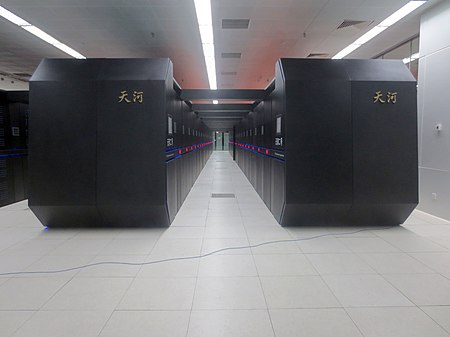
For decades, American and Chinese scientists collaborated on supercomputers, tennis-court-size machines essential to improving artificial intelligence, developing vaccines and predicting hurricanes. But Chinese scientists have become more secretive as the U.S. has tried to hinder China’s technological progress, and they have stopped participating altogether in a prominent international supercomputing forum.
The new secrecy also makes it harder for the U.S. government to answer a question it deems essential to national security: Does the U.S. or China have faster supercomputers? Some academics have taken it upon themselves to hunt for clues about China’s supercomputing progress, scrutinizing research papers and cornering Chinese peers at conferences.
Supercomputers have become central to the U.S.-China technological Cold War because the country with the faster supercomputers can also hold an advantage in developing nuclear weapons and other military technology. “If the other guy can use a supercomputer to simulate and develop a fighter jet or weapon 20% or even 1% better than yours in terms of range, speed and accuracy, it’s going to target you first, and then it’s checkmate,” said Jimmy Goodrich, a senior adviser for technology analysis to Rand Corp., a think tank.
The forum that China recently stopped participating in is called the Top500, which ranks the world’s 500 fastest supercomputers. While the latest ranking, released in June 2024, says the world’s three fastest computers are in the U.S., the reality is probably different. Officially, the fastest computer on the Top500 sits at the Energy Department-sponsored Oak Ridge National Laboratory, in Tennessee. Called Frontier, it is about the size of two tennis courts, cost $600 million to construct and has an electricity bill of about $20 million a year, said Dongarra, who also works at Oak Ridge. It uses tens of thousands of computer chips.
Dongarra doesn’t think Frontier is actually the world’s fastest supercomputer. Scientific papers suggest that certain Chinese machines are better. One has been referred to in state media as a prototype Tianhe-3, after a Chinese term for the Milky Way galaxy, while the other is a model in the Sunway series of supercomputers.
Excerpts from Stu Woo ,US China Rift Hits Supercomputer Ties, WSJ, July 24, 2024

 Law-In-Action