
Tag Archives: corporate unfairness

Futuristic illuminated city with elevated circular spaceport at twilight

What is Wrong with American Capitalism

From a Wall Street Journal Editorial: The widespread popular dissatisfaction with the working of modern American capitalism may be the product of some real, objective problems in the way American capitalism is working:

  1. income and wealth inequality on a scale not seen in a century;
  2. the concentration of economic, cultural and increasingly political power in a class of technology leaders whose products are dissolving the bonds that keep society together;
  3. the tightening nexus between business elites and the people who control the political process;
  4. rampant corruption and a political establishment that doesn’t seem interested in accountability;
  5. the revival, after decades of stable prices, of inflationary pressures that are pushing the cost of living to painful levels…

Inequality is a feature of capitalism and a sign of its health. It isn’t only functionally efficient but morally proper that rewards for talent, hard work, risk-taking and luck are distributed proportionately to those who possess them…But it’s also empirically obvious that the wider the inequality, the more social solidarity diminishes. At some point disintegrating cohesion produces costs…that undermine the benefits of the inequality…By almost all measures, American income and wealth inequality have been increasing sharply in recent decades and social and economic mobility falling. The New York Federal Reserve reported in June 2026 that the labor share of income—wages and salaries—fell to its lowest level in 80 years as returns to capital continue to soar. Studies of intergenerational mobility suggest the inequality is becoming embedded in what looks increasingly like a class-based socioeconomic model. The proportion of Americans earning more than their parents has dropped precipitously in the past 50 years and is expected to drop further. 

Excerpt from Gerard Baker, Socialism is the Wrong Answer, but the Questions are Real, WSJ, Aug. 10, 2026
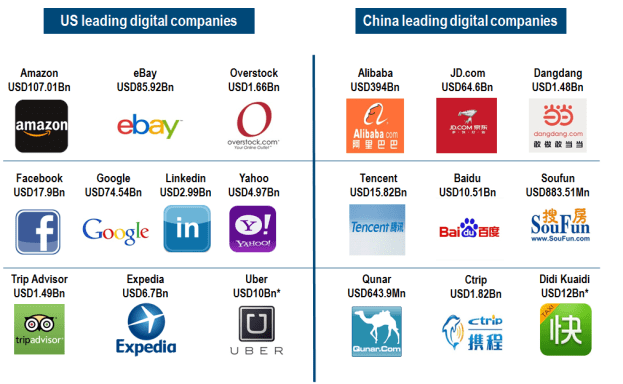
Can’t Touch This! America FANG v. China BATX

The Economist magazine has considered four measures of Chinese corporate unfairness, using data from Morgan Stanley and Bloomberg. The first is the weight of China in the foreign sales that American firms bring in. It stands at 15%; if it was in line with China’s share of world GDP, it would be 20%. This shortfall amounts to a small 1% of American firms’ global sales (both foreign and domestic). America Inc is similarly underweight in the rest of Asia, but there is much less fighting talk about South Korea or Japan.

The second test is whether there is parity in the commercial relationship. Firms based in China make sales to America almost exclusively through goods exports, which were worth $506bn last year. American companies make their sales to China both through exports and through their subsidiaries there, which together delivered about $450bn-500bn in revenue. Again, there is not much of a gap. American firms’ aggregate market share in China, of 6%, is almost double Chinese firms’ share in America, based on the sales of all listed firms.

The third yardstick is whether American firms underperform other multinationals and local firms. In some cases failure is not China-specific. Walmart has had a tough time in China, but has also struggled in Brazil and Britain. Uber sold out to a competitor in China, but has done the same in South-East Asia. American consumer and industrial blue chips are typically of a similar scale in China to their nearest rivals. Thus the sales of Boeing and Airbus, Nike and Adidas, and General Electric and Siemens are all broadly in line with each other. Where America has a comparative advantage—tech—it leads (Facebook, Amazon, Netflix, Google (FANG)). Over half of USA Inc’s sales in China are from tech firms, led by Apple, Intel and Qualcomm. Overall, American firms outperform. For the top 50 that reveal data, sales in China have risen at a compound annual rate of 12% since 2012. That is higher than local firms (9%) and European ones (5%).

The final measure is whether American firms are shut out of some sectors. This is important as China shifts towards services and as the smartphone market, a goldmine, matures. The answer is clearly “yes”. Alphabet, Facebook and Netflix are nowhere, and Wall Street firms are all but excluded from the mainland. Chinese firms, however, can make a similar complaint. The market share of all foreign firms (incuding China’s Baidu, Alibaba,Tencent and Xiaomi popularly called BATX) in Silicon Valley’s software and internet activities, and on Wall Street, is probably below 20%. America’s national-security rules, thickets of regulation, lobbying culture and political climate make it inconceivable that a Chinese firm could play a big role in the internet or in finance there.

Far-sighted bosses know their stance on China must reflect a balanced assessment, not a delusional vision of globalisation in which anything less than a triumph is considered a travesty. But their voices are being drowned out. The shift of the business establishment to hawkishness on China has probably emboldened the White House and also led the Treasury and Department of Commerce to be more combative. Most big firms are blasé about tariffs; they can pass on the cost to clients. Few export lots to China. But soon China will run out of American imports to subject to retaliatory tariffs; in a tit-for-tar war, beating up American firms’ Chinese subsidiaries is a logical next step. USA Inc’s Sino-strop would then end up enabling the opposite of what it wants.

Excerpts from Raging Against Beijing, Economist,  June 30, 2018, at 58