Tag Archives: counterterrorism

GeoProfile as a Surveillance Tool

Guerrillas and terrorists are not fools. They are aware they may be under surveillance, and take what they hope are appropriate counter-measures. They are unlikely, for example, to make calls from inside a safe house in which they are living. Instead, they typically make calls from roughly spaced out nearby locations, taking care not to call too often from the same spot. They hope, thereby, that if their activity is being monitored, it will appear random and therefore meaningless.

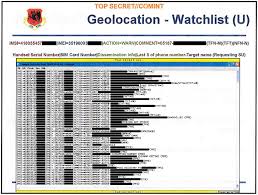
Spacing things out like this is, in mathematical fact, anything but random: that, in itself, is suspicious. But true randomness would also be odd. As Ian Laverty, the boss of ECRI, a geoprofiling-software firm in Vancouver, observes, innocent phone calls have geographical patterns, because people have routines. Those who take steps to elude the authorities thus often end up unwittingly creating a profile of where their home base is—a profile that a piece of ECRI’s software called Rigel Analyst can spot. This software is used by more than 90 intelligence agencies around the world. Its applications include searching for Taliban rocket caches in Afghanistan.

Geoprofiling is thus already an important counter-insurgency tool…according to a geoprofiler in Denmark’s intelligence apparatus who prefers to remain anonymous. This operative uses geoprofiling software called ArcGIS that analyses Global Positioning System (GPS) data provided unwittingly by insurgents’ growing use of smartphones and other gadgets that are equipped, by default, with GPS kit. For example, simply right-clicking on propaganda images posted online often obtains a GPS “geocode” that reveals where the picture was taken.

Excerpts from Counter-Terrorism, Shrinking the Haystack,  /Economist,Jan. 16, 2016, at 86

The Playbook of Targeted Killings

The Obama administration is nearing completion of a detailed counterterrorism manual that is designed to establish clear rules for targeted-killing operations but leaves open a major exemption for the CIA’s campaign of drone strikes in Pakistan, U.S. officials said.  The carve-out would allow the CIA to continue pounding al-Qaeda and Taliban targets for a year or more before the agency is forced to comply with more stringent rules spelled out in a classified document that officials have described as a counterterrorism “playbook.”

The document, which is expected to be submitted to President Obama for final approval within weeks, marks the culmination of a year-long effort by the White House to codify its counterterrorism policies and create a guide for lethal operations through Obama’s second term.

A senior U.S. official involved in drafting the document said that a few issues remain unresolved but described them as minor. The senior U.S. official said the playbook “will be done shortly.”  The adoption of a formal guide to targeted killing marks a significant — and to some uncomfortable — milestone: the institutionalization of a practice that would have seemed anathema to many before the Sept. 11 , 2001, terrorist attacks.Among the subjects covered in the playbook are the process for adding names to kill lists, the legal principles that govern when U.S. citizens can be targeted overseas and the sequence of approvals required when the CIA or U.S. military conducts drone strikes outside war zones.

U.S. officials said the effort to draft the playbook was nearly derailed late last year by disagreements among the State Department, the CIA and the Pentagon on the criteria for lethal strikes and other issues. Granting the CIA a temporary exemption for its Pakistan operations was described as a compromise that allowed officials to move forward with other parts of the playbook.The decision to allow the CIA strikes to continue was driven in part by concern that the window for weakening al-Qaeda and the Taliban in Pakistan is beginning to close, with plans to pull most U.S. troops out of neighboring Afghanistan over the next two years. CIA drones are flown out of bases in Afghanistan.

Excerpt, Greg Miller, Ellen Nakashima and Karen DeYoung, CIA drone strikes will get pass in counterterrorism ‘playbook,’ officials say, Washington Post., Jan 19, 2012

The Yemen Drone War

A U.S.-backed military onslaught may have driven Islamist militants from towns in Yemen they seized last year, but many have regrouped into “sleeper cells” threatening anew the areas they vacated, security officials and analysts say.  The resilience of Al Qaeda in the Arabian Peninsula (AQAP), despite increased U.S. drone strikes to eliminate militants, is worrying for top oil exporter Saudi Arabia next door and the security of major shipping lanes in the seas off Yemen.

When a nationwide uprising against autocratic rule erupted last year, tying up security forces and causing a power vacuum, militants charged into the major south Yemen towns of Zinjibar, Jaar and Shuqra and set up Islamic “emirates”.  To broad their appeal, the militants renamed themselves Ansar al-Sharia (Partisans of Islamic Law), appointed spokesmen to deal with the media and put up signposts and flags. Poverty, unemployment and alienation from a central government seen as aloof and corrupt spurred some young men to join the cause.  Residents said the militants included Saudis, Pakistanis, Egyptians, Chechens and Somalis, hinting at the international scope of the jihadi threat to Saudi and Western interests.

After President Ali Abdullah Saleh finally bowed to popular revolt and stepped down in February, the U.S.-backed Yemeni military swept in and wrested back southern towns from the militants, sometimes after heavy fighting.  But the south, where resentment of tribal domination from the north has long run high and a separatist movement revived in 2007, has since become a more dangerous place, residents say…A rash of deadly violence in the major southern province of Abyan ensued, indicating that Ansar militants were still lurking in the vicinity of the towns they had once controlled.  Nine jihadis including the head of the Jaar “emirate” Nader al-Shaddadi were killed by a U.S. drone missile fired into a farmhouse where they were hiding just outside town on October 19.  Five of the militants were teenagers from Jaar itself who had quietly moved into the farmhouse as a typical sleeper cell, a Yemeni security source told Reuters.

The next day, militants ambushed an army base in Shuqra, killing 16 soldiers, after apparently slipping out of lairs in the barren rugged mountains rearing up above the town.  “Most people are concerned about sleeper cells. We’re aware of it and people have started to be more careful,” said Hasan Ali Hasan, 35, from the Mansoura district of Aden where security forces raided some suspected “safe houses” this month.

In June, the commander of the army’s southern division, a southerner who replaced a Saleh ally from north Yemen in March, was killed by a car bomb in a suburb of Aden, the sprawling main city and port in the south. Security forces subsequently uncovered numerous caches of suicide belts in the area.  There have been dozens of other attacks and kidnappings by undercover militants targeting security and military officials.

Yemeni security sources said the two leading figures in Ansar al-Sharia, Nader al-Shaddadi and Galal Bil-Eidy, are believed to be sheltering in mountains around Shuqra where they form the link between urban cells in Aden and AQAP commanders like Nasser al-Wuhayshi tucked away in mountains to the north.  They said such regional militant chieftains had activated sleeper cells to carry out assassinations of security officials in Aden and attacks like the one in Shuqra.

Formed in 2009, AQAP has carved out a reputation as al Qaeda’s most formidable regional wing with suicide attacks on tourists, diplomats and operations against neighboring Saudi Arabia, the world’s top oil exporter, and U.S. targets abroad….

Excerpt, Andrew Hammond, Al Qaeda goes underground in Yemen against U.S.-driven crackdown, Reuters, Oct 23 2012

Covert Operations in Pakistan Yemen and Somalia
The Kill List and Body Count: Drones

Just days after taking office, the president [Obamaa] got word that the first strike under his administration had killed a number of innocent Pakistanis. “The president was very sharp on the thing, and said, ‘I want to know how this happened,’ “ a top White House adviser recounted.  In response to his concern, the C.I.A. downsized its munitions for more pinpoint strikes. In addition, the president tightened standards, aides say: If the agency did not have a “near certainty” that a strike would result in zero civilian deaths, Mr. Obama wanted to decide personally whether to go ahead.

The president’s directive reinforced the need for caution, counterterrorism officials said, but did not significantly change the program. In part, that is because “the protection of innocent life was always a critical consideration,” said Michael V. Hayden, the last C.I.A. director under President George W. Bush.  It is also because Mr. Obama embraced a disputed method for counting civilian casualties that did little to box him in. It in effect counts all military-age males in a strike zone as combatants, according to several administration officials, unless there is explicit intelligence posthumously proving them innocent.  Counterterrorism officials insist this approach is one of simple logic: people in an area of known terrorist activity, or found with a top Qaeda operative, are probably up to no good. “Al Qaeda is an insular, paranoid organization — innocent neighbors don’t hitchhike rides in the back of trucks headed for the border with guns and bombs,” said one official, who requested anonymity to speak about what is still a classified program.

This counting method may partly explain the official claims of extraordinarily low collateral deaths. In a speech last year Mr. Brennan, Mr. Obama’s trusted adviser, said that not a single noncombatant had been killed in a year of strikes. And in a recent interview, a senior administration official said that the number of civilians killed in drone strikes in Pakistan under Mr. Obama was in the “single digits” — and that independent counts of scores or hundreds of civilian deaths unwittingly draw on false propaganda claims by militants.

But in interviews, three former senior intelligence officials expressed disbelief that the number could be so low. The C.I.A. accounting has so troubled some administration officials outside the agency that they have brought their concerns to the White House. One called it “guilt by association” that has led to “deceptive” estimates of civilian casualties.  “It bothers me when they say there were seven guys, so they must all be militants,” the official said. “They count the corpses and they’re not really sure who they are.”

Excerpt, JO BECKER and SCOTT SHANE, Secret ‘Kill List’ Proves a Test of Obama’s Principles and Will, NY Times, May 29, 2012