Tag Archives: drone warfare

Who is Ready for the Future Global War?

The Economist magazine estimates that the new defense commitments of all countries …will generate over $200bn-$700bn in extra defense spending globally each year…
China’s defense budget has grown by about 75% in real terms in the past ten years. It wants to “basically complete modernization” of its forces by 2035, and become a “world class” military power by 2049. America thinks China wants the capability to invade Taiwan as early as 2027… Overall America’s advantage over its rivals has eroded in the past century…During the first, second and cold wars America’s adversaries had much smaller economies than America did. No longer. Today China’s GDP alone is nearly 80% of America’s.

In the decades after the cold war, the thinking was that to spend less on armies meant to spend more on infrastructure and public services and to lower debt or taxes. Since the 1960s the world has “released” about $4trn a year of spending at current prices in this way, equivalent to the global government budget for education. Now the peace dividend is turning into a “war tax”. How heavy will it be?…

America, by far the world’s largest defense spender, is devoting growing sums to research and development of future weapons. This includes hypersonic missiles, to catch up with China and Russia; “directed energy” such as powerful lasers to shoot down drones and missiles; and artificial intelligence and robotics. It is also buying as many munitions as its factories can produce—from 155mm artillery shells to anti-ship missiles. The war in Ukraine has exposed the extraordinary quantities of munitions needed in a conflict, as well as the inability of peacetime production lines to meet such demand.

America, Russia and China are investing in their nuclear arsenals, too. America is upgrading all legs of its “triad” of ground-, air- and submarine-launched nukes. Russia is working on esoteric weapons, such as the long-distance, nuclear-powered Poseidon torpedo designed to set off an underwater nuclear explosion that, propagandists boast, can cause destructive tidal waves. China is quickly expanding its arsenal, from several hundred warheads to 1,500 by 2035, according to the Pentagon…

Cyber-security, drones and satellite technology straddle both the civilian and military worlds. SpaceX, founded by Elon Musk, has launched American military satellites. Ukrainian warriors make extensive use of his Starlink constellation of satellites. It all amounts to a change of cultural mindset from tech firms that once shunned defense as morally tainted. A defense-tech ecosystem has sprung up in America…

One way or another, a new era of rearmament beckons. As General Mark Milley, chairman of America’s joint chiefs of staff, told the Senate recently: “Preventing great-power war through readiness and deterrence is very expensive, but not as expensive as fighting a war.” And the only thing more costly than that, as he explained, is losing one.

Excerpts from Farewell peace dividend: The Cost of the Global Arms Race, Economist, May 27, 2023 
An Affordable and Risk Free Way to Kill: Drones

Armed drones have become ubiquitous in the Middle East, say Aniseh Bassiri Tabrizi and Justin Bronk of the Royal United Services Institute, a British think-tank, in a recent report. America has jealously guarded the export of such aircraft for fear that they might fall out of government hands, be turned on protesters or used against Israel. America has also been constrained by the Missile Technology Control Regime, an arms-control agreement signed by 35 countries, including Russia, that restricts the transfer of particularly capable missiles and drones (both rely on the same underlying technology).

China…has sold missile-toting drones to Egypt, Jordan, Iraq, Saudi Arabia and the United Arab Emirates (UAE). All are American security partners…. Other countries, such as Israel, Turkey and Iran, have filled the gap with their own models.  America wants to muscle its way back into the market. In April 2018 the Trump administration began loosening export rules to let countries buy armed drones directly from defence companies rather than through official channels. Drones with “strike-enabling technology”, such as lasers to guide bombs to their targets, were reclassified as unarmed. American drones are costlier and require more paperwork than Chinese models, but are more capable. ..The flood of drones into the market is already making an impact—sometimes literally. Ms Tabrizi and Mr Bronk say some Middle Eastern customers see drones as an “affordable and risk-free” way to strike across borders… 

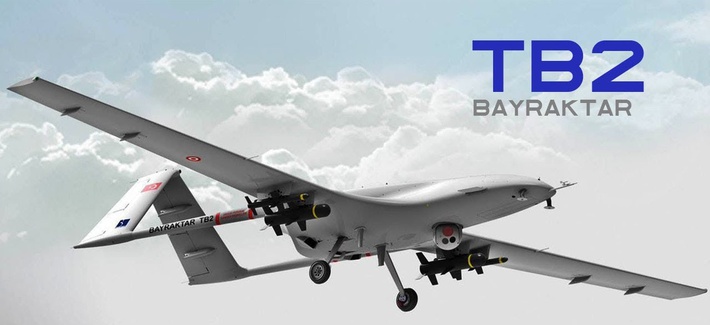
Drone Bayraktar made by Turkey

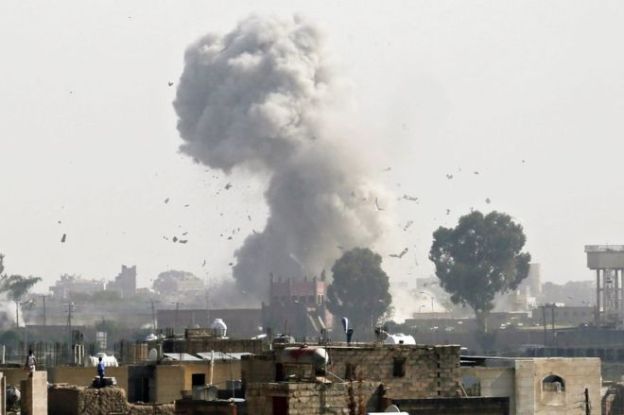
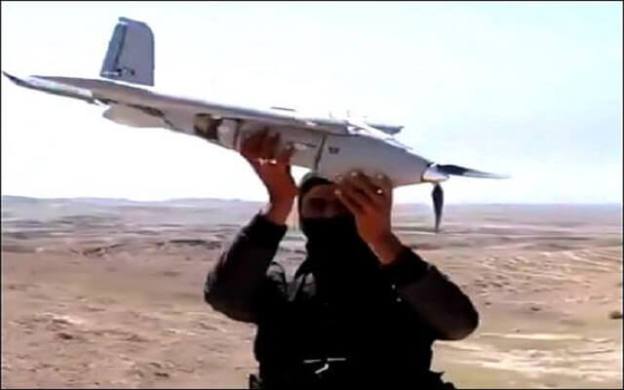
Non-state actors are unwilling to be left out of the party. The jihadists of Islamic State often used drones in Iraq and Syria. Hizbullah used drones when it hit 23 fighters linked to al-Qaeda in Syria in 2014. The Houthi drone that bombed Al-Anad looked a lot like an Iranian model. Last year the Houthis sent a similar one more than 100km (60 miles) into Saudi Arabia before it was shot down. ..

Excerpts from Predator Pricing: Weapon Sales, Economist,  Mar. 9, 2019

Spreading the War Bug

Foreign Policy reported recently that key officials within the Trump administration are “pushing to broaden the war in Syria, viewing it as an opportunity to confront Iran and its proxy forces on the ground there”. The strategy was being advocated over objections from the Pentagon, but it doesn’t seem to be deterring the White House.  As the Washington Post made clear just a few days ago, Iranian and US forces have already been directly clashing in the region, and officials are busy planning the “next stage” of the Syria war once Isis is defeated – a plan that centers around directly attacking the Iranians….

Just this weekend, Politico quoted key Republican senator Tom Cotton saying: “The policy of the United States should be regime change in Iran.” The CIA has already expanded its Iranian covert operations, while the main White House liaison to intelligence agencies, Ezra Cohen-Watnick, has reportedly“told other administration officials that he wants to use American spies to help oust the Iranian government”. And US secretary of state Rex Tillerson, in little noticed comments to Congress last week, called for “regime change” in Iran as well (albeit a “peaceful” one – whatever that means)…

The Trump administration’s plans may not stop in Syria either. Some officials have allegedly also been pushing for the Pentagon to step up its support of Saudi Arabia’s appalling war in Yemen, which has left 20 million people on the verge of starvation – all to go after Iranian-backed forces in the region as well.

All this comes as the Trump administration ramps up war across the Middle East. They are conducting drone strikes at a rate almost four times that of the Obama administration; civilian deaths from US forces in Syria have skyrocketed; special operations in Somalia have been ramping up; and the Pentagon is sending thousands of more troops to Afghanistan.

Excerpt from: Trevor Timm, Trump administration Donald Trump’s bloodlust for war in the Middle East risks chaos, Guardian, June 27, 2017