
Supercooled gas has quickly become one of the world’s most important energy sources—and a flashpoint between Russia and the U.S. Nowhere is that contest more apparent than in Russia’s Arctic north. An enormous new coastal facility is being built there to produce liquefied natural gas, a key project for Russian President Vladimir Putin. The U.S. is using a barrage of sanctions to cripple the initiative, known as Arctic LNG 2. These have stopped Russia from taking delivery of specialized, colossal tankers that it needs to transport the gas, and made it hard to build alternative vessels domestically. “Our role is to ensure Arctic LNG 2 is dead in the water,” Geoffrey Pyatt, the U.S. assistant secretary of state for energy resources, told a conference in Switzerland in April 2024.
Globally, LNG is ascendant. Demand is buoyant as governments ditch dirtier coal and the uptake of power-hungry artificial intelligence accelerates. Supply is surging too, and players such as industry heavyweight Qatar have major expansion plans. For Russia’s part, Putin aims to more than triple LNG exports in the coming years. His goal: Bring in more money to fund the war in Ukraine and offset a decline in Russia’s traditional business of exporting gas via pipelines. ..
About 32 million metric tons a year of capacity are under construction, according to Rystad Energy, a consulting firm, on top of an existing 29 million tons. In December 2023, the first of three liquefaction plants, known in the industry as trains, was completed at Arctic LNG 2, and the facility began producing LNG. The milestone, despite U.S. sanctions, was lauded as a win for Moscow by analysts and Russian officials. A few months later, however, victory looks less certain.
Exports were supposed to begin in the first quarter of 2024, according to Russia’s energy minister. But the custom-built ships that Novatek, the Russian energy giant behind the project, needs to break through frozen parts of the Arctic Ocean haven’t been delivered.
Hanwha Ocean, a South Korean shipbuilder, said it has canceled plans to build three vessels for Arctic LNG 2 for sanctions-related reasons. Mitsui O.S.K. Lines, a Japanese shipping company, has said it also won’t provide vessels to Arctic LNG 2 despite having planned to charter three carriers. Without ships, Novatek can’t export any gas. As a result, LNG output has ground to a halt, and the facility is mostly recirculating already-produced gas, according to people familiar with the plant. Novatek didn’t respond to a request for comment.
France’s TotalEnergies, which holds 10% of Arctic LNG 2, declared a force majeure earlier this year, indicating it can’t supply customers due to circumstances beyond its control. Total said it was complying with sanctions and doesn’t plan to deliver gas from the project this year.
In total, the U.S. has hit Russia’s fledgling LNG industry with four waves of sanctions since September. It has targeted operating companies for the Arctic LNG 2 project, storage vessels, shipping companies it suspected were seeking to buy specialized carriers for the project, and companies working on a second facility near the Baltic Sea.
Excerpts from Anna Hirtenstein, The U.S. Is Trying to Cripple Russia’s Vast Arctic LNG Project, WSJ, Apr. 14, 2024
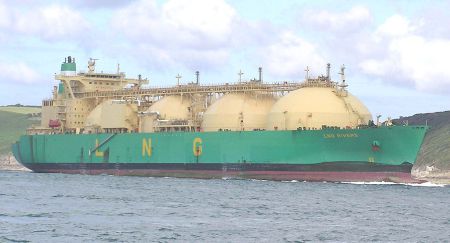
 One day in March 2017, he Rioja Knutsen tanker, filled with liquefied natural gas, was traveling from the U.S. to Portugal. Suddenly, Mexico’s power company lobbed in a higher bid for its cargo. At the Bahamas, the ship abruptly made a starboard turn and headed south. How natural gas is bought and sold in the world’s scattered regional markets for the fuel is changing rapidly. Ships such as the Rioja Knutsen are stitching those regions together and a single global market is emerging. This is already how nearly every other hydrocarbon, from crude oil to obscure petrochemicals, is sold. As gas joins the club, the effects will ripple through energy prices, company profits, the environment and geopolitics.
 Law-In-Action