Tag Archives: improvised explosive devices (IEDs)

Weapons for the Underdogs

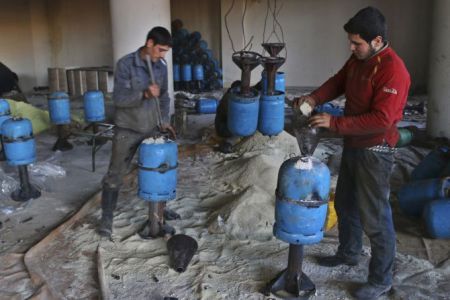
The modern equivalents  of  [improvised weapons] are more high-tech and, like Aleppo’s hell cannons, far deadlier...Any side that begins with a technological advantage will see it erode quickly as the underdogs improve their improvisation capabilities… [H]ell cannons are being mounted on vehicles and fitted with recoil springs to absorb the launch explosion. This improves stability, which in turn enables greater accuracy with follow-up shots. Some designs are no longer fired by lighting a fuse, but at a safe distance with a car battery wired to the propellant charge. Bigger cannons heave oxygen cylinders and, astonishingly, even large household water-heaters packed with enough explosives to destroy a cluster of buildings.

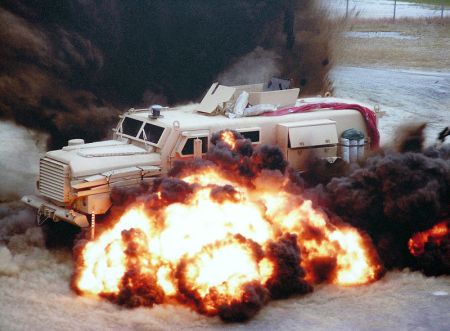
The ominous consequences have led America’s Defence Advanced Research Projects Agency (DARPA), an arm of the Pentagon, to try to keep up with developments by soliciting worldwide for new ways to make weapons using commercially available materials and technologies. More than 20 experts are now reviewing hundreds of submissions. To better assess the risks, some of the most promising designs will be built as prototypes and tested…[DARPA Improv]

Improvised weaponry typically is not as fearsome as that made by defence companies. But it is a lot cheaper and often effective enough… Despite receiving arms shipments from Iran and Russia, Syria’s regime still uses its own improvised “barrel bombs”—devastating devices made by filling oil drums with explosives and scrap metal….

Even defence firms are turning to more commercially available equipment to make weapons. Lasers used to cut and weld materials in industry, for example, are now so powerful that Boeing bought a 10kW model to put into its High Energy Laser Mobile Demonstrator (HEL MD), a system it has assembled for the American army to shoot down drones and incoming mortar shells by firing a laser beam at them. Just think of HEL MD as “a welding torch” with a reach of kilometres, says David DeYoung, head of the Boeing unit that built it. While the off-the-shelf laser is powerful enough for its role, IPG Photonics of Massachusetts is now selling a 20kW laser.

Smartphones are useful in making weapons. They contain GPS navigation and frequency-hopping technology, which transmits signals that are hard to intercept or jam (both were military developments). Other useful things inside include accelerometers, compasses, gyroscopes, motion detectors and sensors for orientation, measuring magnetic fields and capturing reflected infra-red light (to turn off the screen when it detects the phone is close to the ear, saving battery power and preventing inadvertent touches). All of that can be used for missile guidance and communications, adds Mr Shapir. The guidance and remote-control systems sold with consumer drones offer additional capabilities…

Part of the problem is that anyone can buy not just sophisticated hardware but also a 3D printer to make basic weapon components, says Rear-Admiral Brian Brakke, deputy director of operations at the Pentagon’s Joint Improvised-Threat Defeat Agency. In Iraq and Syria, Islamic State has been working on dropping improvised bombs from remotely controlled model aircraft. These might carry bigger payloads than the small quadcopters widely sold as drones to hobbyists and commercial operators. The jihadist group has also begun developing remote-control systems for driverless vehicles to deliver huge improvised explosive devices without suicide-volunteers, Mr Brakke believes….

Recent developments in biotechnology have moved the boundaries as well. So-called “biohacking” groups have begun experimenting with homespun processes, much as early computer hackers did with information technology. The biohackers see DNA as a form of software that can be manipulated to design new biological processes and devices. Some of the amateur labs are still relatively crude, but nevertheless there is concern that they could be used to create killer bugs or provide training for bioterrorists. America’s FBI has been watching developments and even organising some biohacker gatherings. That may seem reckless, but the idea is to encourage responsible behaviour and self-policing rather than risk a crackdown that drives the movement underground.

Excerpts from  Improvised Weapons, Hell’s Kitchen, Economist,  May 21, at 2016
Kill Without Leaving Fingerpints: Iraq War

The Iraq war was, in part, a proxy battle between the US and Iran….By early 2007, some US intelligence estimates held that as many as 150 Iranian operatives were in Iraq. Many were member of the Quds Force, the covert arm of Iran’s Shi’ite theocracy. Their mission was to coordinate the violent campaign being waged against US forces by Iraq’s Shi’ite militias.“It was 100 percent, ‘Are you willing to kill Americans and are you willing to coordinate attacks?’ ” said an officer who studied the Quds Force’s approach closely. “ ‘If the answer is “yes,” here’s arms, here’s money.’ ”

The Joint Special Operations Command (JSOC) set up a new task force, named Task Force 17.Its mandate was simple: go after “anything that Iran is doing to aid in the destabilization of Iraq,” said a Task Force 17 officer…But political restrictions hobbled Task Force 17, particularly as the US lowered its profile in Iraq. The country’s Shi’ite-dominated government, headed by Prime Minister Nouri al-Maliki, wasn’t happy with any attacks that targeted Iran operatives or their Iraqi proxies.  But for a small number of Shi’ite targets, JSOC found a way around the political restrictions by killing its enemies without leaving any US fingerprints.  The command did this using a device called the “Xbox.”

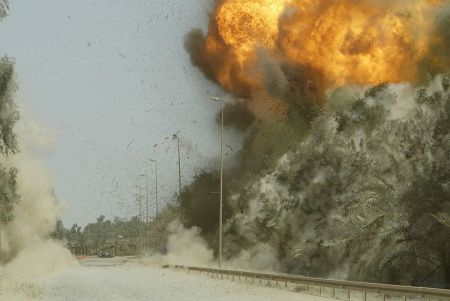
Developed jointly by Delta Force and SEAL Team 6, the Xbox was a bomb designed to look and behave exactly like one made by Iraqi insurgents, using materials typically found in locally made improvised explosive devices…[The Xbox] was made by the Delta and Team 6 explosive ordnance disposal (EOD) personnel… After capturing some IEDs intact on the Afghan and Iraqi battlefields, the EOD troops set about taking them apart.  It wasn’t long before they realized they could build them as well..  At first, the officer said, JSOC’s bomb makers used components typically found in the Afghanistan-Pakistan theater: “Chinese circuits and Pakistani parts . . . and explosives from old Soviet munitions, et cetera.”  The intent was to create a device that if it were sent to the FBI’s Terrorist Explosive Device Analytical Center in Quantico, Va., the Bureau’s experts would mistakenly trace the bomb back to a particular terrorist bomb maker because of certain supposedly telltale signature elements of the design that JSOC’s explosive ordnance disposal gurus had managed to re-create.

But the Xbox was different from regular IEDs in several ways… First, unlike many IEDs, such as those detonated by vehicles running over pressure plates, it had to be command detonated, meaning an operator somewhere was watching the target and then pressing a button. Another design requirement was that the Xbox device had to be extremely stable, to avoid the sort of premature explosions that often kill terrorists.

JSOC wanted to use the device to kill individuals, rather than crowds…JSOC used reconnaissance operators, who are typically some of Delta’s most experienced, because getting the device into position, by placing it in the target’s vehicle, for example, was “a lot of work,” he said. It usually involved surveillance of the target for days on end, understanding his pattern of life — his daily routines — so that the operators could predict when they would be able to gain access to his vehicle unobserved….[A] senior Team 6 source, who questioned the morality of using the device [said]: “[It’s] a great tool, but as many of us have said — hey, we’re no different than the enemy if we’re just blowing people up with booby traps.”

Excerpted from Sean Naylor “Relentless Strike: The Secret History of Joint Special Operations Command” (2015)

Explosive Weapons: Deaths and Damages

Data released by Action on Armed on Violence  (AOAV) on May 14, 2014 shows that civilian deaths and injuries in 2013 from explosive weapons have increased by 15%, up from 2012.Civilians bore the brunt of bombings worldwide. AOAV recorded 37,809 deaths and injuries in 2013, 82% of whom were civilians. The trend was even worse when these weapons were used in populated areas. There civilians made up a staggering 93% of casualties.  These stark figures mean that civilian casualties from bombings and shelling worldwide have gone up for a second consecutive year.  This data is captured in AOAV’s latest report, Explosive Events, which analyses the global harm from the use of explosive weapons like missiles, artillery and improvised explosive devices (IEDs).

KEY FINDINGS
•Iraq, Syria, Pakistan, Afghanistan and Lebanon were the most affected countries in the world. More than a third of the world’s civilian casualties from explosive weapons were recorded in Iraq, where AOAV saw a dramatic escalation in bombings with improvised explosive devices (IEDs).
•Seventy-one percent (71%) of civilian casualties from explosive weapons worldwide were caused by IEDs like car bombs and roadside bombs.
•Civilian casualties in Iraq increased by 91% from 2012, with more than 12,000 deaths and injuries recorded in the country in 2013.
•Market places were bombed in 15 countries and territories, causing 3,608 civilian casualties.
•Ballistic missiles, used only in Syria, caused an average of 49 civilian casualties per incident, the highest for any explosive weapon type.

Military Tanks with No U.S. Parts

The international armoured vehicles market is facing challenging times, especially as the US and its partners withdraw from Afghanistan, potentially flooding the market with used vehicles, according to  [a South African] company [called] DCD Protected Mobility…A recent Frost & Sullivan report said the world military land vehicle market would only grow at .7% until 2021 as the US cuts back its requirements and western defence markets shrink. Certain market segments, such as armoured fighting vehicles, are projected to actually shrink over the next decade.

However… a market does still exist for armoured vehicles. “There is a requirement out there for more MRAPs [Mine-Resistant Armour Protected vehicles].” Addressing the threat of an ex-US armoured vehicles glut, he pointed out that ex-US Army vehicles are not always suitable for other customers as they are still fairly expensive to maintain and operate and are do not always meet user requirements….

That DCD Protected Mobility intends “becoming owners of the route clearance space internationally,” notably with its Husky vehicle mounted mine detection system…. The system comprises of two Husky vehicles: the first acts as a Mine Detection Vehicle (MDV) (previously a Meerkat). The second vehicle (a Husky) tows a mine-detonating trailer..Hundreds of Huskies have been sold to Canada, the USA, UK, France, Australia, Angola, Kenya, Uganda, Spain and Turkey….[T]he Husky programme has made a significant contribution to poverty alleviation in South Africa, creating 1 320 jobs across the supply chain and earning R10.3 billion in foreign exchange for the South African economy… On the sixth of November, DCD and its partners will demonstrate an unmanned version of the Husky system to the US government, developed in partnership with its partners Critical Solutions International (CSI) and Torc Robotics.

With CSI, DCD is looking at international markets like the European Union and Nato. Austria wants to buy four to six two-seat Husky vehicles through the US Foreign Military Sales (FMS) system to provide a route clearance capability they can offer to Nato.  Turkey recently bought four Huskies and… will purchase more. Turkey will “hopefully” buy around 50 more vehicles sometime next year, he told defenceWeb. Other countries that show great promise regarding the vehicle are India and Iraq.

DCD is also trying to focus on Africa and emerging markets, and places where customers do not want any US components in their vehicles. In Africa, the company is pinning some of its hopes on the Springbuck A202 armoured personnel carrier. This is selling well and is aimed at developing countries that need an “affordable but not inferior” vehicle.

Excerpt,  Guy Martin, Budget cuts, Afghanistan withdrawal negatively affecting MRAP market, DefenceWeb, Oct. 31 2013