Sales of U.S. weapons to Israel have surged since October 2023, with Washington approving more than $32 billion in armaments, ammunition and other equipment to the Israeli military…Israel responded to the Oct. 7, 2023, attack led by Hamas, which killed about 1,200 people and took 251 hostages, with a military invasion that has killed more than 68,000 people in Gaza—including more than 18,000 children—according to Gaza health authorities…The fighting throughout the region has presented a fresh opportunity for defense companies in the American heartland and, to a lesser extent, tech giants on the West Coast…
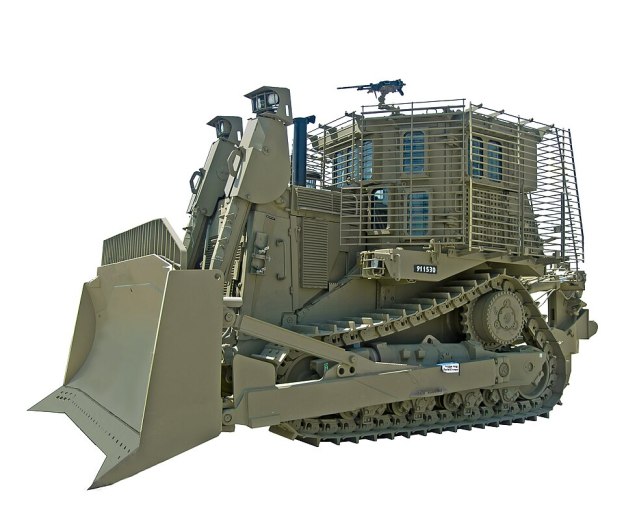
The American company that has brought in the most Israeli business since the Gaza war began is Boeing. The U.S. greenlighted an $18.8 billion sale of Boeing F-15 strike fighters in 2024 to Israel for delivery beginning in 2029. In 2025, various partnerships in which Boeing plays a leading role got approval for $7.9 billion of sales of guided bombs and associated kits…The biggest defense sales approved by Washington are for jet fighters and airborne-guided bombs, reflecting the crucial role of aerial bombings in the conflict…Israel’s Eitan armored fighting vehicles, which have been used widely across Gaza, are equipped with a hull from Wisconsin-based Oshkosh and an engine made by Rolls-Royce’s U.S. unit in Michigan. Caterpillar’s D9 armored bulldozers—used to clear rubble and destroy residences and other structures in Gaza—have been ubiquitous.
In some cases, companies have faced a backlash from investors and employees over their sales to the Israeli military. In 2024, three Norwegian investment funds have sold their stakes in Oshkosh, Palantir Technologies, Caterpillar and Thyssenkrupp over the use of their products for the war in Gaza. On Oct. 1 2025, Dutch pension fund ABP—the biggest in the Netherlands, with more than $400 billion under management—sold its €387 million, or $448 million, stake in Caterpillar, citing concerns over Gaza.
In September 2025, Microsoft disabled the Israeli Defense Ministry’s access to some cloud services in response to staff protests. Before the war began, Microsoft and a partnership between Alphabet-owned Google and Amazon.com had clinched deals with Israel to provide artificial-intelligence and cloud-computing services to the military. Meanwhile, AI giant Palantir, co-founded by Trump ally Peter Thiel, entered into a partnership with the Israeli Defense Ministry in January 2024. At a May 2025 conference, Palantir Chief Executive Alex Karp responded to accusations from a protester that Israel used Palantir’s technology to kill Palestinians, saying that those who were killed were “mostly terrorists.”
American companies have also found business opportunities in responding to the humanitarian crisis sparked by the war. The U.S. State Department said in June 2025 that it had allocated $30 million to the Gaza Humanitarian Foundation, led by former Trump adviser Johnnie Moore, to oversee aid handouts. The foundation hired American contractors Safe Reach Solutions and UG Solutions to provide security for the distribution efforts, which have been beset by dysfunction and violence.
In its 2025 annual report, Lockheed Martin said it had benefited from increased American defense funding related to Israel and Ukraine, notably munitions purchases. Revenue at its missiles division rose 13% last year to $12.7 billion…Armored-vehicles maker Oshkosh said an Israeli order of tactical vehicles had extended the lifespan of a production line that was due to shut in 2024. In its latest 2025 report, Italian contractor Leonardo, whose U.S. unit is selling tanker trailers to Israel, said its international sales should remain stable in 2025 because of “the continuing conflicts in both Ukraine and Israel.”
Excerpt from Benoit Faucon, The Gaza War Has Been Big Business for U.S. Companies, WSJ, Nov. 12, 2025
 Law-In-Action