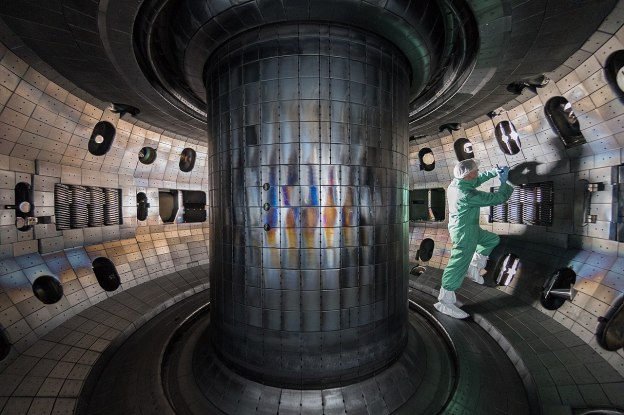
A high-tech race is under way between the U.S. and China as both countries chase an elusive energy source: nuclear fusion. China is outspending the U.S., completing a massive fusion technology campus and launching a national fusion consortium that includes some of its largest industrial companies. Crews in China work in three shifts, essentially around the clock, to complete fusion projects.
The result is an increasing worry among American officials and scientists that an early U.S. lead is slipping away. JP Allain, who heads the Energy Department’s Office of Fusion Energy Sciences, said China is spending around $1.5 billion a year on fusion, nearly twice the U.S. government’s fusion budget. What’s more, China appears to be following a program similar to the road map that hundreds of U.S. fusion scientists and engineers first published in 2020 in hopes of making commercial fusion energy. “They’re building our long-range plan,” Allain said. “That’s very frustrating, as you can imagine.”
China already has a fast-growing nuclear-technology industry and is building more conventional nuclear power plants than any other country. The country’s nuclear-plant development will give it an advantage when commercial fusion is reached, according to a report released last month by the Information Technology and Innovation Foundation, a Washington, D.C.-based think tank with backers that include big tech companies…
The Chinese Academy of Sciences’ Institute of Plasma Physics in the eastern Chinese city of Hefei in 2018 broke ground on a nearly 100-acre magnetic fusion research and technology campus. The facility is expected to be completed in 2025 but is already largely operational and focused on industrializing the technology. In 2023 China said it would form a new national fusion company, and said the state-owned Chinese National Nuclear Corp. would lead a consortium of state-owned industrial firms and universities pursuing fusion energy. Among the largest efforts by a private Chinese company are those of ENN, an energy conglomerate, which created a fusion division from scratch in 2018. Since then, ENN has built two tokamaks, the machines where fusion can happen, using powerful magnets to hold plasma. ENN’s fusion work isn’t well-understood outside of China and its pace of development would be difficult to replicate in the U.S. or Europe.
Excerpts from Jennifer Hiller, China Outspends the U.S. on Fusion in the Race for Energy’s Holy Grail, WSJ, July 9 2024

 Law-In-Action