Tag Archives: protests

Dodging the Camera: How to Beat the Surveillance State in its Own Game

Powered by advances in artificial intelligence (AI), face-recognition systems are spreading like knotweed. Facebook, a social network, uses the technology to label people in uploaded photographs. Modern smartphones can be unlocked with it… America’s Department of Homeland Security reckons face recognition will scrutinise 97% of outbound airline passengers by 2023. Networks of face-recognition cameras are part of the police state China has built in Xinjiang, in the country’s far west. And a number of British police forces have tested the technology as a tool of mass surveillance in trials designed to spot criminals on the street.  A backlash, though, is brewing.

Refuseniks can also take matters into their own hands by trying to hide their faces from the cameras or, as has happened recently during protests in Hong Kong, by pointing hand-held lasers at cctv cameras. to dazzle them. Meanwhile, a small but growing group of privacy campaigners and academics are looking at ways to subvert the underlying technology directly…
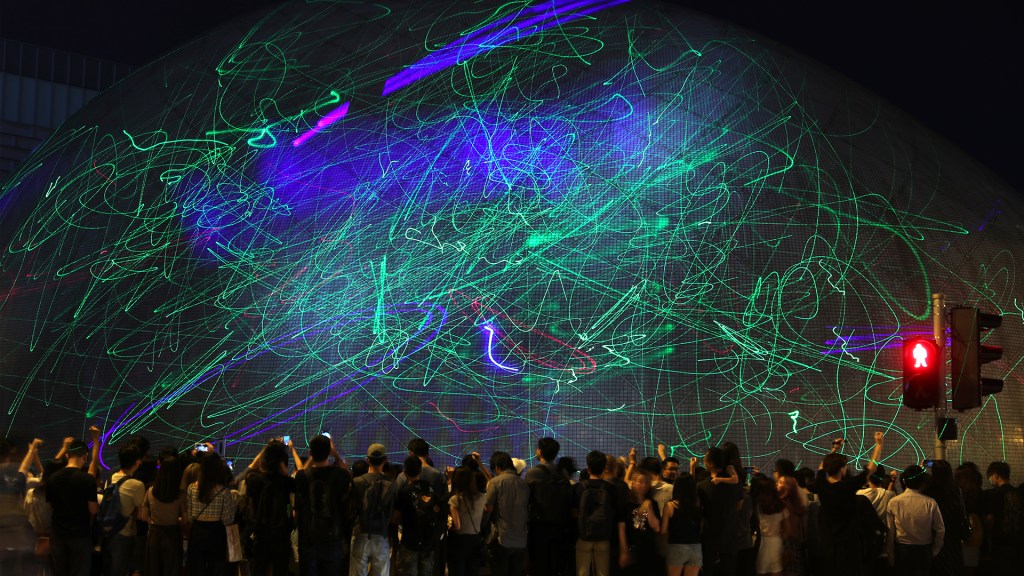
Laser Pointers Used to Blind CCTV cameras during the Hong Kong Protests 2019

In 2010… an American researcher and artist named Adam Harvey created “cv [computer vision] Dazzle”, a style of make-up designed to fool face recognisers. It uses bright colours, high contrast, graded shading and asymmetric stylings to confound an algorithm’s assumptions about what a face looks like. To a human being, the result is still clearly a face. But a computer—or, at least, the specific algorithm Mr Harvey was aiming at—is baffled….

Modern Make-Up to Hide from CCTV cameras

HyperFace is a newer project of Mr Harvey’s. Where cv Dazzle aims to alter faces, HyperFace aims to hide them among dozens of fakes. It uses blocky, semi-abstract and comparatively innocent-looking patterns that are designed to appeal as strongly as possible to face classifiers. The idea is to disguise the real thing among a sea of false positives. Clothes with the pattern, which features lines and sets of dark spots vaguely reminiscent of mouths and pairs of eyes are available…

Hyperface Clothing for Camouflage

 Even in China, says Mr Harvey, only a fraction of cctv cameras collect pictures sharp enough for face recognition to work. Low-tech approaches can help, too. “Even small things like wearing turtlenecks, wearing sunglasses, looking at your phone [and therefore not at the cameras]—together these have some protective effect”. 

Excerpts from As face-recognition technology spreads, so do ideas for subverting it: Fooling Big Brother,  Economist, Aug. 17, 2019
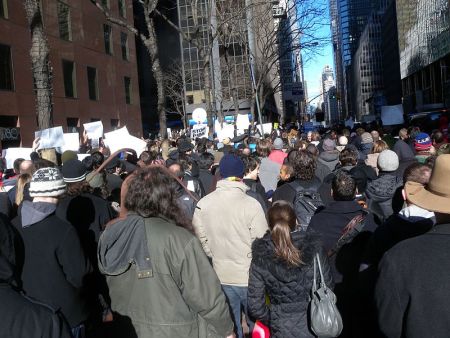
State Surveillance of Twitter Protesters

Enthusiasts called protesters in Egypt, Iran, Moldova and Tunisia “Twitter revolutionaries”. That was premature: much of the social-media content supporting the pro-democracy cause came from supporters abroad. But protests in Turkey and Brazil, where digital media are especially popular, do show how technology can muster, manage and amplify demonstrations. Zeynep Tufekci of Princeton University interviewed scores of Turkish protesters. Most cited social media as a spur.

Social media mean that pictures and video spread rapidly; supporters arrive more quickly than police can cart them away, so governments can no longer rely on quelling minor protests by force. A video circulating in Brazil advises citizen journalists to work in packs, adopting military formations to catch government wrongdoing from every available angle.

Highlighting outrageous police behaviour can prompt people to get involved. It also can show more innocuous scenes than the punch-ups and arrests that attract news photographers. These may encourage the hesitant or timid, showing that “protesters are not hooligans or terrorists but people just like you,” says Ethan Zuckerman of MIT.   Social media also counter inflammatory or complacent official channels. When a Turkish television station broadcast a documentary about penguins instead of the street protests, wags photoshopped the bedraggled birds into images of police soaking youths with water cannon, and circulated them in disgust.

Swelling the number of protesters is one thing. Co-ordinating them is another. Several hundred social-media pages advertised demonstrations across Brazil, offering tips on dodging water cannon; some sought volunteers to care for demonstrators’ children. They also helped to direct people who wished to protest in cities abroad. Brazilian hackers used denial of service attacks to briefly disable government websites, including one for next year’s costly football World Cup. All this can help give startling momentum in the real world and online. But it does not necessarily make the protests effective. An amorphous digital crowd can find it hard to agree on demands, accept compromises, or discipline provocateurs. Online voting and other clever e-democracy tools may solve this problem. But not yet.

In the meantime technology can serve the powerful, too. Protesters in Turkey and Brazil say their mobile internet access was throttled, though congestion, not censorship, may be the real culprit. Instructions issued over social networks are easily monitored by police. Amateur footage provides authorities with visual records of those who attend. Witness, an American charity which trains citizen journalists, says that where official snooping is a danger, protesters should be filmed only from behind; last July YouTube, an online video site, introduced a face-blurring tool.

Most protesters are not so careful, and police are getting better at capturing this information themselves. Since 2011 cops in Brazil have tried head-mounted face-detection cameras, which authorities claim can capture up to 400 faces a second. Hoisting them on cheap drones would offer an even better view. Police forces can also recognise demonstrators without actually seeing them: some officers in America have kit capable of recording the identifying code of all the mobile phones within a given area, and officials can also beg or seize the data from mobile operators.

More sought-after is technology that can help forestall protests. Digital marketers have long analysed social-media messages to gauge opinions about products and brands. Brazil’s security services are said to be increasing online monitoring: this can alert police to impending unrest, and spot the main troublemakers. Such tools are experimental. Technology still gives protesters the upper hand, though what they do with it is another question.

Internet protests: The digital demo, Economist, June 29, 2013, at 56