Tag Archives: face-recognition technology

Replace dark background with light neutral background

How the U.S. Surveillance System Works

In the battle against illegal immigration, the U.S. is spending hundreds of millions of dollars on tools that give federal agents easy access to the home and workplace addresses of American citizens, their social-media accounts, vehicle information, flight history, law-enforcement records and other personal information, as well as data to track their daily comings and goings, The Wall Street Journal found. The government’s tracking system relies on an amalgam of public and private information sifted, sorted and packaged by contractors that include Palantir Technologies, Deloitte, Japanese conglomerate NEC and smaller spyware specialists.

The Department of Homeland Security has put these surveillance tools—facial-recognition software, location tracking and social-media scrapers once aimed largely at suspected terrorists and drug-traffickers—in the hands of federal immigration agents, who can identify, research and track virtually anyone by entering a name, license plate or by simply taking a person’s photo.

The government surveillance system has advanced since the 9/11 terrorist attacks with the aid of artificial intelligence and the linking of government records with far-reaching commercial databases. It has been used against people whom the government alleged opposed or obstructed the immigration crackdown.

With the backing of Congress and President Trump, DHS spent a record $425 million on surveillance tech in 2025, a 17% increase from the prior year…Palantir is the top beneficiary of DHS’s stepped-up spending on deportation and surveillance work,… In 2025, DHS paid Palantir $30 million to put a broad span of information about individuals into an app on agents’ smartphones, allowing them to plot the location of people in the U.S. The app, known as Enhanced Leads Identification and Targeting for Enforcement, or ELITE, lets officers research and track individuals based on criminal history, license plate searches, name, date of birth or locations.

The results display on a map or as a list… The app pulls from a variety of government databases, including information compiled by private investigators known as “skip tracers” who track the current addresses of individuals. ..An ICE agent during court testimony last year compared ELITE to Google Maps: Targets appear as pins on a map, clustered around addresses where immigrants, including “lawful permanent residents,” are likely to live…

Through the year beginning in January 2025, the U.S. paid consulting firms, including Deloitte, $130 million, to aid ICE’s deportation efforts and law enforcement support work. New consultant contracts call for analysts to monitor people on social media, identify threats and create dossiers about people who make them. DHS awarded $15 million to tech company Cellebrite for forensic tools to unlock phones and extract call logs, GPS location data, text messages, deleted photos, contacts and email addresses. US. Customs and Border Protection (CBP) renewed agreements with vehicle-forensics firm Berla to retrieve data, including travel history, from the vehicles of suspects. In 2025, DHS reactivated a $2 million contract with the U.S. subsidiary of Israeli spyware company Paragon Solutions, which makes Graphite, a hacking tool that can infiltrate encrypted messaging apps such as Signal and WhatsApp.

Since January 2025, DHS has announced plans to spend up to nearly $200 million on new surveillance contracts. of which $100 million for Babel Street Insight which provides an AI-driven platform to translate social-media posts from hundreds of languages, map networks of contacts and scan for what the company calls “expressions of violent intent” and “negative” sentiments. Nearly $21 million went to companies that track and identify targets with biometric technology. That included $8 million to NEC for a facial-recognition algorithm that identifies passengers boarding planes. DHS rolled out an app last year that allows agents to identify people from images, using NEC technology. DHS also expanded its use of Clearview AI, another facial-recognition database, which contains more than 70 billion photos.

Excerpt from Shane Shifflett, ‘We Know You Live Right Here’: No Secrets in America’s New Surveillance Dragnet, WSJ, Apr. 30, 2026
Stasi Reborn: Democratizing Internet Censorship

The internet is the “spiritual home” of hundreds of millions of Chinese people. So China’s leader, Xi Jinping, described it in 2016. He said he expected citizens to help keep the place tidy. Many have taken up the challenge. In December 2019 netizens reported 12.2m pieces of “inappropriate” content to the authorities—four times as many as in the same month of 2015. The surge does not indicate that the internet in China is becoming more unruly. Rather, censorship is becoming more bottom-up

Officials have been mobilising people to join the fight in this “drawn-out war”, as a magazine editor called it in a speech in September to Shanghai’s first group of city-appointed volunteer censors. “Internet governance requires that every netizen take part,” an official told the gathering. It was arranged by the city’s cyber-administration during its first “propaganda month” promoting citizen censorship. The 140 people there swore to report any online “disorder”…

 Information-technology rules, which took effect on December 1st, 2019 oblige new subscribers to mobile-phone services not only to prove their identities, as has long been required, but also to have their faces scanned. That, presumably, will make it easier for police to catch the people who post the bad stuff online.

Excerpt from  The Year of the Rat-fink: Online Censorship, Economist, Jan 18, 2020

Dodging the Camera: How to Beat the Surveillance State in its Own Game

Powered by advances in artificial intelligence (AI), face-recognition systems are spreading like knotweed. Facebook, a social network, uses the technology to label people in uploaded photographs. Modern smartphones can be unlocked with it… America’s Department of Homeland Security reckons face recognition will scrutinise 97% of outbound airline passengers by 2023. Networks of face-recognition cameras are part of the police state China has built in Xinjiang, in the country’s far west. And a number of British police forces have tested the technology as a tool of mass surveillance in trials designed to spot criminals on the street.  A backlash, though, is brewing.

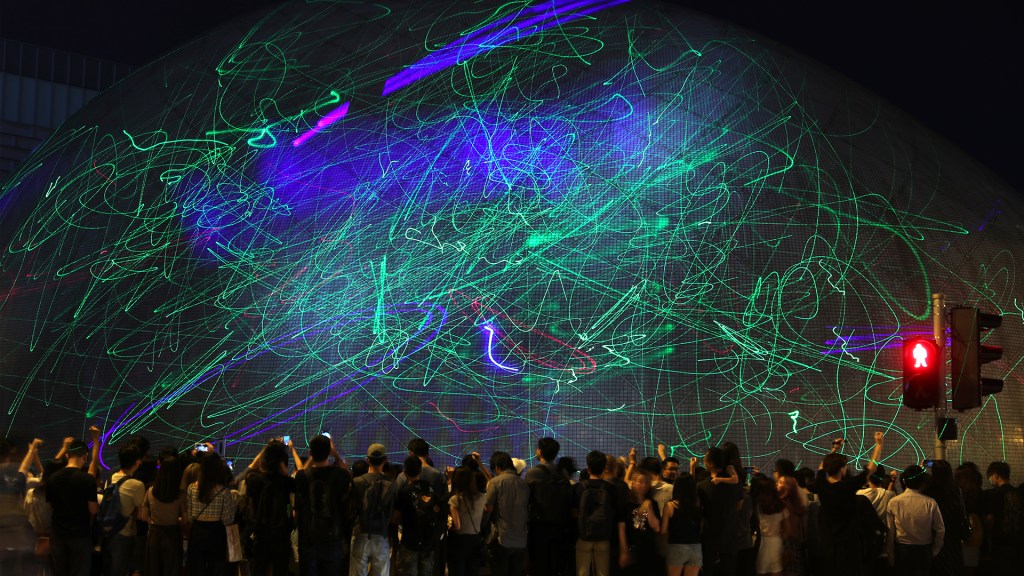
Refuseniks can also take matters into their own hands by trying to hide their faces from the cameras or, as has happened recently during protests in Hong Kong, by pointing hand-held lasers at cctv cameras. to dazzle them. Meanwhile, a small but growing group of privacy campaigners and academics are looking at ways to subvert the underlying technology directly…

Laser Pointers Used to Blind CCTV cameras during the Hong Kong Protests 2019

In 2010… an American researcher and artist named Adam Harvey created “cv [computer vision] Dazzle”, a style of make-up designed to fool face recognisers. It uses bright colours, high contrast, graded shading and asymmetric stylings to confound an algorithm’s assumptions about what a face looks like. To a human being, the result is still clearly a face. But a computer—or, at least, the specific algorithm Mr Harvey was aiming at—is baffled….

Modern Make-Up to Hide from CCTV cameras

HyperFace is a newer project of Mr Harvey’s. Where cv Dazzle aims to alter faces, HyperFace aims to hide them among dozens of fakes. It uses blocky, semi-abstract and comparatively innocent-looking patterns that are designed to appeal as strongly as possible to face classifiers. The idea is to disguise the real thing among a sea of false positives. Clothes with the pattern, which features lines and sets of dark spots vaguely reminiscent of mouths and pairs of eyes are available…

Hyperface Clothing for Camouflage

 Even in China, says Mr Harvey, only a fraction of cctv cameras collect pictures sharp enough for face recognition to work. Low-tech approaches can help, too. “Even small things like wearing turtlenecks, wearing sunglasses, looking at your phone [and therefore not at the cameras]—together these have some protective effect”. 

Excerpts from As face-recognition technology spreads, so do ideas for subverting it: Fooling Big Brother,  Economist, Aug. 17, 2019

The Transparent Individual

By integrating data you want into the visual field in front of you Google Glass is meant to break down the distinction between looking at the screen and looking at the world. When switched on, its microphones will hear what you hear, allowing Glass to, say, display on its screen the name of any song playing nearby…It could also contribute a lot to the company’s core business. Head-mounted screens would let people spend time online that would previously have been offline. They also fit with the company’s interest in developing “anticipatory search” technology—ways of delivering helpful information before users think to look for it. Glass will allow such services to work without the customer even having to reach for a phone, slipping them ever more seamlessly into the wearer’s life. A service called Google Now already scans a user’s online calendar, e-mail and browsing history as a way of providing information he has not yet thought to look for. How much more it could do if it saw through his eyes or knew whom he was talking to…

People may in time want to live on camera in ways like this, if they see advantages in doing so. But what of living on the cameras of others? “Creep shots”—furtive pictures of breasts and bottoms taken in public places—are a sleazy fact of modern life. The camera phone has joined the Chinese burn in the armamentarium of the school bully, and does far more lasting damage. As cameras connect more commonly, sometimes autonomously, to the internet, hackers have learned how to take control of them remotely, with an eye to mischief, voyeurism or blackmail.  More wearable cameras probably mean more possibilities for such abuse.

Face-recognition technology, which allows software to match portraits to people, could take things further. The technology is improving, and is already used as an unobtrusive, fairly accurate way of knowing who people are. Some schools, for example, use it to monitor attendance. It is also being built into photo-sharing sites: Facebook uses it to suggest the names with which a photo you upload might be tagged. Governments check whether faces are turning up on more than one driver’s licence per jurisdiction; police forces identify people seen near a crime scene. Documents released to the Electronic Frontier Foundation, a campaign group, show that in August 2012 the Federal Bureau of Investigation’s “Next Generation Identification” database contained almost 13m searchable images of about 7m subjects.

Face recognition is a technology, like that of drones, which could be a boon to all sorts of surveillance around the world, and may make mask-free demonstrations in repressive states a thing of the past. The potential for abuse by people other than governments is clear, too…In America, warrants to seize user data from Facebook often also request any stored photos in which the suspect has been tagged by friends (though the firm does not always comply). Warrants as broad as some of those from which the National Security Agency and others have benefited in the past could allow access to all stored photos taken in a particular place and time.

The people’s panopticon, Economist,  Nov. 16, 2013, at 27