Tag Archives: Somali pirates

Piracy Alive and Well

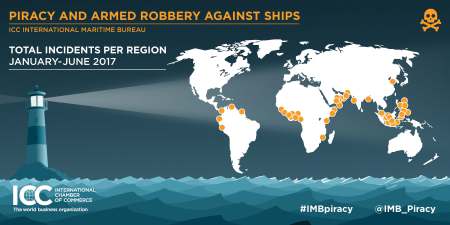
Continuing decline in the number of reported incidents of maritime piracy and armed robbery against ships has been revealed in the second quarter piracy report of the International Chamber of Commerce (ICC) International Maritime Bureau (IMB), published today. According to the report, the first half of 2017 saw a total of 87 incidents reported to the IMB Piracy Reporting Centre compared with 97 for the same period in 2016…

[I]n the first six-months of 2017, 63 vessels were boarded, 12 fired upon, four were hijacked and attacks were attempted on another eight vessels. A total of 63 crew have been taken hostage so far, this year while 41 have been kidnapped from their vessels, three injured and two killed.

The encouraging downward trend has been marred however by the hijacking of a small Thai product tanker en route from Singapore to Songkhla, Thailand. The hijacking, at the end of June 2017, was conducted by six heavily armed pirates who transferred 1,500 MT of gas oil to another vessel. The incident followed a similar pattern to a series of product tanker hijackings in the region which occurred approximately every two weeks between April 2014 and August 2015….

Cooperation between Indonesia, Malaysia and Philippines has been recognised as the fundamental reason for the overall decline in the number of reported incidents in and around the Philippines…

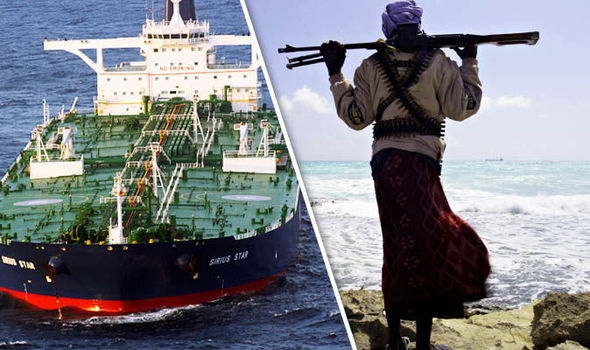
Somali pirates still retain the skills and capacity to attack merchant ships far from coastal waters. Pirates in Nigeria continue to dominate when it comes to reports of kidnappings

Excerpts from Second quarter report reveals 87 incidents of maritime piracy in first half of year,  ICC Commercial Crime Services, Press Release, July 4, 2017.

Pirates and Free Trade

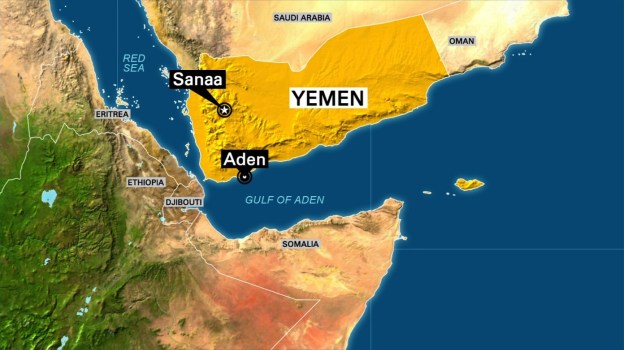
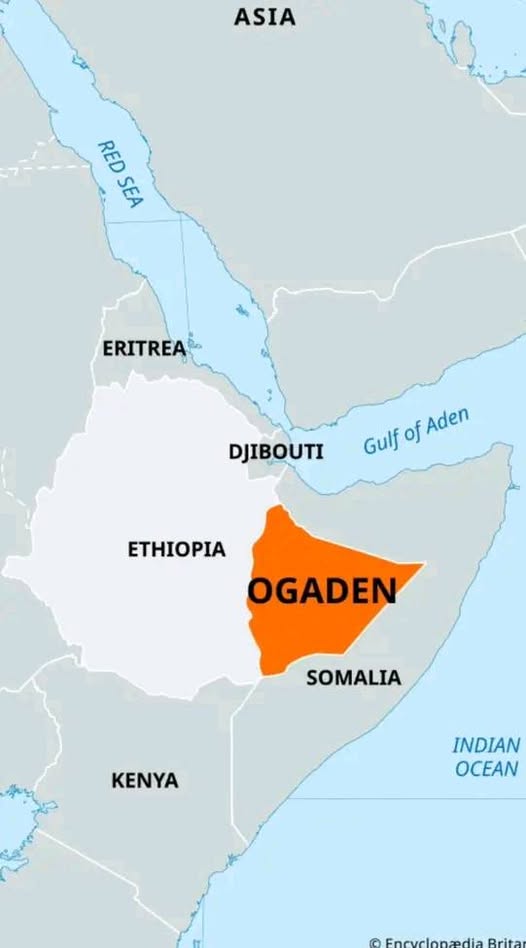
Ships navigating the lawless seas of the Gulf of Aden must keep a constant lookout for Somali pirates. The roots of Somalia’s maritime banditry lie in its desperately poor coastal villages, where the choice between fishing and piracy is an easy one for many.

Anja Shortland and Federico Varese mapped the locations of hijacked ships between 2005 and 2012. They found that hijacked vessels were always anchored far away from regional trading routes, and that big ports were not prone to piracy. There is a reason for that. Somali clans control local trade by issuing licences and charging informal taxes. The researchers reckon that communities which can tax imports and exports refuse to protect pirates because trade is a safer and more lucrative source of revenue than pirate earnings. Only clans that have no other income offer the pirates protection, in return for a share of their loot…..A… solution [to piracy] would be to build new roads and ports, which would allow remote areas to start trading. With alternative sources of income, fewer communities would be willing to harbour pirates….

A former president of Puntland repeatedly requested a road be built to Eyl, a rough-and-ready coastal town, as a quid pro quo for giving up piracy. His request was turned down, and piracy continued. Time for donors to rethink where they spend their pieces of eight.

Crime in Somalia: Pirates v economist, Economist, July 12, 2014, at 42

Hunting Down Somali Pirates: British Empire

Times are tough and getting worse for Somali pirates, as their targets take countermeasures. The number of attacks off the Horn of Africa tumbled from 236 in 2011 to no more than 72 in 2012, according to the International Maritime Bureau, a body that monitors crime at sea.

Now a private naval effort is adding to their woes. A company called Typhon will use a 10,000 tonne “mother ship” to accompany convoys of merchant vessels. With 60 mostly armed, mostly British ex-soldiers on board, it will deploy speedboats and unmanned drones to watch and intercept hostile boats.  Anthony Sharp, Typhon’s boss, says customers will find that more efficient than putting armed guards on every ship. It will also spare them keeping guns on board (which is tricky in law). Typhon plans to have three large ships by the year end, with at least one based in the Gulf of Guinea, a hotspot for pirate attacks last year, and ten by 2016.

Its backers include Simon Murray, a former foreign legionnaire who is now chairman of Glencore, a commodities giant due soon to merge with Xstrata, a mining behemoth. The new outfit will be a big potential customer for Typhon. But Mr Sharp downplays comparisons with Britain’s East India Company, which ran a private empire with its own navy. His is “actually quite a boring business,” he claims. Not for the pirates.

Piracy: Privateers,Economist, Jan.12, 2013, at 54