Tag Archives: somalia

Slyly Conquering East Africa

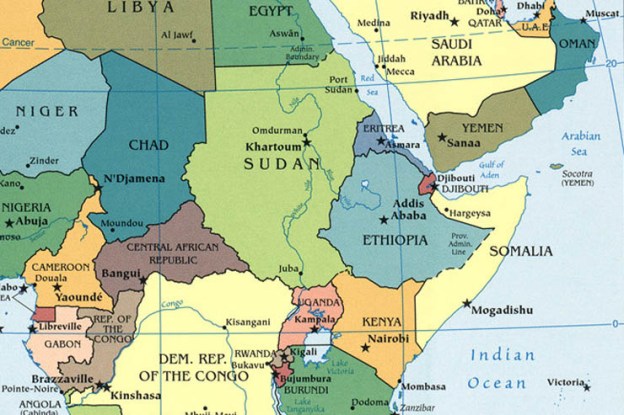
The rulers of United Arab Emirates (UAE), one of whose components, Dubai, own a majority stake in DP World, one of the world’s largest maritime firms with perations in 40 countries.It is one of several Gulf states trying to gain a strategic foothold in east Africa through ports. Controlling these offers commercial and military advantages but risks exacerbating tensions in the region…

DP World thinks the region from Sudan to Somalia needs 10-12 ports. It has just half that. The firm’s first foray was on Djibouti’s coast. When DP World won its first concessions there in the 1990s, the Emiratis were among the few investors interested in the small and poor former French colony. DP World built and operated a new container terminal, Doraleh,and helped finance roads and other infrastructure. Doraleh is now the country’s largest employer and the government’s biggest source of revenue. It runs at nearly full capacity, handling 800,000 containers a year. Much of its cargo travels along a Chinese-built railway from Addis Ababa, Ethiopia’s capital.

Djibouti’s profile rose further after the terrorist attacks on America of September 11th, 2001, when America opened a military base there. France and China also have bases; other navies patrol off its coast to deter Somali pirates. But when the Emiratis wanted to open their own naval base they were rebuffed, partly because of their close ties to Djibouti’s rival, Eritrea (the two states had a bloody border dispute in 2008). In 2015 the UAE started building a naval base in Assab, in southern Eritrea. The base has been used in the Saudi-led war against Houthi rebels in Yemen….In 2016 DP World won a 30-year concession to operate the port of Berbera in Somaliland, which declared independence in 1991 (though no foreign government recognises it). Critics said the deal would hasten the break-up of Somalia.

The Horn ports all sit near the Bab al-Mandab strait, a vital choke-point at the mouth of the Red Sea: 4.8m barrels of oil passed through it every day in 2016. Competition is getting fierce, though. Qatar and its ally, Turkey, are building ports in Sudan. Saudi Arabia is in talks to set up a naval base in Djibouti. All three Gulf states are trying to snap up farmland in east Africa, part of a broader effort to secure food supplies for their arid countries. Emirati-built ports could one day export crops from Emirati-owned farms…

Gulf states could also find themselves in competition with China…In February 2018 Djibouti seized the Doraleh port, a concession to the UAE… Shippers believe it took Doraleh as a sop to China, to which it is heavily indebted. In July 2018, Djibouti opened the first phase of a new $3.5bn free-trade zone, set to be the largest in Africa when it is finished. Built mostly by state-owned Chinese firms, it sits next to Doraleh. DP World says the project violates the terms of its concession and is threatening to sue.

Excerpts from Red Sea Scamble: Ports on the Horn, Economist, July 21, 2018, at 33
Corruption in Somalia

A United Nations panel that monitors compliance with U.N. sanctions on Somalia has accused Somalia’s  president, a former minister, and a U.S. law firm of conspiring to divert Somali assets recovered abroad, according to a new report.  The Somalia and Eritrea Monitoring Group, an 8-person committee, disclosed the findings in a confidential report to the U.N. Security Council’s Somalia/Eritrea sanctions committee. Reuters reviewed a copy of the 37-page document.  The U.N. Monitoring Group said the information it has gathered so far “reflects exploitation of public authority for private interests and indicates at the minimum a conspiracy to divert the recovery of overseas assets in an irregular manner.”

Most of the overseas assets were frozen at the outset of the civil war in 1991 and include cash and gold held in banks during two decades of chaos and conflict in Somalia, as well as government properties on foreign soil.  What the monitors describe as a conspiracy involved the U.S.-based law firm Shulman Rogers, President Hassan Sheikh Mohamud and his office, former foreign minister Fawzia Yusuf H. Adam, as well as two other individuals whom the monitors said acted as liaisons between Shulman Rogers and Somalia…

All those accused of involvement in the plan to divert assets have denied any wrongdoing. Several accused the chairman of the Monitoring Group, Jarat Chopra, of dubious investigative methods and making baseless assertions….

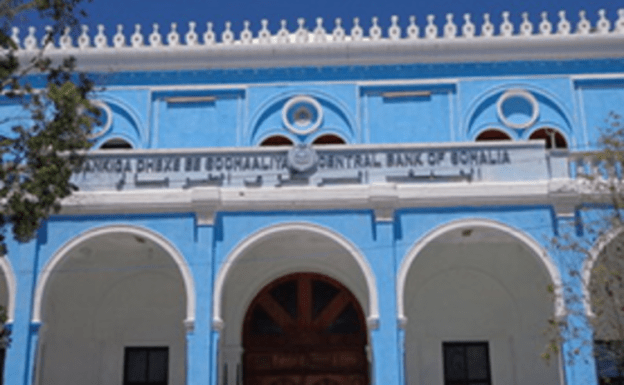
A 2013 U.N. Monitoring Group report said individuals in Mohamud’s government used the Somali central bank as a personal “slush fund”, with an average 80 percent of withdrawals made for private purposes. The presidency and the then-central bank governor Abdusalam Omer have strongly denied that accusation..  In its latest report, the Monitoring Group said that “a complex architecture of multiple secret contracts, which defied a separation of powers between the Presidency and the Central Bank, created the opportunity and rationalization for the misappropriation of public resources.”  “‘Pie-cutting’ of overseas assets by those involved in the project entailed retention of excessive percentages and direct payments from recovered assets as well as attempts to circumvent deposits in the Central Bank of Somalia,” it added.

Abrar, the former central bank governor who was also a former Citigroup vice president, quit last October after seven weeks on the job, alleging she had been pressured to sign a contract with Shulman Rogers that she feared could invite corruption at the central bank.According to the new report, she sent her resignation from Dubai after fleeing from Mogadishu out of fear for her safety.The Monitoring Group said it had followed up on a number of Abrar’s allegations and her concerns about the contract and the planned scheme for the recovery of Somalia’s overseas assets. One of her main worries, the monitors said, was a clause in a July 2013 contract with Shulman Rogers that gave the law firm a bonus of 5 percent of recovered assets in addition to its fees and for Shulman Rogers to retain a further 6 percent of recovered assets for undefined costs and expenses.

“Ms. Abrar considered this clause for undefined costs and expenses to be for hidden fees and ultimately understood that it was meant as a side payment to be divided two percent each between Foreign Minister Adam, Musa Haji Mohamed Ganjab and Abdiaziz Hassan Giyaajo Amalo,” the report said…

After consulting with the World Bank, the Somali president’s office said in a statement to Reuters that it revoked a power of attorney it had granted to Shulman Rogers in May and was renegotiating its contract with the law firm.

Excerpts from LOUIS CHARBONNEAU AND DRAZEN JORGIC, Exclusive: U.N. monitors allege ‘conspiracy’ to divert Somali assets, Reuters, July 15, 2014

The Kill List and Body Count: Drones

Just days after taking office, the president [Obamaa] got word that the first strike under his administration had killed a number of innocent Pakistanis. “The president was very sharp on the thing, and said, ‘I want to know how this happened,’ “ a top White House adviser recounted.  In response to his concern, the C.I.A. downsized its munitions for more pinpoint strikes. In addition, the president tightened standards, aides say: If the agency did not have a “near certainty” that a strike would result in zero civilian deaths, Mr. Obama wanted to decide personally whether to go ahead.

The president’s directive reinforced the need for caution, counterterrorism officials said, but did not significantly change the program. In part, that is because “the protection of innocent life was always a critical consideration,” said Michael V. Hayden, the last C.I.A. director under President George W. Bush.  It is also because Mr. Obama embraced a disputed method for counting civilian casualties that did little to box him in. It in effect counts all military-age males in a strike zone as combatants, according to several administration officials, unless there is explicit intelligence posthumously proving them innocent.  Counterterrorism officials insist this approach is one of simple logic: people in an area of known terrorist activity, or found with a top Qaeda operative, are probably up to no good. “Al Qaeda is an insular, paranoid organization — innocent neighbors don’t hitchhike rides in the back of trucks headed for the border with guns and bombs,” said one official, who requested anonymity to speak about what is still a classified program.

This counting method may partly explain the official claims of extraordinarily low collateral deaths. In a speech last year Mr. Brennan, Mr. Obama’s trusted adviser, said that not a single noncombatant had been killed in a year of strikes. And in a recent interview, a senior administration official said that the number of civilians killed in drone strikes in Pakistan under Mr. Obama was in the “single digits” — and that independent counts of scores or hundreds of civilian deaths unwittingly draw on false propaganda claims by militants.

But in interviews, three former senior intelligence officials expressed disbelief that the number could be so low. The C.I.A. accounting has so troubled some administration officials outside the agency that they have brought their concerns to the White House. One called it “guilt by association” that has led to “deceptive” estimates of civilian casualties.  “It bothers me when they say there were seven guys, so they must all be militants,” the official said. “They count the corpses and they’re not really sure who they are.”

Excerpt, JO BECKER and SCOTT SHANE, Secret ‘Kill List’ Proves a Test of Obama’s Principles and Will, NY Times, May 29, 2012