Tag Archives: SWIFT

US Sanctions and Russian Titanium

The United States imposed sanctions on Russia’s state arms export agency and four defense industry enterprises for alleged violations of international arms control regimes restricting export of nuclear and missile technologies to Iran, North Korea and Syria on Wednesday.

A notice posted on the U.S. government’s Federal Register on the State Department’s behalf on September 2, 2015 said the move was a response to violations of the Iran, North Korea and Syrian Nonproliferation Act (INKSNA).  The act prohibits the transfer of goods, services and technologies restricted under international arms control agreements such as the Missile Technology Control Regime to Iran, North Korea and Syria.

A spokesman from the U.S. Embassy in Moscow, Will Stevens, told The Moscow Times that the Russian entities sanctioned under the act were among 23 foreign entities — including firms and entities based in China, Turkey and the United Arab Emirates — found to be engaging in violations of arms export conventions.

Russian arms export agency Rosoboronexport said it was unable to comment on the issue at this time.  The Russian defense industry firms that were involved in the alleged INKSNA violations were fighter jet manufacturer MiG, the high-precision weapons maker Instrument Design Bureau (KBP) Tula, NPO Mashinostroyenia — a rocket and missile design bureau in Reutov, outside Moscow — and Katod in Novosibirsk, which makes night-vision optics, among other things. The sanctions prevent any U.S. companies or government agencies from doing business with the sanctioned Russian arms entities.

The U.S. did not specify which arms deals in particular triggered the latest sanctions actions imposed on Russia’s defense industry…

Vadim Kozyulin of the Moscow-based PIR Center think tank argued that the imposition of sanctions under the Iran, North Korea and Syria Non-Proliferation Act was politically motivated …Kozyulin speculated that the arms transfers in question are deliveries to Syrian President Bashar Assad’s embattled regime, or the expected future delivery of advanced S-300 air defense systems to Iran — which, he pointed out, is not prohibited by any United Nations resolutions governing arms sales to Iran…

Russia’s largest arms export partners are nations such as China, India and Algeria…“This is not the first time that the U.S. has imposed sanctions on Russian defense companies,” Kozyulin noted. “I used to compile a list of such cases and I guess that you can count about 40 to 50 times when Russian companies were sanctioned by the U.S. since 1998.”…

However, Yury Barmin, an independent Russian expert on the global arms trade, said that “some Russian companies may import spare parts from the U.S. and the latest sanctions may force them to revise their procurement strategies and delay some outstanding orders.”…

Russians responded to the timing of the U.S. decision to place sanctions on 23 global entities for alleged INKSNA violations by accusing Washington of pursuing and protecting its own interests in the global arms market. Barmin argued that Wednesday’s sanctions were only implemented after the completion of a Pentagon contract with Rosoboronexport to deliver 30 Russian-built Mi-17 helicopters to the Afghan military in the wake of NATO’s withdrawal.“Now that this deal has been concluded the U.S. deemed it possible to impose sanctions,” he said.

The CEO of Russian defense firm Katod, which was producing night-vision goggles for sale on the U.S. market, told  that his company was sanctioned because the U.S. feared Russian competition in this segment of the arms market….

Barmin too pointed to the lack of contact with U.S. financial institutions and argued that existing measures will have little impact, “unless Rosoboronexport [is] prevented from performing banking transactions globally, which would imply cutting Russia off from SWIFT altogether.”

If the tit-for-tat game of sanctions with Russia continues, and the U.S. manages to cause significant damage to the Russian defense industry, Kozyulin pointed out that Russia holds certain trump cards that it could use to fight back at the U.S. defense industry.  “For example, Russian titanium,” which is used for Boeing aircraft, “and engines for space rockets might be prohibited for export to the U.S.”

Excerpts from Matthew Bodner, U.S. Sanctions Russian Arms Export Agency for Non-Proliferation Violation, Moscow Times, Sept. 2, 2015
U.S. Sanctions: Abusing SWIFT

The Society for Worldwide Interbank Financial Telecommunication (SWIFT) provides a network that enables financial institutions worldwide to send and receive information about financial transactions in a secure, standardized and reliable environment.  SWIFT is not an international organization.  It is instead a cooperative society under Belgian law and it is owned by its member financial institutions…

But the network’s very usefulness means it is increasingly being cast in a new role, as a tool of international sanctions. In 2012 it was obliged, under European law, to cut off access for Iranian banks that had been subjected to sanctions by the European Union. Now there are calls for Russian banks to be banned from SWIFT in response to Russia’s invasion of Ukraine.

A group of American senators is arguing for the measure, which could be inserted into a broader bill on sanctions against Russia that has a good chance of being passed in the next session of Congress. The European Parliament passed a resolution in September calling on the EU to consider mandating a cut-off…European governments are divided, with Britain and Poland among the keenest.

The earlier SWIFT ban is widely seen as having helped persuade Iran’s government to negotiate over its nuclear programme. The ban was one of the first sanctions Tehran asked to be lifted, points out Mark Dubowitz of the Foundation for Defence of Democracies, a Washington-based think-tank. Though some of the banks blocked from SWIFT managed to keep moving money by leasing telephone and fax lines from peers in Dubai, Turkey and China, or (according to a Turkish prosecutor’s report) by using non-expelled Iranian banks as conduits, such workarounds are a slow and expensive pain. And the sanctions prompted Western banks to stop conducting other business with the targeted banks.

The impact of a reprise on Russia’s already fragile economy would be huge. Its banks are more connected to international trade and capital markets than Iran’s were. They are heavy users not only of SWIFT itself but also of other payment systems to which it connects them, such as America’s Fedwire and the European Central Bank’s Target2. Kommersant, a Russian newspaper, has reported that more than 90% of transactions involving Russian banks cross borders.

Foreign firms that do business in Russia would suffer, too. Countries that trade heavily with Russia, such as Germany and Italy, are therefore none too keen…

SWIFT’s own rules allow it to cut off banks involved in illegal activity, and it has occasionally done so. But if it ends up being used frequently for sanctions, it could come to be seen as an instrument of foreign policy…Already there are calls for it to be used in other conflicts: pro-Palestinian groups have recently sought for Israel’s banks to be shut out, for instance. And as China’s economic clout grows, might it want Taiwanese banks excluded?

Another risk is that using SWIFT in this way could lead to the creation of a rival. Russia’s central bank is pre-emptively working to develop an alternative network; China has also shown interest in shifting the world’s financial centre of gravity eastward. Earlier this year it co-founded a BRICS development bank with Russia, India, China and South Africa, and its UnionPay service, set up in 2002, has loosened the stranglehold of MasterCard and Visa on card payments. If China and other countries that feared being subjected to future Western sanctions joined the Russian venture, it might become an alternative to SWIFT—and one less concerned with preventing money laundering and the financing of terrorism…

America’s current crop of senior Treasury officials are similarly cautious, despite being vocal proponents of sanctions in general. SWIFT is a “global utility”, says one, and using it for sanctions should be “an extraordinary step, to be used in only the most extraordinary situations”. Blocking access to SWIFT, he frets, could mean that traffic shifts to networks that are less secure and easier to disrupt—and thus make life easier for criminals and cyberterrorists, including those in rogue governments. Against those who threaten global security, a SWIFT ban is a powerful and proven weapon. But it is also a risky one.

Financial Sanctions: The Pros and Cons of a SWIFT Response, Economist,  Nov. 22, 2014

Surveillance – Undress People Remotely

Officials from Guinness World Records today recognized DARPA’s Terahertz Electronics program for creating the fastest solid-state amplifier integrated circuit ever measured. The ten-stage common-source amplifier operates at a speed of one terahertz (1012 GHz), or one trillion cycles per second—150 billion cycles faster than the existing world record of 850 gigahertz set in 2012.…Developed by Northrop Grumman Corporation, the Terahertz Monolithic Integrated Circuit (TMIC) exhibits power gains several orders of magnitude beyond the current state of the art…  For years, researchers have been looking to exploit the tremendously high-frequency band beginning above 300 gigahertz where the wavelengths are less than one millimeter. The terahertz level has proven to be somewhat elusive though due to a lack of effective means to generate, detect, process and radiate the necessary high-frequency signals.  Current electronics using solid-state technologies have largely been unable to access the sub-millimeter band of the electromagnetic spectrum due to insufficient transistor performance…

According to  Dev Palmer, DARPA program manager. “This breakthrough could lead to revolutionary technologies such as high-resolution security imaging systems, improved collision-avoidance radar, communications networks with many times the capacity of current systems and spectrometers that could detect potentially dangerous chemicals and explosives with much greater sensitivity.”

DARPA has made a series of strategic investments in terahertz electronics through itsHiFIVE, SWIFT and TFAST programs. Each program built on the successes of the previous one, providing the foundational research necessary for frequencies to reach the terahertz threshold.

Excerpts from DARPA CIRCUIT ACHIEVES SPEEDS OF 1 TRILLION CYCLES PER SECOND, EARNS GUINNESS WORLD RECORD, DARPA website, http://www.darpa.mil, Oct. 28, 2014

This technology can be used for Security and Communications (including military communications): Here from Wikipedia

Security:
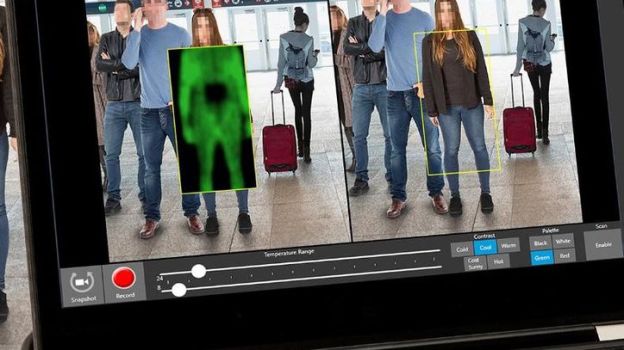
Terahertz radiation can penetrate fabrics and plastics, so it can be used in surveillance, such as security screening, to uncover concealed weapons on a person, remotely. This is of particular interest because many materials of interest have unique spectral “fingerprints” in the terahertz range…. In January 2013, the NYPD announced plans to experiment with the newfound technology to detect concealed weapons, prompting Miami blogger and privacy activist Jonathan Corbett to file a lawsuit against the department in Manhattan federal court that same month, challenging such use: “For thousands of years, humans have used clothing to protect their modesty and have quite reasonably held the expectation of privacy for anything inside of their clothing, since no human is able to see through them.” He seeks a court order to prohibit using the technology without reasonable suspicion or probable cause.