Tag Archives: united states

US Operations in North Africa – Strategic Instability

The Defense Department continues to work with nations in North Africa to promote security and increase stability in the region still feeling the effects of the Arab Spring, Amanda J. Dory, the deputy assistant secretary of defense for African affairs, told a Senate panel today. Libya, Tunisia, Algeria and Morocco are confronting instability and the U.S. military is working to build or strengthen their police and military forces, Dory told the Senate Armed Services Subcommittee on Near eastern and South and Central Asian Affairs….T

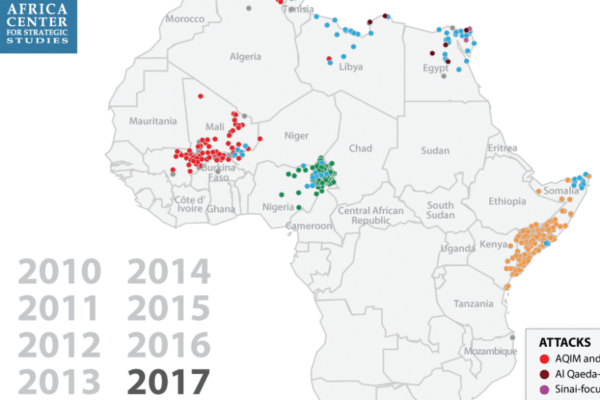
he effects of the Arab Spring in North Africa continue to reverberate within the region and beyond its borders into the Sahelian states of sub-Saharan Africa, she said. Libya remains a key source of instability in North Africa and the Sahel. After the overthrow of Muammar Gadhafi, there is little government infrastructure inside Libya, Dory said, and certainly no tradition of democracy.Violence is rampant in Libya and the Libyan government is too weak to control its borders and militias provide what security there is. Arms merchants are shipping Libyan weapons out of the country and these arms are fueling instability from Mali westward, Dory said…The United States will provide general-purpose-force military training for 5,000-8,000 Libyan personnel, Dory said.“This training effort is intended to help the [Libyan] government build the military it requires to protect government institutions and maintain order,” she said.  The training of Libyan military personnel may begin next year in Bulgaria.

In Morocco, Algeria and Tunisia, DOD maintains close military-to-military ties with their military counterparts. All three are engaged in a security dialogue with the United States and “they share our goals of countering terrorism and enhancing cross-border security,” Dory said…

Excerpts, By Jim Garamone, Military Continues Work With North African Countries American Forces Press Service, Nov. 21, 2013
US Military Laboratory, Djibouti

Other states, such as Singapore and Hong Kong, that also began as ports have diversified in recent decades, but not Djibouti. It lacks the skilled workforce to become a financial-services centre. Yet thanks to three unrelated developments it has turned into an ever more extraordinary transit hub

First, its backdoor leads to the world’s most populous landlocked country, Ethiopia, home to a fast-growing economy that needs access to the sea. Most of the food, oil and consumer goods imported for Ethiopia’s 83m-plus people passes through Djibouti. Instability in Ethiopia’s eastern neighbour, Somalia, and bad blood with Ethiopia’s other old enemy, Eritrea, mean that Djibouti is the only main transit option. Hence a new railway line to Addis Ababa, Ethiopia’s capital, is being built.

At the same time, freighters chugging between Europe and Asia have been seeking an alternative to their traditional halfway stop in Dubai, which involves a detour into the Gulf. Djibouti is more directly en route. In 2009 it spent $400m on a state-of-the-art container terminal, the only one in the region. In the five previous years, trade volume had already doubled and is set to do so again. To expand still more, Djibouti’s port authority is close to securing $4.4 billion from abroad for another five terminals which, it is hoped, will be ready in the next four years.

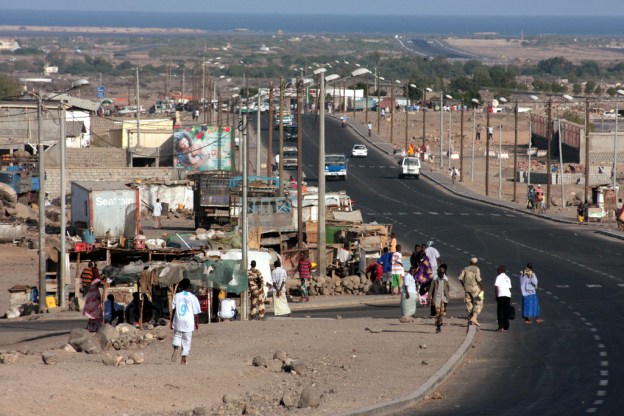
Third, the woes of Djibouti’s neighbours have brought the world’s most powerful navies to its shores. Piracy in Somalia and anti-terror campaigns on the Arabian peninsula, only 32km (20 miles) away across the water, have created what a new report by Chatham House, a London-based think-tank, calls an “international maritime and military laboratory”.The United States is the biggest lab rat. Djibouti hosts the only permanent American base in Africa, home to 3,200 people, not all of them naval. Since 2010, American drones have been flying from Camp Lemonnier, beside the main airport, making it the busiest base for drones outside Afghanistan. Some 50 military flights take off every day, including a squadron of F-15E jets, which arrived in 2011. The Pentagon has drawn up plans to spend $1.4 billion to expand the base and triple the number of its special forces there to more than 1,000.

France, the former colonial master, still guarantees Djibouti’s security and keeps 2,000 troops there. The port-state also hosts the biggest military presence of Japan and China outside Asia, both drawn by the fight against Somali piracy. Along with Western countries, they co-operate keenly to protect commercial vessels—though everyone spies on each other. Djibouti also often hosts security-minded delegations from Russia, Iran and India. Even in the cold war, rarely was neutral territory so colourful or crowded.

All this toing and froing has brought Djibouti windfall revenues. President Ismail Omar Guelleh, whose family has been in charge since independence in 1977, dishes out a good slice of it to the country’s small elite, which is gratefully compliant. The rest of the almost 1m inhabitants are among the poorest in Africa, with 60% of them unemployed.Rattled by the Arab spring and fearing that even minor instability could frighten away foreign military friends and investors, the president has embarked on a carefully staged course of political reform. During legislative elections in February a fifth of the seats were allocated in proportion to votes cast rather than under the previous winner-takes-all system that has long favoured the president’s allies.

Opposition parties were given access to state media and allowed to hold rallies. They won 16 out of 65 seats but then alleged fraud, leading to demonstrations, street clashes with the police and the incarceration of the leading protesters.

The Horn of Africa: Containers—and containing dissent, Economist, May 4, 2013, at 49