
Tag Archives: walled internet

U.S. CIA In China

The U.S. Central Intelligence Agency (CIA) released a new video on on Feb. 13, 2026 seeking to capitalize on upheaval at the top of China’s armed forces to recruit potential spies. The 95-second Mandarin-language video shows an officer walking through a military installation musing about ruthless power struggles at the top of the armed forces. “What the leaders are truly protecting is only their own selfish interests,” the narrator states. “Their power is built on countless lies. But now, these walls of lies are crumbling, leaving us only to clean up the mess.” The highly produced video was released less than a month after Chinese leader Xi Jinping purged two top generals, including his highest-ranking deputy in the military, Gen. Zhang Youxia

“Anyone with leadership ability will inevitably be feared and ruthlessly eliminated,” the narrator says. “I cannot allow these madmen to shape my daughter’s future world.”

Xi has removed more than 60 top officers and defense-industry executives since 2023…The turmoil has left the Central Military Commission, the top body that controls the military, with just two members: Xi himself and the head of the military’s body for internal investigations.

The video concludes with the officer opening a laptop while parked in an isolated spot and calling up a page that says “Contact the CIA” in Chinese. The closing credits display a CIA address on Tor, an anonymizing network.

The CIA posted the videos on YouTube, which is blocked in China, as are many other Western social-media and news sites. Those sites can be accessed using VPNs, and the CIA’s advertisements occasionally run in Hong Kong, where YouTube isn’t blocked.

CIA’s efforts in China were devastated between 2010 and 2012 when nearly 20 spies working for the CIA were executed or imprisoned, leaving the agency struggling to rebuild its human espionage capabilities in China.

Excerpt from CIA Seeks to Recruit Spies Out of China’s Military Turmoil, WSJ, Feb. 13, 2026
The Internet Was Never Open

Rarely has a manifesto been so wrong. “A Declaration of the Independence of Cyberspace”, written 20 years ago by John Perry Barlow, a digital civil-libertarian, begins thus: “Governments of the Industrial World, you weary giants of flesh and steel, I come from Cyberspace, the new home of Mind. On behalf of the future, I ask you of the past to leave us alone. You are not welcome among us. You have no sovereignty where we gather.”

At the turn of the century, it seemed as though this techno-Utopian vision of the world could indeed be a reality. It didn’t last… Autocratic governments around the world…have invested in online-surveillance gear. Filtering systems restrict access: to porn in Britain, to Facebook and Google in China, to dissent in Russia.

Competing operating systems and networks offer inducements to keep their users within the fold, consolidating their power. Their algorithms personalise the web so that no two people get the same search results or social media feeds, betraying the idea of a digital commons. Five companies account for nearly two-thirds of revenue from advertising, the dominant business model of the web.

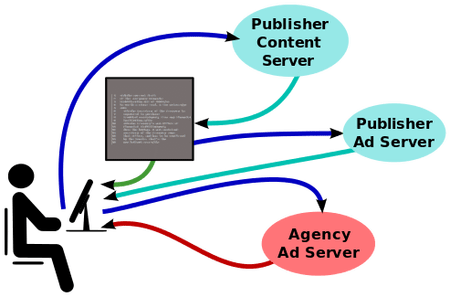
The open internet accounts for barely 20% of the entire web. The rest of it is hidden away in unsearchable “walled gardens” such as Facebook, whose algorithms are opaque, or on the “dark web”, a shady parallel world wide web. Data gathered from the activities of internet users are being concentrated in fewer hands. And big hands they are too. BCG, a consultancy, reckons that the internet will account for 5.3% of GDP of the world’s 20 big economies this year, or $4.2 trillion.

How did this come to pass? The simple reply is that the free, open, democratic internet dreamed up by the optimists of Silicon Valley was never more than a brief interlude. The more nuanced answer is that the open internet never really existed.

[T]e internet, it was developed “by the US military to serve US military purposes”… The decentralised, packet-based system of communication that forms the basis of the internet originated in America’s need to withstand a massive attack on its soil. Even the much-ballyhooed Silicon Valley model of venture capital as a way to place bets on risky new businesses has military origins.

In the 1980s the American military began to lose interest in the internet…. The time had come for the hackers and geeks who had been experimenting with early computers and phone lines.  Today they are the giants. Google, Apple, Facebook, Amazon and Microsoft—together with some telecoms operators—help set policy in Europe and America on everything from privacy rights and copyright law to child protection and national security. As these companies grow more powerful, the state is pushing back…

The other big risk is that the tension between states and companies resolves into a symbiotic relationship. A leaked e-mail shows a Google executive communicating with Hillary Clinton’s state department about an online tool that would be “important in encouraging more [Syrians] to defect and giving confidence to the opposition.”+++ If technology firms with global reach quietly promote the foreign-policy interests of one country, that can only increase suspicion and accelerate the fracturing of the web into regional internets….

Mr Malcomson describes the internet as a “global private marketplace built on a government platform, not unlike the global airport system”.

Excerpts from Evolution of the internet: Growing up, Economist, Mar. 26, 2016

+++The email said Google would be “partnering with Al Jazeera” who would take “primary ownership” of the tool, maintaining it and publicizing it in Syria.  It was eventually published by Al Jazeera in English and Arabic.