Tag Archives: X-51 WaveRider

Leveling: How a 5,000 km/h Speed Feels on Earthlings

Hypersonic missiles [weapons faster than the speed of sound]— specifically hypersonic glide vehicles and hypersonic cruise missiles — are a new class of threat because they are capable both of maneuvering and of flying faster than 5,000 kilometers per hour. These features enable such missiles to penetrate most missile defenses and to further compress the timelines for a response by a nation under attack.

Hypersonic missiles are being developed by the United States, Russia, and China. Their proliferation beyond these three could result in other powers setting their strategic forces on hair-trigger states of readiness. And such proliferation could enable other powers to more credibly threaten attacks on major powers.  The diffusion of hypersonic technology is under way in Europe, Japan, Australia, and India — with other nations beginning to explore such technology. Proliferation could cross multiple borders if hypersonic technology is offered on world markets.

There is probably less than a decade available to substantially hinder the potential proliferation of hypersonic missiles and associated technologies. To this end, the report recommends that (1) the United States, Russia, and China should agree not to export complete hypersonic missile systems or their major components and (2) the broader international community should establish controls on a wider range of hypersonic missile hardware and technology.rs.

The unavoidable requirement is for the United States, Russia, and China to agree on a nonproliferation policy. France could play a key role in bringing other governments into agreement on a broader control policy.

The technical and economic barriers to developing hypersonic technology are great enough to add to the effectiveness of a nonproliferation policy.

A two-tiered approach to containing the spread of hypersonic systems and components appears to be the most promising.

First, we recommend a policy of export denial for complete hypersonic delivery vehicles and enough major subsystems to effectively provide access to complete hypersonic missiles.

Second, given dual-use concerns, we also recommend a policy of case-by-case export reviews for scramjets and other hypersonic engines and components, fuels for hypersonic use, sensors, navigation, and communication items for hypersonic flight, hypersonic flight controls, design tools and modeling for such uses, and ground simulation and testing for hypersonic systems.

The necessary first step is for the United States, Russia, and China to agree not to export complete hypersonic missiles or their major subsystems.

Excerpts from Richard H. Speier et al., Hindering the Spread of a New Class of Weapons, Rand Corporation, Sept. 2017
Hypersonic Weapons

Payloads on hypersonic aircraft, whether they are weapons or sensors, could reach their destination within minutes, rather than hours, said Mark Lewis, former chief scientist of the Air Force and now director of the Science and Technology Institute at the Institute for Defense Analyses, a federally funded research-and-development center.  Hypersonic speed is generally defined as beginning at Mach 5, which is the point where aerodynamic heating caused by the speed of the vehicle cutting through the atmosphere becomes a factor.

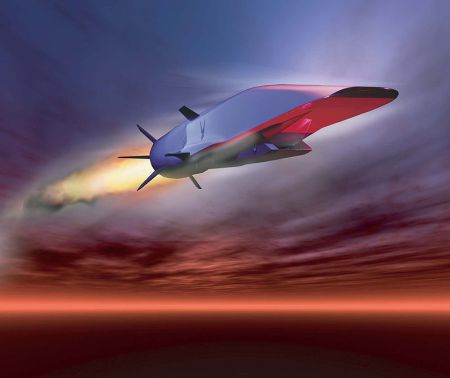
The Air Force concluded its successful X-51 WaveRider program in 2013. The final test had the missile-like aircraft flying at Mach 5.1 for about 200 seconds.  Meanwhile, the Army is testing the advanced hypersonic weapon, a missile designed for vertical launch. It suffered a failed test seconds after takeoff in August 2014, but that was caused by a faulty booster, not the missile or hypersonic technology itself, Lewis noted….

Hypersonic technology could be seen as a follow-on to stealth, Lewis said. Even if an aircraft has that kind of technology, it doesn’t mean it is invisible, he said. Adversaries are growing better at spotting stealthy aircraft, he said. Speed might compensate for that, he said. “If I can fly really fast, it makes it harder to act against me. It doesn’t make it impossible. But it makes it harder.”

Top Air Force leaders are indicating that they want to move hypersonic technology to the next level.  Air Force Chief of Staff Gen. Mark Welsh and Secretary Deborah Lee James in the document “America’s Air Force: A Call to the Future,” said hypersonic development was number one on the service’s list of top five technology priorities.  [T]the Air Force sees hypersonic weapons as a potential means to break through anti-access/area-denied battlefields where adversaries have robust defenses….

The Air Force will team with the Defense Advanced Research Projects Agency on two new hypersonic programs, he said. The first will be a cruise missile called HAWC, the hypersonic air-breathing weapons concept. The other is called tactical boost glide, which will accelerate an aircraft to Mach 5 plus speeds, then let it glide to its target.

Similarly, space planes could deliver payloads in minutes. The reusable space plane concept has been proposed many times over the years, and received a new lease on life when DARPA awarded three contracts to Boeing, Masten Space Systems and Northrop Grumman to study the idea of a two-stage launch system that could rapidly place 3,000 to 5,000 pounds into orbit. The Air Force has never given up on that idea, as evidenced by the new DARPA initiative, Lewis said.  Space planes have been talked about for decades, Lewis said. There have been many starts and stops in developing the concept, he added.

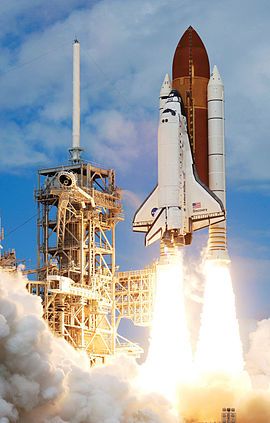
NASA’s space shuttle was originally conceived as a vehicle that could rapidly lift payloads into space at low cost, and be flexible and responsive. It never lived up to that promise.

The DARPA experimental spaceplane (XS-1) program envisions a reusable aircraft that could be launched from a mobile platform, and return 10 times within 10 days. It would employ a reusable first stage that would fly to Mach 10 at a suborbital altitude. At that point, one or more expendable upper stages would separate and deploy a satellite into low-Earth orbit.  While a space plane in low-Earth orbit could potentially be used as a weapon, it would more likely be employed as a means to rapidly replace satellites that have been damaged in a space war, or to place sensors over regions where there are currently no assets, Lewis said….

Meanwhile, more akin to the space shuttle than the DARPA concept for the space plane, the Air Force continues to use the X-37B, a top-secret orbiter that also glides to Earth. One has been in orbit since October 2012. The Air Force has repeatedly denied that it has, or is intended to be, weaponized. What its exact mission is remains classified

Excerpts from Stew Magnuson, Hypersonic Weapons Can Defeat Distance, National Defense Magazine, Nov.  2014