
Tag Archives: Jalisco New Generation cartel Mexico cocaine

For the Poor by the Poor: the Ethics of Cocaine Trade

The First Capital Command, known by its Portuguese initials PCC, started out as a disgruntled band of inmates fighting for soap and toilet paper in the 1990s.  It now has some 40,000 members behind bars and on the streets with a vast network of affiliates—making it the largest criminal group in the Americas by some estimates, operating in nearly 30 countries on every continent…With the scale of Italian organized criminal groups and the efficiency of a multinational corporation, the PCC has helped drive record cocaine seizures in Europe and sparked violent turf wars in the heart of major ports in Belgium and the Netherlands. 

 Unlike the narco-tycoons of Mexico, the heavily armed Colombian cocaine militias or the flashy drug lords of Rio de Janeiro’s Red Command gang, PCC members keep a low, businesslike profile, seeking fortune not fame—and shying away from the kinds of gratuitous violence that attract police and TV news crews. New recruits sign up to a strict internal code of conduct, their swearing-in ceremonies sometimes conducted by videoconference.

By adopting religious personas—pretending to be ministers—PCC figures have gone into far-flung regions of Brazil to gain the trust of locals and recruit new members, while securing routes to neighboring cocaine-producing countries…In 2023, prosecutors in Brazil’s northern state of Rio Grande do Norte investigated a PCC cell accused of setting up at least seven churches to launder drug money—a practice now so common that authorities have a name for it: narco-Pentecostalism. Drug profits are also laundered through gas stations, fintechs, real-estate funds, sex motels, car dealerships and construction firms…Few crimes are outside the PCC’s reach. Members today are involved in everything from illegal gold mining and cargo theft to cybercrimes and the trafficking of exotic birds…

When the PCC was born in August 1993 inside the grimy walls of the Taubaté high-security prison in São Paulo state, its founders weren’t seeking world domination. They demanded better sanitation and beds, among other basics. Brazil’s prisons were slum-like infernos—some of the world’s most overcrowded and violent, plagued by tuberculosis and lice—and rights groups said guards routinely beat inmates. Resentment was simmering at Taubaté after 111 inmates had months earlier been killed when police crushed a rebellion at another prison not far away…Alarmed by the growing jailhouse fraternity, authorities tightened prison controls and transferred inmates to other states. This only accelerated the PCC’s national expansion and hardened its resolve. “Peace, justice and freedom” became the PCC’s rallying call, as it cast itself as a parallel power to a state whose abuses—from prison officials to politicians—help the gang draw recruits….The PCC offers recruits a future in a system “made for the poor by the poor,” said Bruno Manso, a foremost authority on the gang and co-author of “The War: The Rise of the PCC and the World of Crime in Brazil.” Manso said the PCC provides what recruits feel they can’t get elsewhere: escape from “the utter misery of urban life.”

Excerpt from Samantha Pearson, How a Brazilian Prison Gang Became a Global Cocaine Power,WSJ, Apr. 23, 2026
The Mystique of Mexican Drug Cartels

Homicides in Latin America are driven by violent cartels. The impact of Mexican cartels is especially far reaching because they prey upon undocumented migrants along the US-Mexico border, violate human rights, and weaken political and economic institutions. However, cartels remain mysterious despite being a major employer. Because understanding how Mexican cartels function is essential to attenuating their power, Prieto-Curiel et al. conducted a sophisticated analysis that estimated their population size and examined factors driving cartel growth and shrinkage. Factors included “recruitment” (new cartel members join), “incapacitation” (police incarcerate or arrest members), “conflict” (cartels fight other cartels), and “saturation” (members leave). Findings suggest that reducing “recruitment” instead of increasing “incapacitation” is a much more effective policy to decrease violence. This is because cartels are one of the biggest employers in Mexico. Recruiting between 350 and 370 people per week is essential to avoid their collapse because of aggregate losses. 

Summary of Rafael Prieto-Curiel  et al., Reducing cartel recruitment is the only way to lower violence in Mexico, Science, Sept. 21, 2023

The New Underworld Order: Invincible Cartels

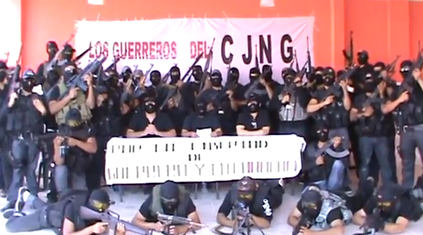
Nemesio “Mencho” Oseguera spent decades building his Jalisco New Generation Cartel into a transnational criminal organization fierce enough to forge a new underworld order in Mexico, displacing the Sinaloa cartel, torn by warring factions, as the world’s biggest drug pusher. The Sinaloans, Mexico’s top fentanyl traffickers, got caught in the crosshairs of the Trump administration, which promised to eradicate the synthetic opioid. The crackdown has left an open field for Jalisco and its lucrative cocaine trade, elevating Oseguera to No. 1.

The Jalisco cartel transports the cocaine by the ton from Colombia to Ecuador and then north to Mexico’s Pacific coast via speedboats and so-called narco subs…The U.S. has a $15 million bounty on Oseguera, but he rarely leaves his mountain compound, according to authorities. Few photos of him circulate. The cadre of men protecting Oseguera, known as the Special Force of the High Command, carry RPG 7 heat-seeking, shoulder-fired rocket launchers capable of piercing a tank, people familiar with cartel operations said. Visitors to the drug lord’s stronghold are hooded before they embark on the six-hour car trip through terrain sown with land mines, those people said. Locations of the pressure-activated explosives are known only by members of Oseguera’s inner circle.

The Jalisco cartel, which controls ports on Mexico’s Pacific coast, now uses routes and tunnels into the U.S. that are controlled by the sons of imprisoned drug kingpin Joaquín “El Chapo” Guzmán….
 
The cartel acts as a parallel government in the southwestern state of Jalisco and other parts of Mexico, taxing such goods as tortillas, chicken, cigarettes and beer, security experts said. It controls construction companies that build roads, schools and sewers for the municipal governments under cartel control.  A booming black market for fuel is another cash cow. Gasoline and diesel stolen from Mexican refineries and pipelines—or smuggled into Mexico from the U.S. without paying taxes—is sold at below market prices to small and large businesses.. The head of the Jalisco cartel’s fuel division is nicknamed “Tank” for his prowess at stealing and storing millions of gallons of fuel. 

Excerpst from Steve Fisher et al., America Loves Cocaine Again—Mexico’s New Drug King Cashes In, WSJ, Sept. 16, 2025