Monthly Archives: April 2026

Is Iran’s Crypto Economy Safe? Crypto’s Deceitful Name

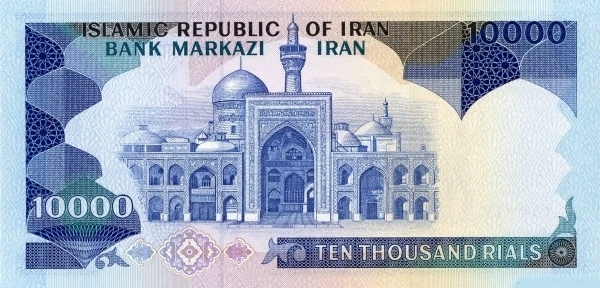
Iran’s demand that oil tankers pay transit tolls in cryptocurrency for passing through the Strait of Hormuz has cast a new light on the country’s $7.8 billion crypto economy and the role digital currencies play for regimes operating outside the mainstream financial system…The situation in Iran echoes that of Venezuela, where the stablecoin tether serves as both a tool for the state-run oil industry to circumvent sanctions and a lifeline for everyday people struggling against a devaluing currency, the bolivar.

The paramilitary Islamic Revolutionary Guard Corps has been among the most active users on Iran’s cryptocurrency market, often straining the country’s scarce electricity resources to mine bitcoin…Bitcoin isn’t the only cryptocurrency used by the Iranian regime. The Central Bank of Iran has acquired at least $507 million of tether—the world’s largest stablecoin pegged to the U.S. dollar—in an apparent bid to prop up the domestic currency and settle international tradet.

In the months leading up to the war, Iranians had increasingly migrated their bitcoin holdings from local crypto exchanges to their personal wallets, fearing state-imposed internet blackouts and financial seizures during domestic protests. And two days after the February 2026 airstrikes, total exchange outflows had reached about 10.3 million.. A 700% surge in outflows from Nobitex, Iran’s largest crypto exchange, within minutes of the initial U.S.-Israeli attacks on Iran. The exodus suggests that the people were withdrawing their funds and sending them to overseas crypto exchanges that typically draw tokens from Iranian accounts during moments of instability…. With more than 11 million users, Nobitex is the primary gateway for Iranian citizens to swap rials for tether, which they can convert into other currencies abroad. Last year, a pro-Israel hacking group called “Predatory Sparrow” drained more than $90 million from Nobitex. U.S. regulators have targeted Iran’s digital infrastructure before. In January 2026, the U.S. Treasury Department’s Office of Foreign Assets Control sanctioned two U.K.-registered crypto exchanges, Zedcex and Zedxion, for facilitating approximately $1 billion in transactions linked to the IRGC, according to TRM Labs.

Excerpt from Vicky Ge Huang, Iran’s $7.8 Billion Crypto Economy Finds New Way to Grow After Cease-Fire, WSJ, Apr. 9, 2026

Hook Them On. Then Cut Them Off

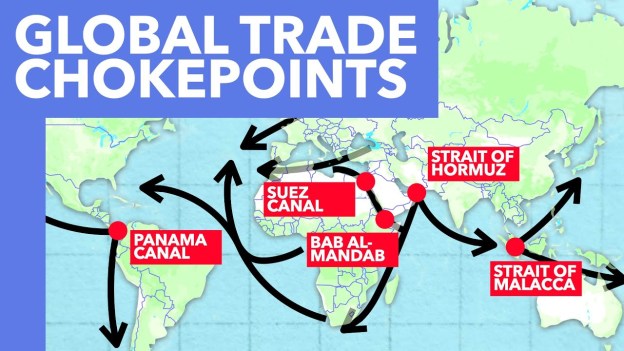
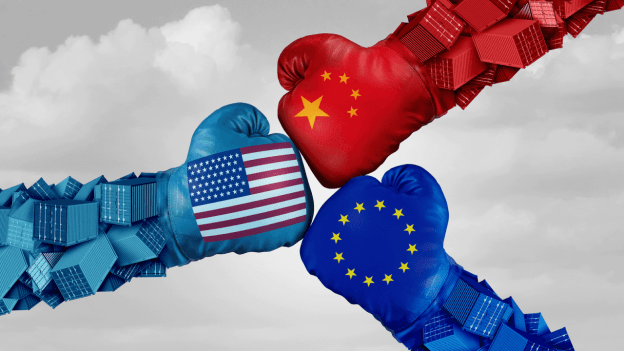
In exploiting the economic pinch-point off its coast, the strait of Hormuz, Iran is following a trail blazed by the U.S. and China, which for years have used their dominance in key areas of global commerce to pursue their foreign-policy goals…Officials and analysts say the goal is “strategic indispensability”—building deterrence by mutually assured economic destruction. “In order to have that deterrence, in order to say ‘don’t cut off what we need,’ you need to be able to say ‘I can cut off what you need,’ ” said Andrew Capistrano, a visiting research fellow at the Institute of Geoeconomics, a Tokyo-based think tank…

Larger economies can exploit pressure points that flow from their heft in the global economy. The U.S. has long used the dollar-based financial system to sanction individuals, businesses and governments. It has also used America’s grip on semiconductor technology to stymie China’s military and put the brake on Beijing’s ambitions to leapfrog the U.S. as the world’s biggest and most advanced economy.

China exercises its economic might through its near-total control of rare earths. Beijing used the supply chain of these minerals, which are critical in the manufacture of everything from jet fighters to smartphones, as leverage to pressure U.S. industries and win relief on trade and tariffs from Trump…To build deterrence, “you need to get other people hooked on your supply. You need to be part of this interconnected web of the global economy in order to have a seat at the table of power,” said Emily Benson, head of strategy at the advisory firm Minerva Technology Futures.

Excerpt from Jason Douglas, Iran Shows You Don’t Have to Be a Superpower to Wage Economic Warfare, WSJ, Apr. 9, 2026

For the Love of Motherland: the Case of Super Micro Computer

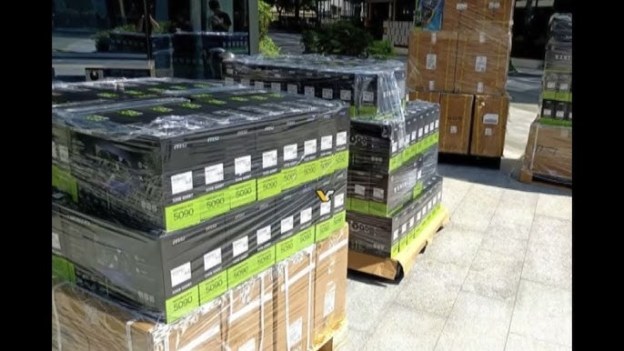
Wally Liaw is the co-founder of server maker Super Micro Computer whose servers contain high-powered Nvidia artificial-intelligence processors. Federal prosecutors say Liaw, 71, helped Chinese customers get $2.5 billion of those servers in violation of U.S. export-control laws. The indictment puts Liaw and Super Micro in the middle of the tech war between the U.S. and China. Based on the indictment Liaw facilitate the shipment of servers containing advanced Nvidia chips, a total $510 million worth of servers, to an Asian pass-through company. All these servers were diverted to China.

Prosecutors also described elaborate efforts to avoid detection. Executives including Liaw allegedly corresponded about bringing in 100 people, including forklift operators, and arranging meals and a 20-person shuttle bus to help stage dummy servers in warehouses before auditors came through. Prosecutors published photos showing one of Liaw’s deputies with an assistant who they said used a hair dryer to remove and affix labels and serial-number stickers to shipping boxes. The goal was to persuade inspectors, including one from the U.S. Commerce Department, that they were looking at genuine Super Micro servers with Nvidia chips inside. Liaw’s team took photographs of the staged servers to send to one of Super Micro’s compliance auditors, who was off-site enjoying entertainment paid for by the Asian pass-through company, the indictment says.

Excerpt from Robbie Whelan et al.,The Silicon Valley Salesman Accused of Helping China Get Nvidia’s Top Chips, WSJ, Mar. 21, 2026

In Your Bedroom and In Your Bathroom: META’s Glasses

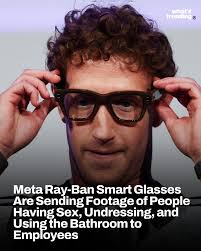
The META glasses—with chunky frames embedded with cameras and microphones—are the way Zuckerberg imagines AI will be democratized for personal users. Eventually, he wants to offer something akin to god-like superintelligence on demand. The promise of AI is that it will become more and more useful because such devices allow it to see and hear your daily life, gobbling up that information, processing it and using it to inform you about your life. But at what cost to privacy?

In March 2026, Meta was named in a lawsuit that seeks class-action status over concerns that data is being gathered from those glasses in ways that violate users’ privacy. The lawsuit, citing whistleblower complaints, alleges video captured on Meta’s devices are being routed to contractors in Africa to manually view and label the data to train Meta’s AI models. Among the videos in question? “People changing clothes, using the bathroom, engaging in sexual activity, handing financial information, and conducting other private activities inside their homes that no reasonable consumer would ever expect a stranger to watch,” the lawsuit said. 

Excerpt from Tim Higgins, The Backlash Against AI Devices That Are Always Watching, WSJ, Mar. 14, 2026

Chinese Billionaires Helping U.S. Billionaires

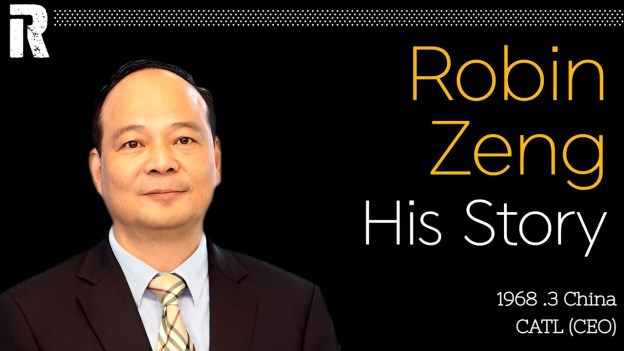
The United States has spent the past few years ghosting Robin Zeng, China’s fourth-richest man. To the U.S. government, Chinese battery maker CATL is a geopolitical threat to be warded off with tariffs and national-security curbs. Yet CATL has grown to become the world’s largest electric-vehicle battery manufacturer thanks to its technology and low costs. It posted record profit of more than $10 billion in 2025, and an estimated one in three EVs sold around the world carries its batteries. Ford recently ditched South Korea’s SK Group as its joint-venture partner for battery projects, focusing instead on its plan to build CATL-designed batteries at a $3 billion factory in Michigan. Ford is paying to license the Chinese company’s intellectual property, a workaround the U.S. allows while it puts up legal and political barriers to prevent CATL from building its own plants. General Motors is set to import China-made batteries from CATL and put them in its new Chevrolet Bolt—also legal, albeit only by swallowing a 60% tariff. And Tesla is using CATL technology for a battery plant in Nevada producing energy-storage systems, a business that is growing strongly while Tesla’s core EV business has stalled.

Critics of China argue that embedding a Chinese battery maker in the U.S. supply chain would make the U.S. even more vulnerable to Beijing’s economic coercion and undercut the chances of American battery companies catching up. CALT was placed in 2025 on a Pentagon list of companies working with China’s military.

Founded just 15 years ago, CATL benefited from a Beijing policy in the second half of the 2010s that gave Chinese EV makers subsidies if they used batteries from approved supplies such as CATL. It also received government money directly—more than $500 million in the first half of 2024 alone, according to CATL filings. Only state-owned petrochemical company Sinopec got more among mainland-China-listed companied. The iron-based battery chemistry, called lithium ferrophosphate, or LFP, costs up to 30% less a kilowatt-hour compared with nickel-manganese-cobalt batteries, the type South Korean and Japanese companies usually produce, industry experts say. In 2025, CATL developed an LFP battery with 500 miles of driving range that can be powered for up to 320 miles in just five minutes.

CATL’s technology is the reason Ford chose it for the Michigan factory tie-up, said Lisa Drake, a Ford executive on the project. “It probably would’ve taken us a decade to catch up and have LFP technology on our own,” Drake said in 2025.  She lamented that LFP batteries were invented in the U.S., but Chinese firms such as CATL figured out how to make them viable in cars. “We just didn’t commercialize that technology,” she said.

Excerpt from Yoko Kubota, The Chinese Billionaire Who Says America’s EV Market Is Doomed Without Him, WSJ, Mar. 23, 2026

World Bank Sorry for Mistakes of 30 Years

World Bank on March 17, 2026 confessed to an error of more than three decades duration, moving to embrace industrial policy as tariffs, subsidies and a variety of other interventions become increasingly popular with governments in search of growth. Back in 1993, the bank published an assessment of the rapid economic growth achieved by some economies in east Asia, and which appeared to owe something to government interventions in support of selected industries. The bank controversially concluded that their economic success had nothing to do with those interventions, which it instead described as a “costly failure.” As World Bank Chief Economist Indermit Gill wrote in a new report, that conclusion helped “stigmatize” industrial policy just as a leap forward in transport and communications technologies spurred a period of intense globalization. Instead, governments were encouraged to let markets operate without direction or barriers to trade, while keeping inflation low and budget deficits narrow and backing investment in education and vital infrastructure. “That advice has not aged well—it has the practical value of a floppy disk today,” wrote Gill.

Taking a fresh look at the evidence, the new report concludes that the South Korean government’s “big push” during the 1970s in support of heavy industry and chemicals has resulted in the economy being 3% larger each year. In other words, it was very much not a failure, nor was it particularly costly.

Despite the stigma, many economies never entirely lost faith in industrial policy. Indeed, China resorted to a wide variety of interventions during its period of record growth. In emulation, many rich economies—including the U.S.—have begun to implement industrial policies. “Industrial policy—the range of policy tools that governments use to shape what an economy produces rather than leave it to the discretion of markets alone—is back with a vengeance,” the bank said.

Excerpt from Paul Hannon, World Bank Embraces Industrial Policy, Abandoning Three Decades of Stigma, WSJ, May 17, 2026