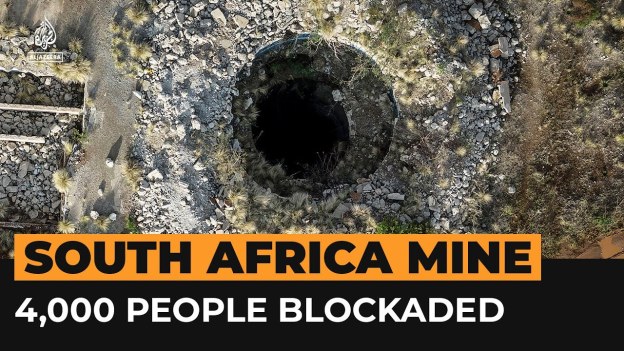
With hundreds of miners trapped below ground without food or water, two men from down the road volunteered to venture where no police, government officials or professional rescuers were willing to go.
On their first descent into the shaft this week, Mandla Charles and Mzwandile Mkwayi, wearing white hardhats, headlamps and T-shirts, stepped out of a red cage dangling on a cable from a crane on the surface 4,200 feet above them. Their lights illuminated a sea of emaciated faces, men crowded into a chamber who were crying and pleading to be saved from the pitch black of the abandoned Buffelsfontein gold mine. The miners’ lights had burned out weeks or months earlier. The volunteers made more than 30 round trips underground over the next three days, bringing up 246 living prospectors and the remains of 78 more. The cage, designed to hold six people in close confinement, lifted as many as 13 men to the surface on some trips.
“I can’t explain the smell down there,” Charles, 38, told The Wall Street Journal at the mine entrance in Stilfontein, 100 miles southwest of Johannesburg. “They told us they were eating human flesh and cockroaches. They had lost hope.” The rescue mission, which concluded January 16,2025 when no more survivors could be found, ended a monthslong standoff between miners who had been illegally digging for gold and a government determined to force them to the surface. The miners had been holed up since the police cut off their supplies of food and water in August 2024.
For about five months, the informal workers were trapped underground as police tried to “smoke them out,” in the words of Khumbudzo Ntshavheni, minister in the South African presidency. The operation was part of the police’s “Close the Hole” plan to combat illegal mining, which has reached crisis levels here. A staggering 42% unemployment rate in South Africa has led to high levels of chronic poverty, leaving many men with little choice but to clamber down gold shafts closed by some of the world’s biggest mining companies, in order to feed their families. The zama zamas are often the lowest-level workers for larger criminal gangs that ultimately sell the gold abroad.
Excerpts from Alexandra Wexler, Hundreds of Miners Were Trapped for Months—Until an Extraordinary Two-Man Rescue Mission, WSJ, Jan. 17, 2025
 Law-In-Action