Tag Archives: China suppy chain

While United States Sleeping, China Made Ships

A $16 billion merger of two state-controlled shipbuilders in China was set for completion the week of August 11, 2025 creating the world’s biggest shipbuilder while the U.S. searches for a path back into the business.  American shipbuilders are playing catch-up after decades of maritime-industry decline…but Trump’s threat to impose higher fees on ships made in China is giving South Korean and Japanese rivals an opening to win back market share.

The Chinese champion is called China State Shipbuilding, or CSSC. In August 2025, it is scheduled to absorb its merger partner, China Shipbuilding Industry, and take the sole listing on the Shanghai Stock Exchange… Beijing is currently looking to consolidate state-led companies in sensitive industries, particularly those connected with the military. CSSC’s main business is commercial, but it is also an important contractor for the Chinese navy. China Shipbuilding Industry designed and built China’s first homegrown aircraft carrier, the Shandong.

Beijing set its sights on dominating the shipbuilding industry decades ago, and now Chinese shipbuilders make up more than half of the global market. China-built ships accounted for about 55% of global tonnage in 2024, compared with less than 0.05% for the U.S. China possesses 232 times the shipbuilding capacity of the U.S., according to the U.S. Navy…


Meanwhile, smaller rivals in Japan are looking to reclaim market share after decades of being pushed into a corner by lower-cost Chinese and South Korean rivals. A proposal in June in 2025 from Japan’s ruling Liberal Democratic Party calls for extensive subsidies for local shipyards to protect national security, including a $6.7 billion public-private fund. “If we fail to act now, Japan risks losing its shipbuilding industry entirely, as Europe and the United States did,” the party said.

Excerpt from China Creates World’s No. 1 Shipbuilder, Driven by Rivalry With U.S., WSJ, Aug. 11, 2025


Out-of-Date: Academic Cooperation

Mr. Trump noted in the summer of 2025  that “the United States is in a race to achieve global dominance in artificial intelligence,” which Joe Biden called “a defining technology of our era.” Universities help drive that race. Meta’s chief AI officer, Alexandr Wang, has argued that the rate of AI progress may be such that “you need to prevent all of our secrets from going over to our adversaries and you need to lock down the labs.”

Thousands of Chinese citizens are working and studying in such labs….In AI specifically, nearly 40% of top-tier researchers at U.S. institutions are of Chinese origin. Beijing is aggressively cultivating American-educated and American-employed researchers via the Thousand Talents program.

Blindly embracing academic cooperation with a geopolitical rival is absurd. Nobody suggests we should train Iranian nuclear physicists or Russian ballistics engineers. The U.S. wouldn’t have been better off collaborating more with Nazi Germany in the 1930s or with the Soviet Union during the Cold War. Why make an exception for a nation dedicated to surpassing the U.S. in emerging technologies?

Excerpt from  Mike Gallagher, Send Harvard’s Chinese Students Home, WSJ, Aug. 19, 2025

The Battle to Block Access to AI

The U.S. is imposing some of its strongest measures yet to limit Chinese advances in artificial intelligence, requiring companies to get government approval to export certain information about their AI models and set up large AI computing facilities overseas.

The rules, in January 2025, are a final push by the Biden administration in a yearslong effort to use export controls to stem China’s advances in chip-making and AI, and they have sparked a backlash from companies including Nvidia. The rules impose caps on how many advanced AI chips can be exported to certain countries and require a license to export the data that underpins the most sophisticated AI systems.

Strict sales restrictions on these chips are already in place for China, Iran and other U.S. adversaries, and the new rules carve out exemptions for a group of 18 close U.S. allies and partners. These include countries such as the U.K., France and Germany, a senior administration official said. But a broad category of more than 120 other countries, including U.S. allies in the Middle East and Asia, are set to face new hurdles in setting up huge AI computing facilities.

While the impact of the rules isn’t yet clear, they threatened to limit sales of AI chips from Nvidia, which has built a large business out of satisfying demand for AI infrastructure in countries such as the United Arab Emirates and Saudi Arabia. Company officials said they expected to bring in almost $10 billion of revenue last year from so-called “sovereign AI,” where countries around the world increasingly see AI computing facilities as national assets.

Under the new rules, companies that produce AI models—the likes of OpenAI and Google—would need export licenses to send the “weights” attached to those models to many foreign countries. Model weights are the secret sauce in advanced AI systems like ChatGPT, a series of digital knobs that fine-tune their performance.

Excerpts from Asa Fitch and Liza Lin U.S. Targets China With New AI Curbs, Overriding Nvidia’s Objections, WSJ, Jan. 13, 2025

Crossing the Pacific: the Logistics of War

Every two weeks since 2023, US officers convene a classified intelligence briefing about fighting in the Red Sea. The attendees aren’t politicians, policymakers or spies. They are private shipping executives. The meetings are part of a push by the Pentagon’s Transportation Command, or Transcom, to integrate shipping lines as crisis supply lines. The policy stems from a dire need in an unloved but vital corner of America’s military behemoth. A House select committee in February 2024 called Transcom’s sea-cargo capacity “woefully inadequate.” The U.S. is investing heavily in new weapons systems, but missiles, warships and jet fighters are only a fraction of what the military worries about. Troops sent to battle also need food and water. Their equipment devours fuel and spare parts. Guns without ammunition are dead weight. Wounded fighters require evacuation.

Moving all of that—and keeping supplies flowing for months or years—demands vast and complex support infrastructure, broadly termed logistics. If it doesn’t function, even a battle-proven force will grind to a halt…China’s rise has exposed America’s shipping weakness. Beijing isn’t just Washington’s biggest military rival. It is also by far the world’s biggest logistics operation. Within China’s centrally directed economy, the government controls commercial shippers, foreign port facilities and a globe-spanning cargo-data network that in a conflict could be repurposed for military aims or to undermine the U.S., including on home soil. Transcom’s fleet of planes and cargo ships, meanwhile, is aging and insufficient.

In conflict with China, the Pentagon would send roughly 90% of its provisions by sea. Among 44 government-owned ships for moving vehicles that Transcom can tap, 28 will retire within eight years. Replacements have faced repeated delays. But military logistics isn’t “just logistics” because in wartime, supply lines are prime targets. During Russia’s assault on Kyiv in 2022, Ukrainians crippled Moscow’s forces by destroying their provisions.

Robust logistics, in contrast, can deter attacks. If adversaries believe the U.S. can quickly mobilize a massive response, they are less likely to initiate hostilities. During the Cold War, North Atlantic Treaty Organization allies routinely made a show of flooding Europe with American troops and gear before exercises.

The U.S. has decades of experience working with NATO allies to send military supplies to Europe for a potential conflict with Russia. Cargo ships generally need about two weeks to cross the Atlantic. For a conflict with China, logistics would be more complicated because distances are far greater. Crossing the Pacific takes much longer than the Atlantic, and shipping routes could face greater danger of attack.

In 1990, at the Cold War’s end, the U.S. had roughly 600 available merchant ships. In 1960, it had more than 3,000. China today has more than 7,000 commercial ships. Chinese entities own every sixth commercial vessel on the seas—including ships flying other countries’ flags—a share comparable only to Greece.

Excerpts from Daniel Michaels and Nancy A. Youssef, Pentagon’s limited capacity to support a potential China conflict forces planners to tap private cargo companies, WSJ, Nov. 1, 2024

China’s Nuclear Triad: Land, Sumbarines and Bombers

Based on United States Report released in 2020 “Military and Security Developments Involving the People’s Republic of China” by the Secretary of Defense, China’s progress in upgrading its strategic bombers to carry nuclear payloads puts it on the cusp of achieving a “triad” of delivery systems ((1) land-launched nuclear missiles, (2) nuclear-armed submarines, and (3) aircraft delivered nuclear bombs).  The development of a nuclear triad raises the long-term stakes in the complex relationship between Beijing and Washington. …The heavy emphasis on China’s nuclear improvements will probably be used by the Pentagon to press lawmakers and the public to support the massive reinvestment already underway in modernized nuclear weapons. This includes the B-21 bomber, an $85 billion Ground Based Strategic Deterrent ICBM program and the $128 billion Columbia-class ballistic missile submarine.

China’s defense ministry denounced the report as a document created with a “zero-sum-game mindset and Cold War mentality,” saying that the U.S. had “misinterpreted” the country’s nuclear policy and stirred up confrontation with Taiwan. “It’s extremely wrong and China firmly rejects it.”  As part of President Xi Jinping’s efforts to build a “world class” military by 2049, the Defense Department report said the People’s Liberation Army has already achieved parity with or exceeded the U.S. in at least three key areas: shipbuilding, land-based conventional ballistic and cruise missiles and integrated air defense systems.

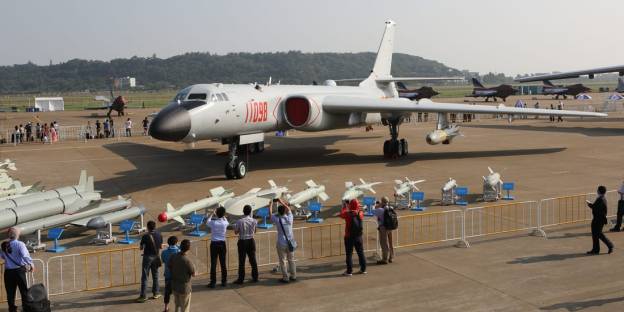
While the country has one overseas military base, in the East African nation of Djibouti, China’s government “is very likely already considering and planning for additional overseas military logistics facilities to support naval, air and ground forces…”.  China’s current nuclear arsenal includes 100 silo or road-mobile intercontinental ballistic missiles, as many as six Jin-class nuclear missile submarines capable of carrying 12 missiles each and a new air-refuelable H-6N long-range bomber. The bomber is an upgrade on a previous model and comes with a modified fuselage “that allows it to carry either a drone or an air-launched ballistic missile that may be nuclear-capable. 

Excerpts from Anthony Capaccio, Pentagon Warns China Is Nearing a Milestone in Nuclear Weapons Buildup, Bloomberg, Sept. 1, 2020

China denounced the Pentagon report. According to Xinhua, the Pentagon report is crowded with anti-China hogwash. Fear-mongering over China has always been the Pentagon’s trick to demand more appropriations from the U.S. Congress. A fabricated grave threat to world peace can also help Washington sell more weapons to its allies, and serves as an excuse for America’s pursuit of global domination…While Washington is selling its latest “China-scare” fiction to the world, it is hard to overlook such facts that the United States spent more on military than 144 countries combined in 2018 and maintains nearly 800 military bases in over 70 countries.

Excerpt from Commentary: Lies, conspiracies behind Pentagon’s China military report, Xinhua, Sept. 5, 2020


Trade in Human and Animal Hair in the 21st Century

“My outfit for the day determines what hair I will be wearing,” says Olayinka Titilope, a Nigerian wigmaker. She has a different peruke for each day of the month…She sells wigs for between $60 and $800. Those at the top end are made of human hair from Cambodia, she says.  Some African feminists argue that to wear a long, straight-haired wig or hair extension is to grovel to Western ideals of beauty. Yet wig-buyers in Nigeria seem to enjoy variety. Sellers advertise hair from everywhere. Brazilian is praised for its sheen and durability; Vietnamese, for its bounce; Mongolian, because it is easy to curl. One seller in Lagos offers “Italian posh hair” which is supposedly odour-free. Whatever the label says, much of the hair really comes from elsewhere, often China, a source some buyers deem downmarket.

It is hard even for the most conscientious hair-traders to trace where their wares came from. Most of the hair that reaches Africa travels via factories in China, where it is sorted and often treated, dyed or curled. Bundles of human hair may be bulked up with horse mane or goat thatch….“The demand for hair generally exceeds supply, fuelling an almost constant sense of scarcity,”…

In the past decade Myanmar has quadrupled the volume of hair it ships out and is now the world’s fourth-largest exporter. Nay Lin, a hair-trader in the former capital, Yangon, says he knows when the economy is bad because more women turn up at his shop to sell their tresses. …Some 500km north of Yangon, in the town of Pyawbwe, farmers who once harvested onions and chillies now spend their days unpicking hairballs. These are often gathered by door-to-door collectors, who buy hair from people’s combs and bathroom plugs. Some hairballs arrive in sacks from India and Bangladesh. Workers in Pyawbwe (which has earned the nickname “Hair City”) make about $1.20 a day untangling them and removing lice or white strands. This hair is so common in Chinese factories that it is referred to as “standard hair”. It costs more than the fake stuff, but less than locks cut straight from a head. “We call that stuff factory trash,” scoffs Ms Titilope, who insists that none of it goes into her products…

Excerpts from Nigeria’s demand for fancy wigs fuels a global trade, Economist, Aug. 15, 2020

Made in China, Always? COVID-19, the Survival of Resilience

As they walk through the valley of the shadow of death brought by COVID-19 chief executives and corporate strategists are beginning to look to the post-covid world to come. What they think they see, for good or ill, is an acceleration. Three existing trends—the deglobalisation unpicking the business world that grew up in the 2000s; the infusion of data-enabled services into ever more aspects of life; a consolidation of economic power into the hands of giant corporations—look likely to proceed at a faster rate than before, and perhaps to go further, too…

China’s government may encourage its state-owned firms to go global by buying distressed car companies in Europe. The share price of Daimler is less than half what it was when Geely, a Chinese carmaker, bought a 10% stake in 2018. Car companies may also see offers from technology giants keen to improve co-operation between metal bashers and the engineers of autonomy—currently wary at best. The healthier airlines, such as Qantas and IAG, owner of British Airways, will snap up airport slots from their bankrupt rivals and may try to acquire others only just staying aloft. Private-equity firms, which have mountains of committed investor cash, may start buying up fundamentally sound but impecunious suppliers in various industries, aware that when demand returns such companies will see its first fruits…

In 2019 many global firms sought to reduce their dependency on China. One of their favoured strategies was to put more business into factories elsewhere in Asia.  But the acute stage of China’s covid-19 crisis made it clear how essential China remains as a provider of inputs to such factories elsewhere in Asia and around the world. “What people thought was a global supply chain was a Chinese supply chain,”…

Joerg Wuttke, president of the EU Chamber of Commerce in China, says that if there is one lesson people are drawing from the pandemic in this regard it is that “single source is out and diversification is in.” In other words, companies do not just need suppliers outside China. They need to build out their choice of suppliers, even if doing so raises costs and reduces efficiency

Excerpts from Sinking, Swimming and Surfing, Economist,  Apr. 11, 2020, at 13