Tag Archives: facebook divisive content

The Role of Telegram in the Russia-Ukraine War

Russian authorities have reacted with unusual fury to the arrest of Telegram founder Pavel Durov by French authorities on August 2024. Telegram is more than a mere social-media app to Moscow. Russian soldiers and spies depend on it for battlefield communications, including the guidance of artillery, the coordination of movements and intelligence gathering. “Many are joking that the arrest of Pavel Durov is essentially the arrest of the chief signals officer of the Russian armed forces,” said Aleksey Rogozin, a Russian parliament adviser and former senior military industry executive.

“As wild as it sounds, the transmission of intelligence, the targeting of artillery, the broadcasting of drone feeds and many other things are currently very frequently done via Telegram,” Rogozin said on Telegram… 

Both the Russian and the Ukrainian militaries started relying on commercial platforms. While the Ukrainians prefer Western providers such as Signal or Discord, the Russians chose Telegram because it is based in the United Arab Emirates, which maintains good relations with Moscow. They think the app is more impervious to Western signals intelligence.

Russian volunteers who supply drones, night-vision scopes, vehicles and other aid to military units operate almost exclusively through Telegram. The service also has offered a lucrative social-media platform to Russian war propagandists, with millions of subscribers, who work in close cooperation with the Russian Ministry of Defense.

“The detention of Durov, by itself, wouldn’t have necessarily caused such a resonance in Russia, except for one circumstance. De facto, it is the main messenger of this war, an alternative to the classified military network,” Andrey Medvedev, a correspondent for Russian state TV and a deputy chair of the Moscow city council, wrote on Telegram…

The Russian government has reacted to Durov’s detention in France with far more outrage and fury than would be expected given the circumstances of the entrepreneur’s departure from Russia in 2014…The director of Russia’s SVR external intelligence service, Sergey Naryshkin, said recently that he expects Durov not to share with French and other Western governments any information that would harm the Russian state. “I very much count on him not to allow it,” the Russian spymaster said in an interview with TASS news agency.

Excerpt from Yaroslav Trofimov, Telegram Arrest Sows Russian War Worries, WSJ, Aug. 31, 2024
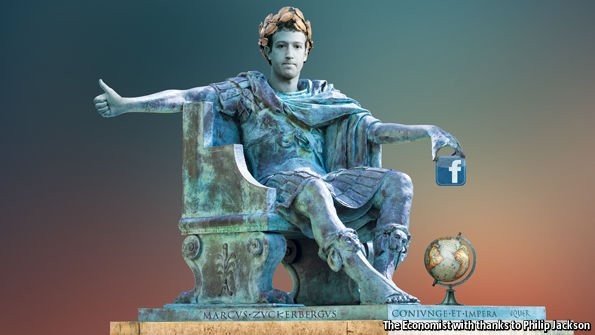
Genocide in the Empire of Mark Zuckerberg

Facebook failed to quickly stop the spread of hate speech and misinformation against the Rohingya people, in turn contributing to the persecution and alleged genocide of the minority community in Myanmar, according to a lawsuit filed in December 2021 in a California court that asks for more than $150 billion in compensation.
 
The class-action lawsuit against Meta, Facebook’s parent company, was brought by a Rohingya woman in Illinois on behalf of the 10,000-plus Rohingya refugees who have resettled in the United States since 2012. It alleges that Facebook’s algorithm amplified hate speech and that the company neglected to remove inflammatory content despite repeated warnings that such posts could foment ethnic violence.
A similar complaint against the tech giant is expected to be filed in a British court.

Myanmar’s military launched a “scorched-earth campaign” in 2017 to push Rohingya residents, who are mostly Muslim, out of Rakhine state. Some 750,000 Muslim men, women and children were driven out in a campaign of rape, murder and razed villages that a top United Nations official called a “textbook example of ethnic cleansing.” That year, Doctors Without Borders estimated that at least 6,700 Rohingya people had been killed as a result of the attacks. Around the same time, influential figures such as nationalist monks and top government officials posted or recirculated slurs against the Rohingya, while spreading falsehoods and doctored images that suggested some Rohingya burned their own villages and then blamed it on Myanmar security forces. Myanmar has denied the genocide accusations and has justified some actions on counterterrorism grounds.
 
In 2018, a U.N. report connected Facebook to the atrocities against the Rohingya people. According to the report:

“Facebook has been a useful instrument for those seeking to spread hate, in a context where, for most users, Facebook is the Internet. Although improved in recent months, the response of Facebook has been slow and ineffective. The extent to which Facebook posts and messages have led to real-world discrimination and violence must be independently and thoroughly examined.” 

After the publication of the UN Report, the region became a priority for the company, which began flooding it with resources in 2018… The platform said that it removed some 64,000 pieces of content in Myanmar that violated its policies against hate speech…“Not until 2018 — after the damage had been done — did Facebook executives … meekly admit that Facebook should and could have done more,” the lawsuit alleges. “Facebook is like a robot programed with a singular mission: to grow. And the undeniable reality is that Facebook’s growth, fueled by hate, division, and misinformation, has left hundreds of thousands of devastated Rohingya lives in its wake.”….

Backed by the Organization of Islamic Cooperation, Gambia asked a U.S. court to force Facebook to turn over data related to accounts it deleted in 2018 that fueled atrocities in Myanmar. After some legal wrangling, a federal judge in D.C. shot down the request  on December 3, 2021.

Excerpt from Amy Cheng, Rohingya refugees sue Facebook for $150 billion, alleging it helped perpetuate genocide in Myanmar, Washington Post, Dec. 7, 2021

Facebook Mobs and Facebook Profits

A Facebook team had a blunt message for senior executives. The company’s algorithms weren’t bringing people together. They were driving people apart. “Our algorithms exploit the human brain’s attraction to divisiveness,” read a slide from a 2018 presentation. “If left unchecked,” it warned, Facebook would feed users “more and more divisive content in an effort to gain user attention & increase time on the platform.”

That presentation went to the heart of a question dogging Facebook almost since its founding: Does its platform aggravate polarization and tribal behavior?  The answer it found, in some cases, was yes.  Facebook had kicked off an internal effort to understand how its platform shaped user behavior and how the company might address potential harms… 

But in the end, Facebook’s interest was fleeting. Mr. Zuckerberg and other senior executives largely shelved the basic research, according to previously unreported internal documents and people familiar with the effort, and weakened or blocked efforts to apply its conclusions to Facebook products…

An idea [proposed by those who wanted to reduce polarization at Facebook] was to tweak recommendation algorithms to suggest a wider range of Facebook groups than people would ordinarily encounter.  Building these features and combating polarization could have come, though, at the cost of lower engagement and it was “antigrowth” [meaning less profits for Facebook].

Excerpt from Jeff Horwitz and Deepa Seetharaman, Facebook Executives Shut Down Efforts to Make the Site Less Divisive, WSJ, May 26, 2020