Tag Archives: Fordow Iran

The Unintentional Making of a Global Power: Iran

In 2024, Iran, under Supreme Leader Ali Khamenei’s leadership, thwarted decades of U.S. pressure and emerged from years of isolation largely by aligning itself with Russia and China…Iran’s economy remains battered by U.S. sanctions, but oil sales to China and weapons deals with Russia have offered financial and diplomatic lifelines…Today, Tehran poses a greater threat to American allies and interests in the Middle East than at any point since the Islamic Republic was founded in 1979. 

Iran’s military footprint reaches wider and deeper than ever. Iranian-backed armed groups have hit Saudi oil facilities with missiles and paralyzed global shipping in the Red Sea. They have dominated politics in Iraq, Lebanon, Yemen and Syria, and launched the most devastating strike on Israel in decades, when Hamas attacked in October. Iran launched its first direct military attack from its soil on Israel in April 2024. It has also orchestrated attacks on opponents in Europe and beyond, Western officials say. 

“In many respects, Iran is stronger, more influential, more dangerous, more threatening than it was 45 years ago,” said Suzanne Maloney, director of the foreign-policy program at the Brookings Institution, who advised Democratic and Republican administrations on Iran policy. 

U.S. policy has at times unintentionally contributed to Iran’s strength. The 2003 toppling of Saddam Hussein removed a sworn enemy from Iran’s borders. Washington’s failure to stabilize postwar Iraq bolstered Tehran’s influence…

Excerpts from Sune Engel Rasmussen and Laurence Norman, How Iran Defied the U.S. to Become an International Power, WSJ, July 2, 2024
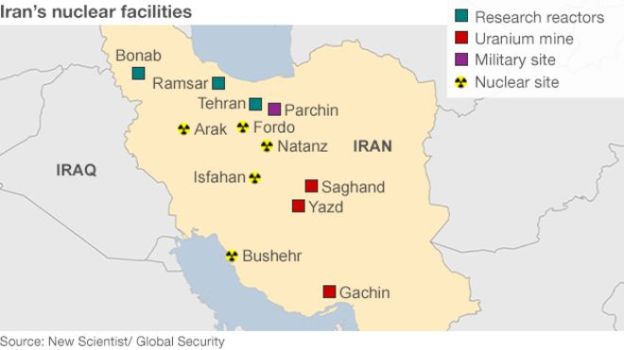
Nuclear Capability of Iran – Natanz, Fordow, Parchin

One [of the problems] is the ambiguity about what rights the Iranians will have to continue nuclear research and development. They are working on centrifuges up to 20 times faster than today’s, which they want to start deploying when the agreement’s [the currently negotiated agreement between Iran and United States/Europe]  first ten years are up. The worry is that better centrifuges reduce the size of the clandestine enrichment facilities that Iran would need to build if it were intent on escaping the agreement’s strictures.

That leads to the issue on which everything else will eventually hinge. Iran has a long history of lying about its nuclear programme. It only declared its two enrichment facilities, Natanz and Fordow, after Western intelligence agencies found out about them. A highly intrusive inspection and verification regime is thus essential, and it would have to continue long after other elements of an agreement expire. Inspectors from the IAEA would have to be able to inspect any facility, declared or otherwise, civil or military, on demand…

For a deal to be done in June 2015, Iran will have to consent to an [intrusive] inspection regime. It will also have to answer about a dozen questions already posed by the IAEA about the “possible military dimensions” of its nuclear programme. Yet on March 23, 2015Yukiya Amano, the agency’s director, said that Iran had replied to only one of those questions. Parchin, a military base which the IAEA believes may have been used for testing the high-explosive fuses that are needed to implode, and thus set off, the uranium or plutonium at the core of a bomb, remains out of bounds. Nor has the IAEA been given access to Mohsen Fakhrizadeh, the physicist and Revolutionary Guard officer alleged to be at the heart of the weapons development research. The IAEA’s February 19, 2015 report on Iran stated that it “remains concerned about the possible existence…of undisclosed nuclear-related activities…including activities related to the development of a nuclear payload for a missile.”

Excerpts from, The Iran Nuclear Talks: Not Yet the Real Deal, Economist, Apr. 4, 2015, at 43