The Houthis, predominantly Shia Muslims, and al-Shabaab operating from Somalia, which adheres to Sunni Islam, are among the hundreds of millions divided by a seventh-century schism over who was the rightful successor to the Prophet Muhammad. The sectarian split still flares into violence in spots from Afghanistan to Iraq to Syria. Common enemies, however, now unite the Houthis and al-Shabaab. “They hate the West, they hate Israel,” said Abdulaahi Mohamed Ali, a former Somali intelligence chief. The cooperation the Houthis and al-Shabaab has been strengthened through the exchange of expertise and coordination, particularly in facilitating the transfer of weapons and military equipment…
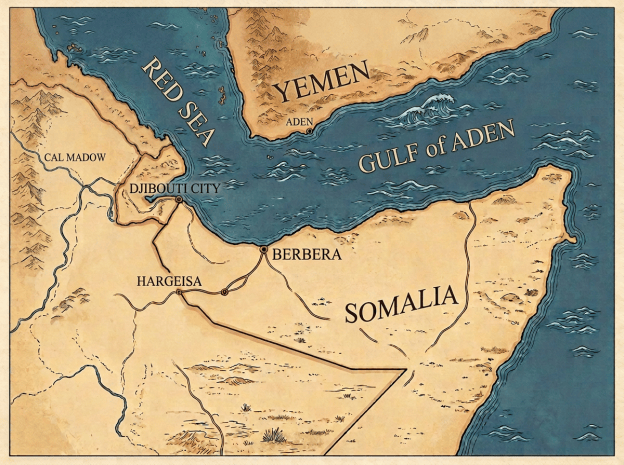
Complicating security concerns was Israel’s decision in December 2025 to recognize the independence of Somaliland, a region within the northwest of Somalia’s acknowledged borders that declared itself a separate country in 1991. Somaliland could provide Israel access to Berbera, a Red Sea port city with a runway so long that NASA once rented it as an emergency landing strip for the space shuttle. Berbera could give the Israelis another position where they could monitor and attack their Houthi enemies…
Al-Shabaab fighters regularly travel to Yemen for Houthi training to build more lethal roadside bombs as well as operate advanced weaponry. At least 100 al-Shabaab fighters have made the trip…. The U.N. reported in 2025 that al-Shabaab sends classes of about 30 militants to learn marksmanship, antiaircraft operations and techniques for making more lethal booby-trap bombs.
The Al-Shabaab brings in at least $100 million a year extorting money from Somali businesses and passersby at roadside checkpoints and the port of Mogadishu. Al-Shabaab also exploits artisanal gold mines along the northern Cal Madow Mountains, according to Abdullahi, the former Somali commander.
Excerpt from Michael M. Phillips, Al Qaeda-Houthi Alliance Stirs New Trouble for U.S., WSJ, Sept. 2, 2026


 A withering United Nations report on Yemen’s civil war provides fresh evidence about the extent to which Saudi Arabia and Iran have intervened in the conflict, pursuing their regional proxy war even as Yemen disintegrated into “warring statelets” that would be difficult to reunite. The U.N. panel said there were “strong indications of the supply of arms-related material manufactured in, or emanating from, the Islamic Republic of Iran,” in violation of a U.N. embargo on Yemen.
