Tag Archives: Gaza drones

How to Make Money No Matter What

Sales of U.S. weapons to Israel have surged since October 2023, with Washington approving more than $32 billion in armaments, ammunition and other equipment to the Israeli military…Israel responded to the Oct. 7, 2023, attack led by Hamas, which killed about 1,200 people and took 251 hostages, with a military invasion that has killed more than 68,000 people in Gaza—including more than 18,000 children—according to Gaza health authorities…The fighting throughout the region has presented a fresh opportunity for defense companies in the American heartland and, to a lesser extent, tech giants on the West Coast…

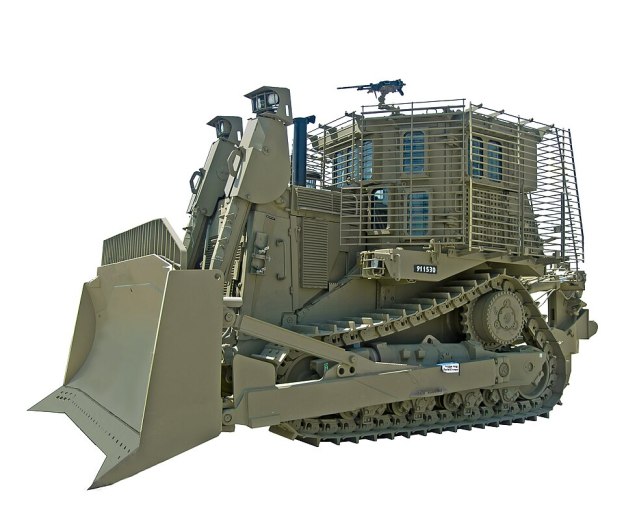
The American company that has brought in the most Israeli business since the Gaza war began is Boeing. The U.S. greenlighted an $18.8 billion sale of Boeing F-15 strike fighters in 2024 to Israel for delivery beginning in 2029. In 2025, various partnerships in which Boeing plays a leading role got approval for $7.9 billion of sales of guided bombs and associated kits…The biggest defense sales approved by Washington are for jet fighters and airborne-guided bombs, reflecting the crucial role of aerial bombings in the conflict…Israel’s Eitan armored fighting vehicles, which have been used widely across Gaza, are equipped with a hull from Wisconsin-based Oshkosh and an engine made by Rolls-Royce’s U.S. unit in Michigan. Caterpillar’s D9 armored bulldozers—used to clear rubble and destroy residences and other structures in Gaza—have been ubiquitous.

In some cases, companies have faced a backlash from investors and employees over their sales to the Israeli military. In 2024, three Norwegian investment funds have sold their stakes in Oshkosh, Palantir Technologies, Caterpillar and Thyssenkrupp over the use of their products for the war in Gaza. On Oct. 1 2025, Dutch pension fund ABP—the biggest in the Netherlands, with more than $400 billion under management—sold its €387 million, or $448 million, stake in Caterpillar, citing concerns over Gaza.

In September 2025, Microsoft disabled the Israeli Defense Ministry’s access to some cloud services in response to staff protests. Before the war began, Microsoft and a partnership between Alphabet-owned Google and Amazon.com had clinched deals with Israel to provide artificial-intelligence and cloud-computing services to the military. Meanwhile, AI giant Palantir, co-founded by Trump ally Peter Thiel, entered into a partnership with the Israeli Defense Ministry in January 2024. At a May 2025 conference, Palantir Chief Executive Alex Karp responded to accusations from a protester that Israel used Palantir’s technology to kill Palestinians, saying that those who were killed were “mostly terrorists.”

American companies have also found business opportunities in responding to the humanitarian crisis sparked by the war. The U.S. State Department said in June 2025 that it had allocated $30 million to the Gaza Humanitarian Foundation, led by former Trump adviser Johnnie Moore, to oversee aid handouts. The foundation hired American contractors Safe Reach Solutions and UG Solutions to provide security for the distribution efforts, which have been beset by dysfunction and violence.

In its 2025 annual report, Lockheed Martin said it had benefited from increased American defense funding related to Israel and Ukraine, notably munitions purchases. Revenue at its missiles division rose 13% last year to $12.7 billion…Armored-vehicles maker Oshkosh said an Israeli order of tactical vehicles had extended the lifespan of a production line that was due to shut in 2024.  In its latest 2025 report, Italian contractor Leonardo, whose U.S. unit is selling tanker trailers to Israel, said its international sales should remain stable in 2025 because of “the continuing conflicts in both Ukraine and Israel.”

Excerpt from Benoit Faucon, The Gaza War Has Been Big Business for U.S. Companies, WSJ, Nov. 12, 2025
Drone War 2014 – Covert and Lethal

A UN counter-terrorism expert has published the second report of his year-long investigation into drone strikes, highlighting 30 strikes where civilians are reported to have been killed.  The report, by British lawyer Ben Emmerson QC, identifies 30 attacks between 2006 and 2013 that show sufficient indications of civilian deaths to demand a ‘public explanation of the circumstances and the justification for the use of deadly force’ under international law.

Emmerson analysed 37 strikes carried out by the US, UK and Israel in Afghanistan, Pakistan, Yemen, Somalia and Gaza, to arrive at a ‘sample’ of strikes that he believes those nations have a legal duty to explain.

Britain and the US conduct strikes as part of the armed conflict in Afghanistan, and the US also conducts covert strikes in Pakistan, Yemen and Somalia.  Although Israel has never officially acknowledged using armed drones, Emmerson met with Israeli officials in the course of preparing his report and lists seven attacks in Gaza among those requiring investigation.

This report expands on an argument for the legal obligation for states to investigate and account for credible claims of civilian casualties, which Emmerson first laid out in his previous report, presented to the UN General Assembly in October (2013).

He writes: ‘in any case in which there have been, or appear to have been, civilian casualties that were not anticipated when the attack was planned, the State responsible is under an obligation to conduct a prompt, independent and impartial fact-finding inquiry and to provide a detailed public explanation of the results.

A February 2010 attack in Afghanistan serves as a ‘benchmark’ of the kind of disclosure that should follow claims of civilian casualties. After a US drone attack on a convoy of trucks reportedly killed up to 23 civilians, the International Security Assistance Force (Isaf), which runs international operations in Afghanistan, partially declassified the findings of its internal investigation. Emmerson writes that this report strongly criticised the crew’s actions and revealed ‘a propensity to “kinetic activity” [lethal action]‘.  This level of transparency is rare.

The most recent incident featured in Emmerson’s report is a December 2013 attack that hit a wedding procession near Rada’a in Yemen, killing at least 12. Multiple sources have identified numerous civilian casualties among the dead, including a Human Rights Watch investigation published last week.   Three unnamed US officials told Associated Press after the publication of Human Rights Watch’s report that an internal investigation had found only alleged militants were killed – but no results of this investigation have yet been officially released.

Information is particularly scarce for activity in Somalia, Emmerson notes. The only strike from the country in the report is the February 2012 strike that killed former British citizen Mohamed Sakr, whose case the Bureau has reported on as part of its investigation into the British government’s deprivation of citizenship.

Neither the US nor the UK routinely publish details of their drone operations. The UK states that it has killed civilians in only one incident in Afghanistan, a March 2011 strike that killed four civilians.  The US has repeatedly dismissed the Bureau’s estimate that at least 400 civilians have died in Pakistan drone strikes as ‘ludicrous’; the CIA director John Brennan has said that claims of high civilian casualties amount to ‘disinformation’.

Emmerson notes that operations that kill civilians are not necessarily illegal under international law, but states have a duty of transparency where there are credible allegations of non-combatants being harmed.  The report does not take a position on the legality of drone strikes away from the battlefield, but says there is an ‘urgent and imperative need’ for international agreement on the legal arguments advanced in favour of covert lethal action.

The US has argued that its strikes are legal on two grounds: they are legitimate acts of self-defence against an imminent threat, and they are part of an armed conflict against an enemy, al Qaeda, and its ‘associated forces’. Emmerson asks a series of questions – about the thresholds for action in self-defence, the definition of ‘imminent’ threat, al Qaeda’s current state, and more – on which he says the international community must reach consensus.  Last week the European Parliament voted 534 to 49 in favour of a motion calling on the EU to develop a ‘common position’ on drone strikes and other targeted killings.  To date, Europe has remained largely silent on the issue, but the motion expressed ’grave concern’ over drone strikes ‘outside the international legal framework’ and called on member states not to ‘facilitate such killings by other states’.

The UK has refused to clarify whether it shares intelligence with the US that could lead to drone strikes in Pakistan; in January the Court of Appeal ruled that any attempt to force the government to disclose such information could endanger international relations. In December, Emmerson told a meeting in parliament that such intelligence-sharing is ‘inevitable’ owing to the closeness of the relationship between the US and UK. ‘It would be absurd if it were not the case,’ he added.

Alice K. Ross, UN report identifies 30 drone strikes that require ‘public explanation, Bureau of Investigative Journalism, Mar. 1, 2014