Tag Archives: Israel drones

Israel’s Killing Machine and the Enemies Within

Israel stunned and hobbled Iran starting on June 13, 2025 when it pulled off an intelligence and military operation years in the making that struck high-level targets with precision. Guided by spies and artificial intelligence, the Israeli military unleashed a nighttime fusillade of warplanes and armed drones smuggled into Iran to quickly incapacitate many of its air defenses and missile systems. With greater freedom to fly over Iran, Israel bombarded key nuclear sites and killed top generals and scientists. By the time Iran mustered a response hours later, its ability to retaliate — already weakened by past Israeli strikes — was greatly diminished.

The Mossad and the military worked together for at least three years to lay the operational groundwork…To further diminish Iranian air defenses and missile systems, Mossad agents had smuggled precision weapons into Iran that were prepositioned to strike from close range…Those weapons included small, armed drones, which agents snuck into the country in vehicles…Mossad agents stationed weapons close to Iranian surface-to-air missile sites…To analyze information gathered from various sources, Israel used the latest artificial-intelligence…AI was used to help Israelis quickly sift through troves of data they had obtained….An investigation by The Associated Press conducted in early 2025 uncovered that the Israeli military uses U.S.-made AI models in war to sift through intelligence and intercept communications to learn the movements of its enemies. It’s been used in the wars with Hamas in Gaza and with Hezbollah in Lebanon.

In addition to AI, the Mossad relied on spies to identify top nuclear scientists and members of Iran’s Revolutionary Guard… At least eight members of the Guard, including the head of its missile program, were killed in a single Israeli strike on an underground bunker.

Another facet of the attack was to strike Iranian vehicles used to transport and launch missiles. The strategy was similar to a Ukrainian operation earlier this month in Russia. In that operation, nearly a third of Moscow’s strategic bomber fleet was destroyed or damaged with cheaply made drones snuck into Russian territory…In an interview with Iranian state-run television, the country’s police chief, Gen. Ahmadreza Radan, said “several vehicles carrying mini-drones and some tactical drones have been discovered.” ….

In the 2000s, Iranian centrifuges used for enriching uranium were destroyed by the so-called Stuxnet computer virus, believed to be an Israeli and American creation….In 2018, Israel stole an archive of Iranian nuclear research that included tens of thousands of pages of records…In July 2024, Israel killed a senior leader of Hamas, Ismail Haniyeh, with a bomb in a bedroom of a government guesthouse in Tehran.

Excerpts from JULIA FRANKEL and SAM MEDNICK, How Israel used spies, smuggled drones and AI to stun and hobble Iran, AP, June 17, 2025

Flying off the Shelves: the entrenching of drone warfare

A 2018 report published by Drone Wars UK reveals that over the last five years the number of countries actively using armed drones has quadrupled. Drone Wars: The Next Generation demonstrates that from just three states (US, UK and Israel) in 2013, there are now a further nine who have deployed armed drones in a variety of roles including for armed conflict and counter-terror operations. The report also shows that a further nine states are very close to having armed drone capabilities, almost doubling the number of existing users. To this number, we have added five non-state actors who have used armed drones, which will take the number of active operators of armed drones to over 25 in the next few years.

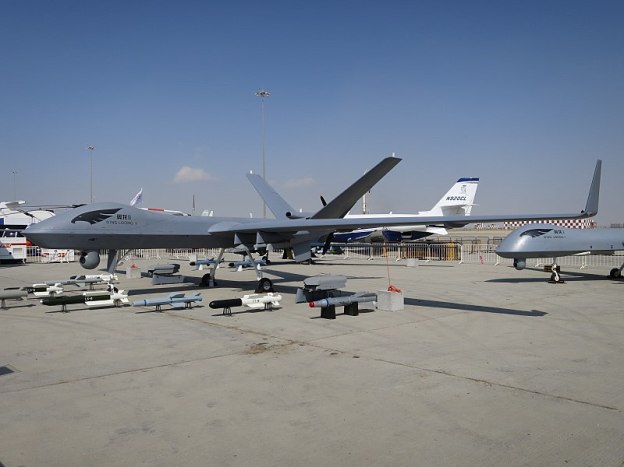
As is well known, China has sold armed drones to a number of countries around the world. Since 2013, Nigeria, Pakistan, Saudi Arabia, Iraq, UAE and Egypt have begun operating armed Chinese drones whilst another four countries (Jordan, Myanmar, Kazakhstan and Turkmenistan) are thought to have recently taken possession of, or be in discussion about the sale of, Chinese drones. These Wing Loong and CH series drones are cheaper and less powerful than US Predators and Reapers.  As, according to their specifications, they are not capable of delivering a payload of at least 500 kg to a range of at least 300 km they do not fall into the category of systems that would be refused under Category 1 of the Missile Technology Control Regime (MTCR) as the US systems do.

Turkey, Pakistan and Iran are actively using their own manufactured drones. Iran has, it seems, supplied Hamas, Hezbollah and the Houthis with armed drones while ISIS and the PKK  (Kurdistan Workers’ Party) have attached small explosives to off-the-shelf drones. Turkey are thought to be concluding deal with Qatar and the Ukrain eand South Korea are very close to beginning production of their own armed drones.

As for the larger countries that one might expect to have already deployed armed drones, such as Russia and India, they still appear to be some distance from producing workable models…Several cross-European projects are underway to develop indigenous armed drones within the EU.

Excerpts from New research shows rise in number of states deploying armed drones, Press Release from Drone Wars UK, May 17, 2018

Drone War 2014 – Covert and Lethal

A UN counter-terrorism expert has published the second report of his year-long investigation into drone strikes, highlighting 30 strikes where civilians are reported to have been killed.  The report, by British lawyer Ben Emmerson QC, identifies 30 attacks between 2006 and 2013 that show sufficient indications of civilian deaths to demand a ‘public explanation of the circumstances and the justification for the use of deadly force’ under international law.

Emmerson analysed 37 strikes carried out by the US, UK and Israel in Afghanistan, Pakistan, Yemen, Somalia and Gaza, to arrive at a ‘sample’ of strikes that he believes those nations have a legal duty to explain.

Britain and the US conduct strikes as part of the armed conflict in Afghanistan, and the US also conducts covert strikes in Pakistan, Yemen and Somalia.  Although Israel has never officially acknowledged using armed drones, Emmerson met with Israeli officials in the course of preparing his report and lists seven attacks in Gaza among those requiring investigation.

This report expands on an argument for the legal obligation for states to investigate and account for credible claims of civilian casualties, which Emmerson first laid out in his previous report, presented to the UN General Assembly in October (2013).

He writes: ‘in any case in which there have been, or appear to have been, civilian casualties that were not anticipated when the attack was planned, the State responsible is under an obligation to conduct a prompt, independent and impartial fact-finding inquiry and to provide a detailed public explanation of the results.

A February 2010 attack in Afghanistan serves as a ‘benchmark’ of the kind of disclosure that should follow claims of civilian casualties. After a US drone attack on a convoy of trucks reportedly killed up to 23 civilians, the International Security Assistance Force (Isaf), which runs international operations in Afghanistan, partially declassified the findings of its internal investigation. Emmerson writes that this report strongly criticised the crew’s actions and revealed ‘a propensity to “kinetic activity” [lethal action]‘.  This level of transparency is rare.

The most recent incident featured in Emmerson’s report is a December 2013 attack that hit a wedding procession near Rada’a in Yemen, killing at least 12. Multiple sources have identified numerous civilian casualties among the dead, including a Human Rights Watch investigation published last week.   Three unnamed US officials told Associated Press after the publication of Human Rights Watch’s report that an internal investigation had found only alleged militants were killed – but no results of this investigation have yet been officially released.

Information is particularly scarce for activity in Somalia, Emmerson notes. The only strike from the country in the report is the February 2012 strike that killed former British citizen Mohamed Sakr, whose case the Bureau has reported on as part of its investigation into the British government’s deprivation of citizenship.

Neither the US nor the UK routinely publish details of their drone operations. The UK states that it has killed civilians in only one incident in Afghanistan, a March 2011 strike that killed four civilians.  The US has repeatedly dismissed the Bureau’s estimate that at least 400 civilians have died in Pakistan drone strikes as ‘ludicrous’; the CIA director John Brennan has said that claims of high civilian casualties amount to ‘disinformation’.

Emmerson notes that operations that kill civilians are not necessarily illegal under international law, but states have a duty of transparency where there are credible allegations of non-combatants being harmed.  The report does not take a position on the legality of drone strikes away from the battlefield, but says there is an ‘urgent and imperative need’ for international agreement on the legal arguments advanced in favour of covert lethal action.

The US has argued that its strikes are legal on two grounds: they are legitimate acts of self-defence against an imminent threat, and they are part of an armed conflict against an enemy, al Qaeda, and its ‘associated forces’. Emmerson asks a series of questions – about the thresholds for action in self-defence, the definition of ‘imminent’ threat, al Qaeda’s current state, and more – on which he says the international community must reach consensus.  Last week the European Parliament voted 534 to 49 in favour of a motion calling on the EU to develop a ‘common position’ on drone strikes and other targeted killings.  To date, Europe has remained largely silent on the issue, but the motion expressed ’grave concern’ over drone strikes ‘outside the international legal framework’ and called on member states not to ‘facilitate such killings by other states’.

The UK has refused to clarify whether it shares intelligence with the US that could lead to drone strikes in Pakistan; in January the Court of Appeal ruled that any attempt to force the government to disclose such information could endanger international relations. In December, Emmerson told a meeting in parliament that such intelligence-sharing is ‘inevitable’ owing to the closeness of the relationship between the US and UK. ‘It would be absurd if it were not the case,’ he added.

Alice K. Ross, UN report identifies 30 drone strikes that require ‘public explanation, Bureau of Investigative Journalism, Mar. 1, 2014