Tag Archives: non-proliferation treaty

The Never-Ending Nuclear Arms Race

The United States Los Alamos National Laboratory (LANL) announced in October 2024 it had manufactured its first plutonium “pit”—used in the core of a thermonuclear warhead to initiate an nuclear explosion—since the United States largely halted such production in 1989. Under a nuclear arsenal modernization plan launched in 2008, the lab will scale up production to 30 pits per year, with an additional 50 to be produced annually starting in the mid-2030s at the Savannah River Site in South Carolina. But the work faces opposition from critics who say it could help fuel a new international nuclear arms race and also risks the health of workers and the environment. In September 30 2024, opponents won a ruling in federal district court in South Carolina when a judge ruled the U.S. Department of Energy failed to adequately consider other options for locating the production facilities. The judge is considering a request to pause production at LANL. The United States halted pit manufacturing in 1989 at the Rocky Flats Plant, near Denver, after an inspection revealed hazardous waste contamination.

Excerpt from U.S. resumes making nuke triggers, Science, Oct. 11, 2024
Lasers for Nuclear Weapons

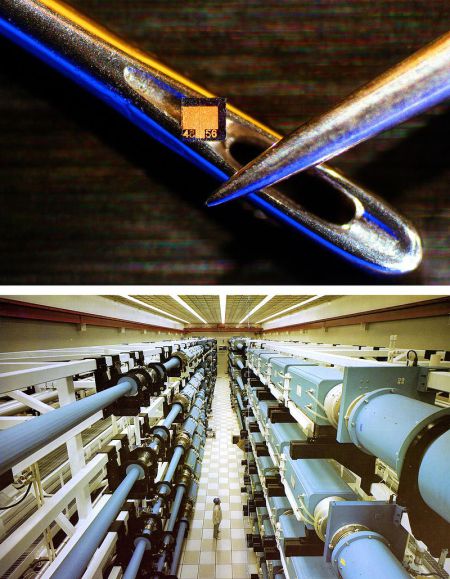
 Using spinning gas centrifuges to enrich fuel for nuclear bombs requires a structure the size of a department store, and enough electricity for some 10,000 homes. An alternative method being developed would make the search far more difficult...The alternative is to zap the uranium vapour with a powerful infra-red beam from a laser…At least 27 countries, by one tally, have worked on laser enrichment since the 1970s. Most gave up, largely because production batches were tiny. Now, however, two firms say that they have learned how to scale up the process.

Jeffrey Eerkens of Neutrek, a Californian research firm, says its laser process requires around half the space and electricity that centrifuges need. A competing laser method is offered by Global Laser Enrichment (GLE), a consortium of General Electric, Hitachi and Cameco, a Canadian uranium producer. It, too, requires less space. In 2012 GLE was awarded a licence to build a facility in North Carolina for the commercial production of reactor fuel.

America has classified the technology, but that may not stop it spreading. The most important bit of laser-enrichment know-how has already leaked, says Charles Ferguson, head of the Federation of American Scientists—namely, that companies now consider it to be practical. This will reinvigorate efforts by other countries to develop the technology for themselves….

Non-proliferation optimists think laser-enrichment might not work as well as advertised, because GLE has still not begun commercial production. But this may be only temporary, because the company says the price of enriched uranium is too low to justify completing the project. A regime keen for a more discreet path to the bomb would not bother with such considerations.

Monitoring nuclear weapons: Lasering the fuel, Economist Technology Quarterly,  Sept. 5, 2015