Tag Archives: Nvidia chips

Nationalizing a Crown Jewel: the case of Nexperia

U.S. officials’ warning to their Dutch counterparts was stark: If they wanted a Netherlands-based chip maker to avoid being put on a trade blacklist, it would almost certainly have to remove its Chinese owner as CEO. “The fact that the company’s CEO is still that same Chinese owner is problematic,” American officials said in a June 2025 meeting on the topic. The Americans soon got their wish. In September 25, 2025, the Dutch economy ministry seized control of Nexperia from China’s Wingtech Technology. The next day, a Dutch court granted an emergency petition to suspend Wingtech founder Zhang Xuezheng as Nexperia’s CEO and put all but one of the semiconductor company’s shares under external management.

China quickly fired back at the seizure, ordering Wingtech in early October to suspend exports of Nexperia of chips that the company has long sent for packaging and testing in China…The Dutch economy minister said in a letter to parliament that he moved to seize control of Nexperia based on evidence that the CEO was moving quickly to shift production capacity, financial resources and intellectual property to China, not because of pressure from any other country… The Dutch government and Dutch and German executives of the company had tried for months to ringfence the company’s business from Chinese control to accommodate domestic concerns—and avoid being hit by the U.S. blacklist… Dutch officials told Nexperia that the coming expansion of U.S. trade restrictions could lead to restrictions on the business, unless measures were taken to limit the transfer of knowledge and capabilities to China.

In the past, Nexperia relied on its European factories and contract manufacturers in Taiwan to make chips for China. In 2020, Zhang set up a wafer factory in Shanghai. The business, called Wingskysemi, started production in 2023 and has become one of Nexperia’s key suppliers….

Excerpt from Sam Schechner et al, , How U.S. Pressured Netherlands to Oust CEO of Chinese-Owned Chip Maker, WSJ, Oct. 14, 2025

Nvidia CEO Has a Magic Needle

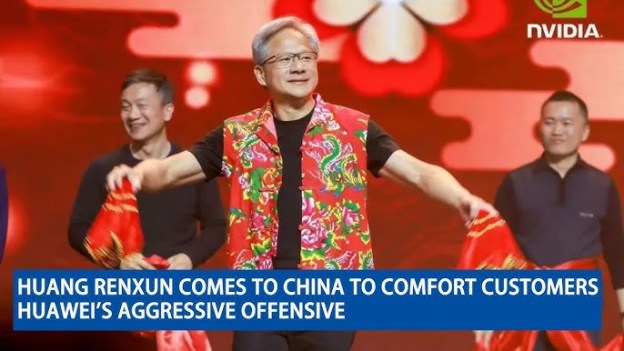
Nvidia’s market share in China fell to 50% from 95% over the past four years under U.S. restrictions, Huang, Nvidia’s CEO,  said in May 2025.  He visited China at least three times in 2025 to reassure Chinese tech executives and government officials that Nvidia was committed to the market…. Huang has met with top executives of Chinese cloud-computing leader Alibaba, smartphone and automaker Xiaomi and OpenAI challenger MiniMax.People in China’s tech industry said they appreciated Huang’s efforts to modify his chips so they could be sold in China. Engineers there nicknamed him “Magic Tailor” for his skill in designing chips to thread the needle of U.S. regulations.

Knowing the importance of the Chinese market to Nvidia, Beijing increased pressure on the company: China’s cybersecurity regulator recently summoned Nvidia representatives to discuss alleged security risks of the H20 chips, citing comments by U.S. lawmakers about the need for a bill to require tracking capabilities for advanced chips sold abroad….

Excerpt from Lingling Wei et al, With Billions at Risk, Nvidia CEO Buys His Way Out of the Trade Battle, WSJ, Aug. 11, 2025


Nvidia Geopolitical Games

Nvidia plans (in 2025) to open a research and development center in Shanghai to maintain its presence in China. The facility will help Nvidia understand Chinese customer demands and design products that are compliant with US export controls and sanctions. Chief Executive Jensen Huang visited China in April 2025 and discussed the plan with Shanghai’s mayor, who welcomed it and offered to provide support…Since 2022, Washington has required licenses for exports of Nvidia’s most advanced AI chips to China. That has reduced China sales, which accounted for 13% of revenue in its last fiscal year, down from 26% before the export restrictions.

The company is seeking to lease an office space in Shanghai for the new facility to accommodate existing employees and potential new hires, the people said. Officials in the city, where Tesla’s China plant is located, have told the company that it would offer tax breaks and reduce red tape for its new project, the people said. 

The company has repeatedly created downgraded variants of chips after Washington tightened its rules so that it could keep selling to China. The practice has angered some U.S. officials, who were upset the company wasn’t being more helpful in curbing China’s AI advances. Nvidia has said it follows U.S. export rules and has advocated for selling to Chinese customers rather than ceding the market to domestic companies such as Huawei Technologies, which are filling in the gap left by Nvidia and its American peers.

Excerpt from Raffaele Huang, Nvidia to Set Up Research Center in Shanghai, Maintaining Foothold in China, WSJ, May 16, 2025

The Cat-and-Mouse Game: US-China, Chip Giants

The U.S. on March 28 2025 added dozens of Chinese companies to a trade blacklist over national security concerns. American businesses seeking to sell technology to these companies will need approval from the government. Among those added were subsidiaries of Inspur Group, China’s largest server maker and a major customer for U.S. chip makers such as Nvidia, Intel and Advanced Micro Devices. Companies linked to China’s largest supercomputer maker, Sugon, were also added…

Nearly 80 companies were put on the Commerce Department’s blacklist, known as the entity list…including the U.S. server maker Aivres Systems that is wholly owned by Inspur Electronic. The latter is one-third owned by Inspur Group, according to corporate records. Aivres has been assembling high-end artificial-intelligence equipment for Nvidia. The AI-chip giant has said that Aivres will make servers using chips in the Blackwell family, Nvidia’s newest and most powerful processors.  Aivres advertises on its website that it sells servers and infrastructure powered by Blackwell chips, which are banned from sale into China…About two months after Inspur Group was added to the trade blacklist in March 2023, California-based Inspur Systems changed its name to Aivres Systems.

Excerpts from Liza Lin, Trump Takes Tough Approach to Choking Off China’s Access to U.S. Tech, WSJ, Mar. 26, 2025

The Battle to Block Access to AI

The U.S. is imposing some of its strongest measures yet to limit Chinese advances in artificial intelligence, requiring companies to get government approval to export certain information about their AI models and set up large AI computing facilities overseas.

The rules, in January 2025, are a final push by the Biden administration in a yearslong effort to use export controls to stem China’s advances in chip-making and AI, and they have sparked a backlash from companies including Nvidia. The rules impose caps on how many advanced AI chips can be exported to certain countries and require a license to export the data that underpins the most sophisticated AI systems.

Strict sales restrictions on these chips are already in place for China, Iran and other U.S. adversaries, and the new rules carve out exemptions for a group of 18 close U.S. allies and partners. These include countries such as the U.K., France and Germany, a senior administration official said. But a broad category of more than 120 other countries, including U.S. allies in the Middle East and Asia, are set to face new hurdles in setting up huge AI computing facilities.

While the impact of the rules isn’t yet clear, they threatened to limit sales of AI chips from Nvidia, which has built a large business out of satisfying demand for AI infrastructure in countries such as the United Arab Emirates and Saudi Arabia. Company officials said they expected to bring in almost $10 billion of revenue last year from so-called “sovereign AI,” where countries around the world increasingly see AI computing facilities as national assets.

Under the new rules, companies that produce AI models—the likes of OpenAI and Google—would need export licenses to send the “weights” attached to those models to many foreign countries. Model weights are the secret sauce in advanced AI systems like ChatGPT, a series of digital knobs that fine-tune their performance.

Excerpts from Asa Fitch and Liza Lin U.S. Targets China With New AI Curbs, Overriding Nvidia’s Objections, WSJ, Jan. 13, 2025

US-China Locked in Perpetual Cat and Mouse Game

Chinese artificial-intelligence developers have found a way to use the most advanced American chips without bringing them to China. They are working with brokers to access computing power overseas, sometimes masking their identity using techniques from the cryptocurrency world. The tactic comes in response to U.S. export controls that have prevented Chinese companies from directly importing sought after AI chips developed by U.S.-based Nvidia. While it is still possible for Chinese users to physically bring Nvidia’s chips to China by tapping a network of gray-market sellers, the process is cumbersome and can’t supply all the needs of big users.

One entrepreneur helping Chinese companies overcome the hurdles is Derek Aw, a former bitcoin miner. He persuaded investors in Dubai and the U.S. to fund the purchase of AI servers housing Nvidia’s powerful H100 chips. In June 2024, Aw’s company loaded more than 300 servers with the chips into a data center in Brisbane, Australia. Three weeks later, the servers began processing AI algorithms for a company in Beijing. “There is demand. There is profit. Naturally someone will provide the supply,” Aw said.

Renting far away computing power is nothing new, and many global companies shuffle data around the world using U.S. companies’ services such as Google Cloud, Microsoft Azure and Amazon Web Services. However, those companies, like banks, have “Know Your Customer” policies that may make it difficult for some Chinese customers to obtain the most advanced computing power.

The buyers and sellers of computing power and the middlemen connecting them aren’t breaking any laws, lawyers familiar with U.S. sanctions say. Washington has targeted exports of advanced chips, equipment and technology, but cloud companies say the export rules don’t restrict Chinese companies or their foreign affiliates from accessing U.S. cloud services using Nvidia chips. The Commerce Department in January 2014 proposed a rule that seeks to prevent malicious foreign entities from using U.S. cloud computing services for activities including training large AI models. U.S. cloud companies argue that the rule won’t prevent abuse and could instead undermine customer trust and weaken their competitiveness.

In platforms used by Aw and others, the billing and payment methods are designed to give the participants a high degree of anonymity. Buyers and sellers of computing power use a “smart contract” in which the terms are set in a publicly accessible digital record book. The parties to the contract are identified only by a series of letters and numbers and the buyer pays with cryptocurrency. The process extends the anonymity of cryptocurrency to the contract itself, with both using the digital record-keeping technology known as blockchain. Aw said even he might not know the real identity of the buyer. As a further mask, he and others said Chinese AI companies often make transactions through subsidiaries in Singapore or elsewhere.

The service of selling scattered computing power is called a decentralized GPU model.

Excerpts from Raffaele Huang, China’s AI Engineers Are Secretly Accessing Banned Nvidia Chips, WSJ, Aug. 26, 2024