Tag Archives: sanctions Huawei

Nvidia CEO Has a Magic Needle

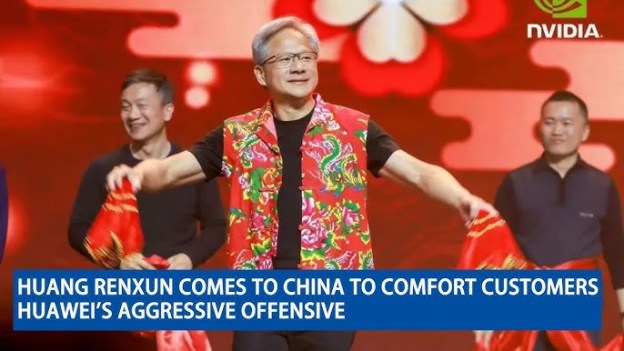
Nvidia’s market share in China fell to 50% from 95% over the past four years under U.S. restrictions, Huang, Nvidia’s CEO,  said in May 2025.  He visited China at least three times in 2025 to reassure Chinese tech executives and government officials that Nvidia was committed to the market…. Huang has met with top executives of Chinese cloud-computing leader Alibaba, smartphone and automaker Xiaomi and OpenAI challenger MiniMax.People in China’s tech industry said they appreciated Huang’s efforts to modify his chips so they could be sold in China. Engineers there nicknamed him “Magic Tailor” for his skill in designing chips to thread the needle of U.S. regulations.

Knowing the importance of the Chinese market to Nvidia, Beijing increased pressure on the company: China’s cybersecurity regulator recently summoned Nvidia representatives to discuss alleged security risks of the H20 chips, citing comments by U.S. lawmakers about the need for a bill to require tracking capabilities for advanced chips sold abroad….

Excerpt from Lingling Wei et al, With Billions at Risk, Nvidia CEO Buys His Way Out of the Trade Battle, WSJ, Aug. 11, 2025


Nvidia Geopolitical Games

Nvidia plans (in 2025) to open a research and development center in Shanghai to maintain its presence in China. The facility will help Nvidia understand Chinese customer demands and design products that are compliant with US export controls and sanctions. Chief Executive Jensen Huang visited China in April 2025 and discussed the plan with Shanghai’s mayor, who welcomed it and offered to provide support…Since 2022, Washington has required licenses for exports of Nvidia’s most advanced AI chips to China. That has reduced China sales, which accounted for 13% of revenue in its last fiscal year, down from 26% before the export restrictions.

The company is seeking to lease an office space in Shanghai for the new facility to accommodate existing employees and potential new hires, the people said. Officials in the city, where Tesla’s China plant is located, have told the company that it would offer tax breaks and reduce red tape for its new project, the people said. 

The company has repeatedly created downgraded variants of chips after Washington tightened its rules so that it could keep selling to China. The practice has angered some U.S. officials, who were upset the company wasn’t being more helpful in curbing China’s AI advances. Nvidia has said it follows U.S. export rules and has advocated for selling to Chinese customers rather than ceding the market to domestic companies such as Huawei Technologies, which are filling in the gap left by Nvidia and its American peers.

Excerpt from Raffaele Huang, Nvidia to Set Up Research Center in Shanghai, Maintaining Foothold in China, WSJ, May 16, 2025

The New Trump Doctrine: Kiss the Hand you Cannot Bite

Four US major automakers are racing to find workarounds to China’s stranglehold on rare-earth magnets, which they fear could force them to shut down some car production within weeks. Several traditional and electric-vehicle makers—and their suppliers—are considering shifting some auto-parts manufacturing to China to avoid looming factory shutdowns, people familiar with the situation said.

Ideas under review include producing electric motors in Chinese factories or shipping made-in-America motors to China to have magnets installed. Moving production to China as a way to get around the export controls on rare-earth magnets could work because the restrictions only cover magnets, not finished parts, the people said.

If automakers end up shifting some production to China, it would amount to a remarkable outcome from a trade war initiated by President Trump with the intention of bringing manufacturing back to the U.S.  “If you want to export a magnet [from China] they won’t let you do that. If you can demonstrate that the magnet is in a motor in China, you can do that,” said a supply-chain manager at one of the carmakers.

China in April 2025 began requiring companies to apply for permission to export magnets made with rare-earth metals, including dysprosium and terbium. The country controls roughly 90% of the world’s supply of these elements, which help magnets to operate at high temperatures. Much of the world’s modern technology, from smartphones to F-35 jet fighters, rely on these magnets….In May 2025, industry groups representing most major automakers and parts suppliers told the Trump administration that vehicle production could be reduced or shut down imminently without more rare-earth components from China.

Excerpt from Sean McLain et al., Automakers Race to Find Workaround to China’s Stranglehold on Rare-Earth Magnets, WSJ, June 4, 2025

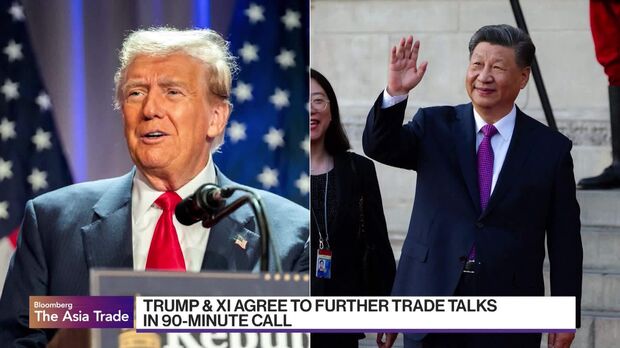
Two days after the publication of this WSJ article, Trump announced, on June 6, 2024, that Xi agreed to let rare earth minerals flow to US (in exchange of? not revoking Chinese student visas? what else?)

I Can’t Imagine Germany without China

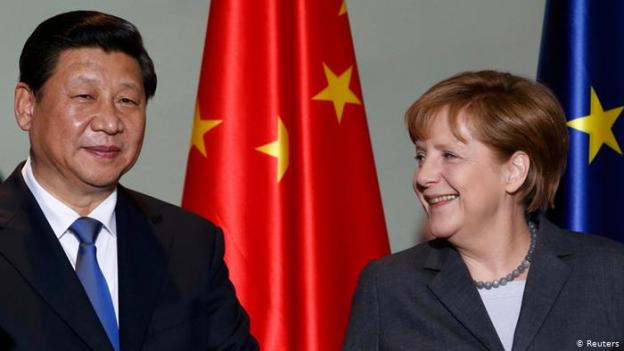
Germany is struggling to pick sides in the escalating dispute between the U.S. and China over issues including trade and human rights, amid mounting American pressure and Beijing’s authoritarian drift. Of all advanced economies outside Asia, Germany has the deepest economic ties in both camps and would have the most to lose from a Cold War between Washington and Beijing.

Berlin’s snaking trade links with China and the U.S. have served Germany well in the past two decades, providing it with steady growth, near full employment and full public coffers that have allowed the deployment of more than €1 trillion ($1.13 trillion) in measures to support its economy during the pandemic.  Now, Germany’s reluctance to take sides is diluting Europe’s broader efforts to present a united front to China, undermining the bloc’s power to shape a new global architecture…

Germany’s export-oriented economic model means it can’t really choose at all. It needs both the US and China.  China is Germany’s largest trading partner; the U.S. its biggest export market. And they stand neck-and-neck: Last year, Germany exported €119 billion of goods to the U.S. and €96 billion to China….Around 28% of jobs in Germany are directly or indirectly linked to exports, and in manufacturing that figure is 56%, according to the German Ministry for Economic Affairs. Germany exports nearly as much as the U.S. despite having only one-quarter the population.

Germany’s world-beating engineering companies supplied the factory equipment and the infrastructure that powered China’s transformation into the world’s top manufacturer. Harnessed to the fast-growing giant, Germany rebounded strongly after the financial crisis and weathered the eurozone debt crisis…

“I can’t imagine Volkswagen without China,” said Ferdinand Dudenhoeffer, director of the Center Automotive Research at the University of Duisburg-Essen.  Volkswagen CEO Herbert Diess, who refers to China as his company’s “second home,” has recently praised China’s handling of the coronavirus pandemic. The company in May said it would pour $2 billion into China’s electric-car market….

Excerpts from Tom Fairless et al., U.S.-China Tensions Leave Germany Squirming in the Middle, WSJ, June 24, 2020

Your Death, My Life: Ericsson versus Huawei

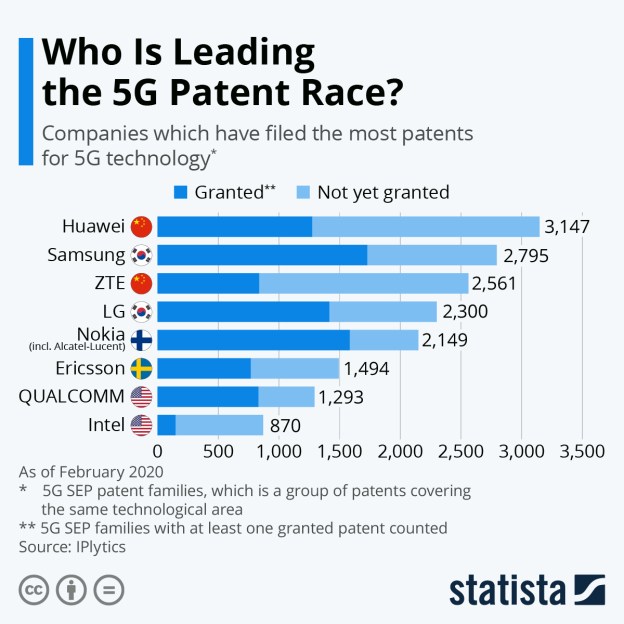
The Trump administration’s increasingly aggressive effort to cripple China’s Huawei has presented Ericsson the opportunity to lead the rollout of 5G technology around the world.  The Swedish company is emerging as the steadiest player in the $80-billion-a-year cellular-equipment industry, telecommunications executives and analysts say, because it makes a technically advanced product that one rival, Nokia,was late to develop and that Huawei may not be able to make in the future because of recent U.S. measures.

The Trump administration last month stepped up efforts to hamper Huawei by imposing export restrictions that make it harder for the company to buy computer chips that are produced using U.S.-designed equipment —a move that could prevent it from manufacturing advanced 5G hardware. The U.S. has also sought to boost Huawei’s rivals by providing loans to wireless carriers in developing countries so they can buy equipment from non-Chinese suppliers, among other moves.

U.S. Attorney General William Barr in February suggested that the U.S. government take a financial stake in Ericsson or Nokia, or both, to “make it a more formidable competitor and eliminate concerns over its staying power.”

The White House quickly backed away from the idea….Ericsson provides equipment for all three major U.S. carriers: AT&T Inc., Verizon Communications Inc. and T-Mobile US Inc….

Ericsson struggled in the cellular-equipment industry against China’s Huawei and ZTE Corp., which sold comparable products, often at lower prices. Among Ericsson’s key innovations are cellular antennas. Ericsson’s use a new technology, called massive multiple-input multiple-output, or massive MIMO, that sends wireless signals in strong jets to different devices. Typical cellular antennas, which sit on steel towers or rooftops, send wireless signals in a wide cone, similar to the way a garden hose sprays water.

Wireless carriers want Ericsson’s concentrated wireless technology because it enables fast connections and allows them to serve more customers using existing cellular towers. Building new towers is unattractive because it is a bureaucratic process that can cost tens of thousands of dollars….Ericsson notched a victory the spring of 2020 when it joined Huawei in winning 5G contracts to supply all three major wireless carriers in China, the world’s second-biggest telecom-equipment market

The big question for wireless carriers and equipment makers is whether Huawei can continue making massive MIMO 5G equipment with the quality that wireless carriers have come to expect. The technology requires supplies from the world’s top semiconductor companies, but the Trump administration’s recent actions may mean even foreign chip suppliers must seek Washington’s approval to sell to Huawei. For now, Ericsson is assuming China has advanced its own semiconductor industry enough to continue supplying Huawei.

Excerpts from Stu Woo, Ericsson Emerges as 5G Leader After U.S. Bruises Huawei, WSJ,  June 2, 2020