Tag Archives: trade sanctions

Chinese Billionaires Helping U.S. Billionaires

The United States has spent the past few years ghosting Robin Zeng, China’s fourth-richest man. To the U.S. government, Chinese battery maker CATL is a geopolitical threat to be warded off with tariffs and national-security curbs. Yet CATL has grown to become the world’s largest electric-vehicle battery manufacturer thanks to its technology and low costs. It posted record profit of more than $10 billion in 2025, and an estimated one in three EVs sold around the world carries its batteries. Ford recently ditched South Korea’s SK Group as its joint-venture partner for battery projects, focusing instead on its plan to build CATL-designed batteries at a $3 billion factory in Michigan. Ford is paying to license the Chinese company’s intellectual property, a workaround the U.S. allows while it puts up legal and political barriers to prevent CATL from building its own plants. General Motors is set to import China-made batteries from CATL and put them in its new Chevrolet Bolt—also legal, albeit only by swallowing a 60% tariff. And Tesla is using CATL technology for a battery plant in Nevada producing energy-storage systems, a business that is growing strongly while Tesla’s core EV business has stalled.

Critics of China argue that embedding a Chinese battery maker in the U.S. supply chain would make the U.S. even more vulnerable to Beijing’s economic coercion and undercut the chances of American battery companies catching up. CALT was placed in 2025 on a Pentagon list of companies working with China’s military.

Founded just 15 years ago, CATL benefited from a Beijing policy in the second half of the 2010s that gave Chinese EV makers subsidies if they used batteries from approved supplies such as CATL. It also received government money directly—more than $500 million in the first half of 2024 alone, according to CATL filings. Only state-owned petrochemical company Sinopec got more among mainland-China-listed companied. The iron-based battery chemistry, called lithium ferrophosphate, or LFP, costs up to 30% less a kilowatt-hour compared with nickel-manganese-cobalt batteries, the type South Korean and Japanese companies usually produce, industry experts say. In 2025, CATL developed an LFP battery with 500 miles of driving range that can be powered for up to 320 miles in just five minutes.

CATL’s technology is the reason Ford chose it for the Michigan factory tie-up, said Lisa Drake, a Ford executive on the project. “It probably would’ve taken us a decade to catch up and have LFP technology on our own,” Drake said in 2025.  She lamented that LFP batteries were invented in the U.S., but Chinese firms such as CATL figured out how to make them viable in cars. “We just didn’t commercialize that technology,” she said.

Excerpt from Yoko Kubota, The Chinese Billionaire Who Says America’s EV Market Is Doomed Without Him, WSJ, Mar. 23, 2026
The New Trump Doctrine: Kiss the Hand you Cannot Bite

Four US major automakers are racing to find workarounds to China’s stranglehold on rare-earth magnets, which they fear could force them to shut down some car production within weeks. Several traditional and electric-vehicle makers—and their suppliers—are considering shifting some auto-parts manufacturing to China to avoid looming factory shutdowns, people familiar with the situation said.

Ideas under review include producing electric motors in Chinese factories or shipping made-in-America motors to China to have magnets installed. Moving production to China as a way to get around the export controls on rare-earth magnets could work because the restrictions only cover magnets, not finished parts, the people said.

If automakers end up shifting some production to China, it would amount to a remarkable outcome from a trade war initiated by President Trump with the intention of bringing manufacturing back to the U.S.  “If you want to export a magnet [from China] they won’t let you do that. If you can demonstrate that the magnet is in a motor in China, you can do that,” said a supply-chain manager at one of the carmakers.

China in April 2025 began requiring companies to apply for permission to export magnets made with rare-earth metals, including dysprosium and terbium. The country controls roughly 90% of the world’s supply of these elements, which help magnets to operate at high temperatures. Much of the world’s modern technology, from smartphones to F-35 jet fighters, rely on these magnets….In May 2025, industry groups representing most major automakers and parts suppliers told the Trump administration that vehicle production could be reduced or shut down imminently without more rare-earth components from China.

Excerpt from Sean McLain et al., Automakers Race to Find Workaround to China’s Stranglehold on Rare-Earth Magnets, WSJ, June 4, 2025

Two days after the publication of this WSJ article, Trump announced, on June 6, 2024, that Xi agreed to let rare earth minerals flow to US (in exchange of? not revoking Chinese student visas? what else?)

Strangling China with Hong Kong: the Politics of Fear

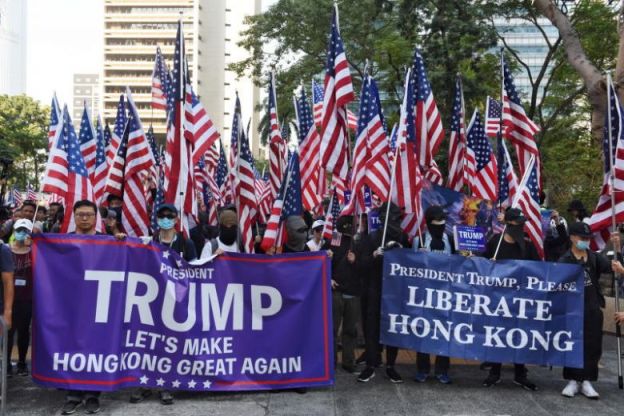
The U.S. determination  that Hong Kong is no longer autonomous from mainland China, under the Hong Kong Policy Act of 1992, will have significant implications for the city’s exporters and businesses.  Sensitive U.S. technologies could no longer be imported into Hong Kong, and the city’s exports might be hit with the same tariffs levied on Chinese trade.

But the act doesn’t cover the far more extensive role Hong Kong plays as China’s main point of access to global finance.  As of 2019, mainland Chinese banks held 8,816 trillion Hong Kong dollars ($1.137 trillion) in assets in the semiautonomous city, an amount that has risen 373% in the last decade…. China’s banks do much of their international business, mostly conducted in U.S. dollars, from Hong Kong. With Shanghai inside China’s walled garden of capital controls, there is no obvious replacement.

While the U.S. doesn’t directly control Hong Kong’s status as a financial center, Washington has demonstrated its extensive reach over the dollar system, with penalties against Korean, French and Lebanese financiers for dealing with sanctioned parties. The U.S. recently threatened Iraq’s access to the New York Federal Reserve, demonstrating a growing willingness to use financial infrastructure as a tool of foreign policy.  Even though the U.S. can’t legislate Hong Kong’s ability to support Chinese banks out of existence, the role of an international funding hub is greatly reduced if your counterparties are too fearful to do business with you.

Putting the ability of Chinese banks to conduct dollar-denominated activities at risk would be deleterious to China’s ability to operate financially overseas, posing a challenge for the largely dollar-denominated Belt and Road global infrastructure initiative. It would also put the more financially fragile parts of the country, like its debt-laden property developers, under strain.  China’s hope to develop yuan into an influential currency also centers on Hong Kong’s remaining a viable global financial center—more than 70% of international trade in the yuan is done in the city.

Excerpts from Mike Bird, How the US Could Really Hurt China, WSJ, May 290, 2020