Tag Archives: weather modification Korea

First Pollute: Then, Fire the Clouds to Make Rain

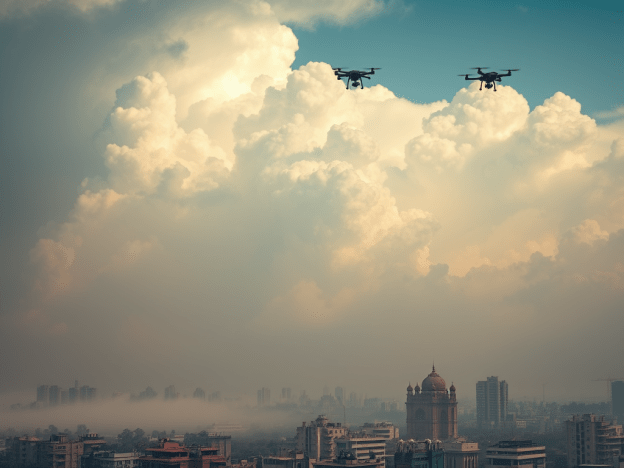
Authorities in Indian capital Delhi unsuccessfully carried out in October 2025 a cloud seeding trial, which is the technique of altering clouds to make rain, to tackle the city’s worsening air pollution.

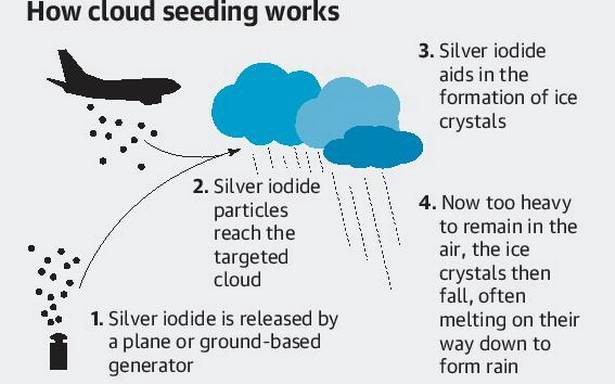
[What is Cloud Seeding?] Cloud seeding is done by firing small particles – usually silver iodide – into clouds to produce rain. The technique is used around the world, but experts doubt its efficacy as a long-term air pollution control measure. A team of the Indian Institute of Technology (IIT) Kanpur and the Delhi government carried out the trial over several neighbourhoods, as thick smog enveloped the city. But the attempt – the first in 53 years – was “not completely successful” due to the lack of moisture in the air. As a result, Delhi’s Air Quality Index (AQI) – which measures the level of PM 2.5 or fine particulate matter in the air that can clog lungs – is still hovering between 300 and 400, which is nearly 20 times the acceptable limit…

Delhi’s first cloud-seeding experiment was carried out in 1957, followed by another attempt in 1972, according to the Indian Institute of Tropical Meteorology. While those experiments were aimed at drought management, this was the first indigenous effort at cloud seeding to control pollution.

China has boasted about its success to manage rains before hosting the Olympics, with Beijing using rockets, cannons and drones to do cloud seeding. However, in the United Arab Emirates, questions over the technique were raised, following floods in Dubai in 2024.

Excerpt from Abhishek Dey, Why Delhi’s experiment to fix toxic smog with artificial rain failed, BBC, Oct. 29, 2025
Addicted to Weather Modification: Make it Rain Now

Attempts to modify the weather can be dangerous. They require pilots to head into the kind of clouds they would normally avoid. But officials claim that China’s efforts to trigger or boost precipitation by scattering chemicals in the sky, which began in the 1950s, have been hugely successful. Today the country spends at least $200m a year on the programme. In 2018 about 50,000 people were involved in it, most of them part-time or seasonal staff working from small offices in rural areas.

Among the 50 or so countries where cloud-seeding is practiced, China is the most enthusiastic promoter of it….Officials claim it can help to put out wildfires and reduce air pollution. State media report that cloud-seeding brings down about 50bn cubic metres of extra rain or snow across the country each year—equal to about 8% of total water demand. Officials in Beijing claim that in the parched capital, seeding can boost rainfall by 15%…

Recent advances in radar and computer modelling have made rigorous tests more possible. Scientists now generally agree that cloud-seeding can slightly augment snowfall from specific types of cloud that form on the slopes of mountains. Some of China’s weather-modification projects take place in such environments. But elsewhere, despite the lack of convincing proof that it works, farmers still want the government to try. And the government likes getting credit when rain does fall. Cloud-seeding creates employment in poor rural places, in particular for army veterans who believe that the government owes them a job.

Only a few of China’s rainmakers use planes. More commonly, they fire silver iodide into the sky from artillery pieces. But that can be dangerous, too. Locals are often advised to keep an eye out for unexploded shells, which occasionally land on people’s homes….

Excerpts from No silver lining: Cloud-seeding will not solve China’s water shortages, Economist, Mar. 27, 2021

Weather Modification: South Korea

Amid rising concerns over climate change all over the world, Korea’s Rural Development Administration opened the country’s first weather modification facility for crop research and development.  The facility functions as a control tower where meteorological conditions affecting the growth of crops can be manipulated artificially.
Temperatures can be set from minus 10 degrees Celsius to up to 40 degrees, and carbon dioxide levels can be maximized up to 1,500 ppm.
In particular, the facility can create up to 50mm of artificial rain per hour, a feature that no other cloud-seeding system in the world has been able to achieve…

The local farm industry has been widely affected by rising temperatures. In particular, Napa cabbages and chili peppers, two main ingredients for making kimchi, have been found to respectively rot quicker and be highly susceptible to anthracnose outbreaks. At this pace, it is forecast that it will no longer be possible to cultivate chili peppers by 2050. Even rice production is expected to dip by 20 percent in the next 30 years.

Excerpts from Cho Sung-min, Korea establishes first weather modification facility for crop research and developmen, Arirang News, June 29, 2017