Tag Archives: Y-12 Nuclear Security Complex

The Real Nuclear Weapons Doctrine of the United States

The U.S. Joint Chiefs of Staff in mid-June 2019 briefly published the Pentagon’s official doctrine on the use of nuclear weapons. The joint chiefs quickly pulled the document — Joint Publication 3-72, Nuclear Operations from the public website. [But a public copy has been preserved] “Using nuclear weapons could create conditions for decisive results and the restoration of strategic stability,” the doctrine opines. “Specifically, the use of a nuclear weapon will fundamentally change the scope of a battle and create conditions that affect how commanders will prevail in conflict.”

The joint chiefs published the nuclear document around the same time that the Stockholm International Peace Research Institute (SIPRI) published its annual 2019 report, detailing the world’s atomic arsenals.  At the start of 2019, Russia, the United States, and seven other countries possessed 13,865 nuclear weapons, SIPRI found. That represents “marked decline” from the 14,465 atomic weapons in world arsenals at the beginning of 2018, according to SIPRI….But the cuts could reverse. New START will expire in 2021 unless both parties agree to extend the treaty. “…

A senior U.S. intelligence official on May 29, 2019 accused Russia of secretly conducting nuclear tests in violation of an international treaty and the country’s own moratorium on such tests….But the Arms Control Association in Washington, D.C. was skeptical of the general’s claim. “Ashley would only say that Russia had the ‘capability’ to conduct very low-yield supercritical nuclear tests in contravention of the treaty, a capability which Russia, China and the United States have long had. He did not say that Russia has conducted or is conducting such tests.”  Ashley’s allegation is consistent with repeated attempts by Pres. Donald Trump, his administration and his allies in Congress to dismantle existing arms-control regimes by accusing Russia of violating them, thus justifying a U.S. withdrawal from the same regimes and clearing the way for a U.S. arms build-up.

The Trump administration echoed the administration of Pres. Barack Obama in accusing Russia of willfully violating the 1987 Intermediate-Range Nuclear Forces treaty, an accusation Russia has denied. The White House in February 2019 announced the United States’ withdrawal from the treaty, which bans land-based, medium-range missiles in Europe.

There’s irony in Ashley accusing Russia of violating the 1996 Comprehensive Test Ban Treaty, which according to the Arms Control Association “prohibits any nuclear test explosions that produce a self-sustaining, supercritical chain reaction and creates a robust international verification regime.”  “The United States has signed but not ratified the treaty,” the association pointed out. “The most effective way for the United States to enforce compliance with the zero-yield standard is for the Trump administration and the U.S. Senate to support ratification of the treaty and help to bring it into force, which would allow for intrusive, short-notice, on-site inspections to detect and deter any possible cheating.”

Davide Axe, Oops: The Pentagon Just Revealed Its Nuclear Doctrine, National Interest, June 20, 2019

Nuclear Weapons: Belgium

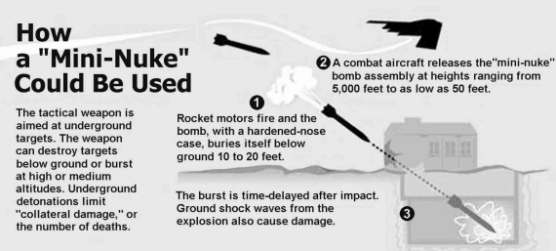
The US has approximately 180 B61 bombs – more than 10 times as powerful as those dropped on Hiroshima – at six locations in five countries across Europe.  An unknown number of these weapons are stored at the Kleine Brogel airbase in Belgium.  And Belgium has been the focus of European security services due to its reputation as a hotbed of radicalisation. During the first breach in 2010, anti-nuclear campaigners spent up to an hour wandering around the air base before security personnel moved in.A few months later activists again managed to sneak onto the site, this time reportedly gaining access to one of the hardened shelters used to house F-16 fighter jets as well as atomic weapons….

The US has stored non-strategic or tactical forward-deployed weapons at European facilities since the Cold War.The US Defence Department maintains about 4,760 nuclear warheads; an estimated 2,080 warheads are deployed while 2,680 warheads are held in storage….US bases have also been hit by worrying security breaches, including the break-in at the Y-12 site in Tennessee in 2012, one of the United States’ most sensitive sites. …….

Belgian authorities evacuated nuclear power plants at Doel, which houses four reactors, and Tihange, which houses three, in the immediate aftermath of terrorist attacks of March 2016…

Excerpts from TOM BATCHELOR, Security breaches uncovered at EUROPEAN bases storing US nuclear warheads, Express UK, Apr. 4, 2016

Weapons-Grade Uranium-S. Africa: better than gold

In the early hours of 28 July 2012, three people, one of them an 82-year-old nun named Megan Rice, broke into the Y-12 Nuclear Security Complex near the city of Oak Ridge, Tennessee. Y-12 is where all of America’s highly enriched uranium (HEU) – for making nuclear weapons is stored… in November 2007, two groups of intruders cut through the security fences surrounding South Africa’s 118-acre Pelindaba Nuclear Research Centre, west of Pretoria. They got as far as the emergency operations centre before a barking dog alerted a stand-in security office….=

Pelindaba houses South Africa’s stockpile of HEU, which was extracted in 1990 from the six or seven nuclear bombs that the old National Party government had built. According to the Center for Public Integrity (CPI) report, the HEU was melted down and cast into ingots, which were stored at Pelindaba. Over the years, some of the HEU was used to make medical isotopes for sale…..

Now, according to the CPI report, about 220 kg of the HEU remains, with no immediate purpose. This gives Pretoria the theoretical ability to make nuclear weapons again. But what really bothers the US officials who the CPI interviewed is that terrorists could steal the HEU and use it to make nuclear weapons. The report says Pelindaba contains enough weapons-grade uranium to fuel half a dozen bombs, each powerful enough to obliterate central Washingt

…US President Barack Obama has been trying very hard since 2011 to persuade President Jacob Zuma to relinquish the HEU stockpile, as part of his global effort to mop up such fissile material from nuclear states.

So why won’t South Africa give up its HEU stockpile? …Pelindaba is now probably more secure than most US nuclear facilities – especially after the US spent nearly US$10 million in helping South Africa to upgrade security there after the 2007 break-in. … [T]he main reason Pretoria wants to keep its HEU is because ‘it’s a stick they are using to beat up on the US for not dismantling its own nuclear weapons.’

In the end though, the 220 kg of highly enriched uranium stored away in the depths of Pelindaba has much more than commercial or tactical value…the stockpile is a symbol of South Africa’s sovereignty, its power and its integrity: of its ability to use nuclear energy for peaceful purposes – and even of its technical ability to construct an atomic weapon. But also of its firm moral determination never to do so.  In that sense, the 220 kg of highly enriched uranium ingots are more precious to the African National Congress government than all the gold bullion in the Reserve Bank. They aren’t going anywhere.

Excerpt from Peter Fabricius, Foreign Editor, Independent Newspapers, South Africa ISS,  Why is Pretoria so jealously guarding it fissile material? Mar. 19, 2014