Tag Archives: Alien Tort Claims Act

The first genocide of the 20th century

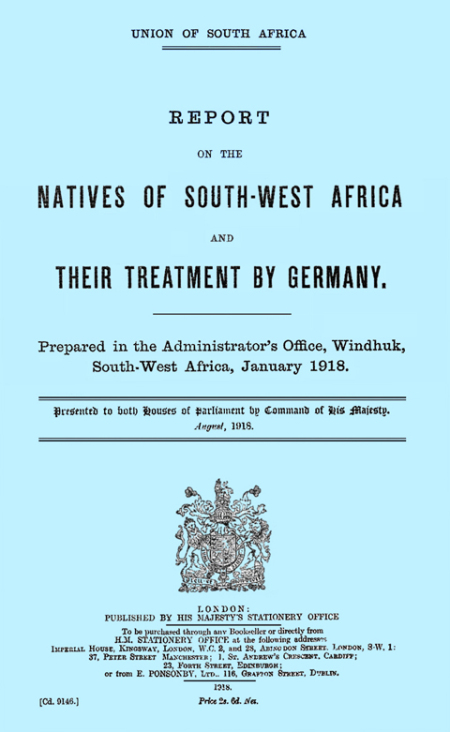
Germany was sued for damages in the United States on January 6, 2017 by descendants of the Herero and Nama people of Namibia, for what they called a genocide campaign by German colonial troops in the early 1900s that led to more than 100,000 deaths .

See Herero v. Germany (pdf)

According to a complaint filed with the US District Court in Manhattan, Germany has excluded the plaintiffs from talks with Namibia regarding what occurred and has publicly said any settlement will not include reparations to victims, even if compensation is awarded to Namibia itself.

“There is no assurance that any of the proposed foreign aid by Germany will actually reach or assist the minority indigenous communities that were directly harmed,” the plaintiffs’ lawyer Ken McCallion said in an email. “There can be no negotiations or settlement about them that is made without them.”  The proposed class-action lawsuit seeks unspecified sums for thousands of descendants of the victims, for the “incalculable damages” caused.

The slaughter took place from roughly 1904 to 1908, when Namibia was a German colony known as South West Africa, after the Herero and Nama groups rebelled against German rule.According to published reports, victims were also subjected to harsh conditions in concentration camps and some had their skulls sent to Germany for scientific experiments.Some historians view what occurred as the 20th century’s first genocide, and a 1985 United Nations report said the “massacre” of Hereros qualified as genocide…

The plaintiffs…sued under the Alien Tort Statute, a 1789 US law often invoked in human rights cases.

The US Supreme Court narrowed the law’s reach in a 2013 decision, Kiobel v. Royal Dutch Petroleum Co, saying it was presumed not to cover foreign conduct unless the claims sufficiently “touch and concern” the United States.  McCallion said Kiobel and later rulings “leave the door open” for US courts to assert jurisdiction in genocide cases. The plaintiffs, including some from New York, also brought federal common law and New York state law claims.

Germany sued over early 1900s Namibia slaughter, Reuters, Jan. 6, 2017

Multinational Corporations in US Courts: Kiobel v. Shell

The Alien Tort Statute (ATS)… grants American district courts jurisdiction over “any civil action by an alien for a tort only, committed in violation of the law of nations or of a treaty of the United States”. At the age of 190 it sprang back to life on April 6th 1979, when it was used to allow two Paraguayans to sue a former Paraguayan policeman in an American court for acts of torture committed in Paraguay.Since then, roughly 150 lawsuits have been filed against American and foreign corporations for actions committed around the world. Four local plaintiffs used the ATS to sue Unocal in a federal court in Los Angeles for human-rights violations allegedly committed during the construction of an oil pipeline in Myanmar. A human-rights organisation used it to sue Yahoo on behalf of two Chinese democracy activists for actions committed in China by a subsidiary. ATS suits against DaimlerChrysler and Rio Tinto, among others, are pending. Though most ATS cases have been dismissed or settled, the costs of settlements can be high and the negative publicity damaging.

Multinational companies will therefore cheer the Supreme Court’s unanimous decision in Kiobel v Royal Dutch Petroleum (Shell), released on April 17th, 2013. It dramatically limits the ability of plaintiffs to file suit against corporations in American courts for actions committed abroad.  The ruling stems from a case brought in New York by 12 Nigerian plaintiffs living in America. They allege that Shell was complicit in human-rights violations—including murder, rape, theft and destruction of property—committed by Nigeria’s armed forces in the region of Ogoniland. A federal appeals court dismissed their suit, arguing that the ATS provides no grounds for corporate-liability lawsuits. But as the 150 ATS suits show, other courts have disagreed. The Supreme Court agreed to hear the case in order to settle the question.

In an earlier ruling, in 2004, the court cautiously ruled that the ATS permitted lawsuits for “a modest number of international law violations”, such as piracy and crimes involving ambassadors, which would have been recognised when it was adopted. The court’s Kiobel ruling goes much further. It holds that the ATS does not apply to actions committed by foreign companies, and noted a strong presumption against applying American law outside the United States, “There is no indication,” wrote John Roberts, the chief justice, “that the ATS was passed to make the United States a uniquely hospitable forum for the enforcement of international norms”.  In a separate concurrence, four of the court’s liberals took a slightly softer tack, arguing that the ATS should allow suits that prevent America from becoming “a safe harbour…for a torturer or other common enemy of mankind”. But that reasoning still does not permit foreign nationals to use American courts to sue foreign companies for acts committed on foreign soil.

Extraterritoriality: The Shell game ends, Economist, Apr. 20, 2013, at 34