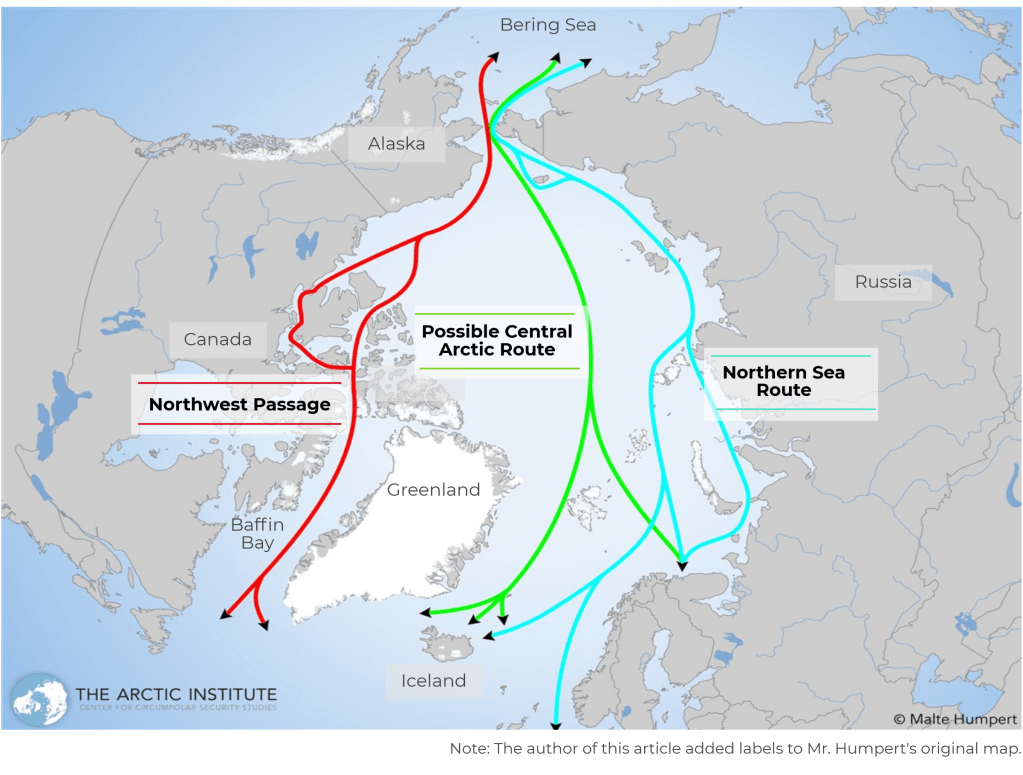
Chinese research submarines for the first time traveled thousands of feet beneath the Arctic ice the summer of 2025, a technical feat with chilling military and commercial implications for America and its allies. Beijing views future sea routes through the High North as a shortcut for global commerce, a so-called Polar Silk Road. China sent a cargo ship, in the summer of 2025, to the Polish port of Gdansk by skirting the North Pole, a route twice as fast as travel times using the Suez Canal..
Chinese and Russian military planes in 2025 flew patrols near Alaska for the first time, with Chinese long-range bombers operating from a Russian air base. Such cooperation not only gives China new abilities to strike North America but raises the prospect of a joint attack by America’s most powerful adversaries….In the Arctic, the U.S. and NATO worry most about subsea warfare. Submarine navigation relies on detailed knowledge of ocean-floor topography and undersea conditions. China is cataloging the world’s oceans to build computer models to guide submarines and help them evade detection, military experts say…U.S. analysts say data China gathered from its Arctic dives north of Alaska and Greenland isn’t just about studying climate change, but also to educate the Chinese navy, which operates relatively noisy submarines that are easily tracked by U.S. forces. ..
China’s ultimate aim, said Adm. Samuel Paparo, head of U.S. Indo-Pacific Command, is to end “American undersea dominance,” he told a conference in Canada in 2024.
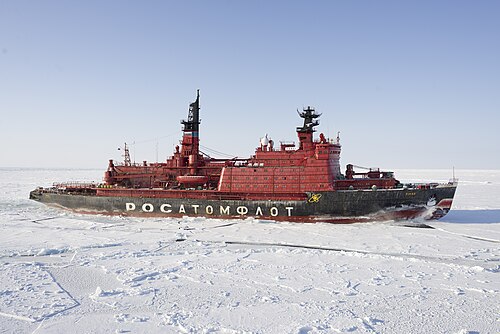
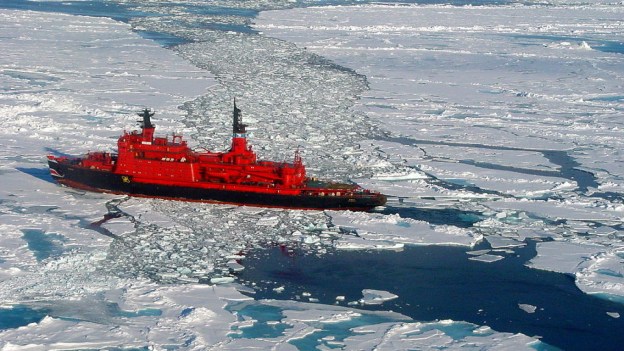
Both Beijing and the U.S. are short of vessels capable of navigating thick Arctic ice compared with Russia, which has more than 40. China in 2025 commissioned its fifth icebreaker. The U.S. has only two such vessels in operation, and Trump is buying more. After years of development, China launched its first domestically built icebreaker in 2019 with Finnish help. In 2025, it built and deployed its first domestically designed icebreaker in 10 months, a swift accomplishment noted with worry in Arctic countries.
Excerpt from Daniel Michaels, China’s Push to Master the Arctic Opens an Alarming Shortcut to U.S., WSJ
Supercooled gas has quickly become one of the world’s most important energy sources—and a flashpoint between Russia and the U.S. Nowhere is that contest more apparent than in Russia’s Arctic north. An enormous new coastal facility is being built there to produce liquefied natural gas, a key project for Russian President Vladimir Putin. The U.S. is using a barrage of sanctions to cripple the initiative, known as Arctic LNG 2. These have stopped Russia from taking delivery of specialized, colossal tankers that it needs to transport the gas, and made it hard to build alternative vessels domestically. “Our role is to ensure Arctic LNG 2 is dead in the water,” Geoffrey Pyatt, the U.S. assistant secretary of state for energy resources, told a conference in Switzerland in April 2024.
Globally, LNG is ascendant. Demand is buoyant as governments ditch dirtier coal and the uptake of power-hungry artificial intelligence accelerates. Supply is surging too, and players such as industry heavyweight Qatar have major expansion plans. For Russia’s part, Putin aims to more than triple LNG exports in the coming years. His goal: Bring in more money to fund the war in Ukraine and offset a decline in Russia’s traditional business of exporting gas via pipelines. ..
About 32 million metric tons a year of capacity are under construction, according to Rystad Energy, a consulting firm, on top of an existing 29 million tons. In December 2023, the first of three liquefaction plants, known in the industry as trains, was completed at Arctic LNG 2, and the facility began producing LNG. The milestone, despite U.S. sanctions, was lauded as a win for Moscow by analysts and Russian officials. A few months later, however, victory looks less certain.
Exports were supposed to begin in the first quarter of 2024, according to Russia’s energy minister. But the custom-built ships that Novatek, the Russian energy giant behind the project, needs to break through frozen parts of the Arctic Ocean haven’t been delivered.
Hanwha Ocean, a South Korean shipbuilder, said it has canceled plans to build three vessels for Arctic LNG 2 for sanctions-related reasons. Mitsui O.S.K. Lines, a Japanese shipping company, has said it also won’t provide vessels to Arctic LNG 2 despite having planned to charter three carriers. Without ships, Novatek can’t export any gas. As a result, LNG output has ground to a halt, and the facility is mostly recirculating already-produced gas, according to people familiar with the plant. Novatek didn’t respond to a request for comment.
France’s TotalEnergies, which holds 10% of Arctic LNG 2, declared a force majeure earlier this year, indicating it can’t supply customers due to circumstances beyond its control. Total said it was complying with sanctions and doesn’t plan to deliver gas from the project this year.
In total, the U.S. has hit Russia’s fledgling LNG industry with four waves of sanctions since September. It has targeted operating companies for the Arctic LNG 2 project, storage vessels, shipping companies it suspected were seeking to buy specialized carriers for the project, and companies working on a second facility near the Baltic Sea.
Excerpts from Anna Hirtenstein, The U.S. Is Trying to Cripple Russia’s Vast Arctic LNG Project, WSJ, Apr. 14, 2024
In 2018 the NATO alliance, joined by Sweden and Finland, held Trident Juncture, its largest exercise since the end of the cold war, in Norway. That involved the first deployment of an American aircraft-carrier in the Arctic Circle for three decades. Western warships have been frequent visitors since. On May 1, 2020 a “surface action group” of two American destroyers, a nuclear submarine, support ship and long-range maritime patrol aircraft, plus a British frigate, practised their submarine hunting skills in the Norwegian Sea.
Such drills are not unusual. But on May 4, 2020 some of those ships broke off and sailed further north into the Barents Sea, along with a third destroyer. Although American and British submarines routinely skulk around the area, to spy on Russian facilities and exercises covertly, surface ships have not done so in a generation. On May 7, 2020 Russia’s navy greeted the unwelcome visitors by announcing that it too would be conducting exercises in the Barents Sea—live-fire ones, in fact. On May 8, 2020… the NATO vessels departed.
It is a significant move. The deployment of destroyers which carry missile-defence systems and land-attack cruise missiles is especially assertive. After all, the area is the heart of Russian naval power, including the country’s submarine-based nuclear weapons. Russia’s Northern Fleet is based at Severomorsk on the Kola peninsula, to the east of Norway’s uppermost fringes.
Western navies are eager to show that covid-19 has not blunted their swords, at a time when America and France have each lost an aircraft-carrier to the virus. But their interest in the high north predates the pandemic. One purpose of the foray into the Barents Sea was “to assert freedom of navigation”, said America’s navy. Russia has been imposing rules on ships that wish to transit the Northern Sea Route (NSR), an Arctic passage between the Atlantic and Pacific that is becoming increasingly navigable as global warming melts ice-sheets . America scoffs at these demands, insisting that foreign warships have the right to pass innocently through territorial waters under the law of the sea. Although last week’s exercise did not enter the NSR, it may hint at a willingness to do so in the future.
On top of that, the Arctic is a growing factor in NATO defence policy. Russia has beefed up its Northern Fleet in recent years…Russian submarine activity is at its highest level since the cold war…Ten subs reportedly surged into the north Atlantic in October 2019 to test whether they could elude detection….Russia’s new subs are quiet and well-armed. As a result, NATO’s “acoustic edge”—its ability to detect subs at longer ranges than Russia—“has narrowed dramatically.”
Russia primarily uses its attack submarines to defend a “bastion”, the area in the Barents Sea and Sea of Okhotsk where its own nuclear-armed ballistic-missile submarines patrol. A separate Russian naval force known as the Main Directorate of Deep-Sea Research (GUGI, in its Russian acronym) might also target the thicket of cables that cross the Atlantic.
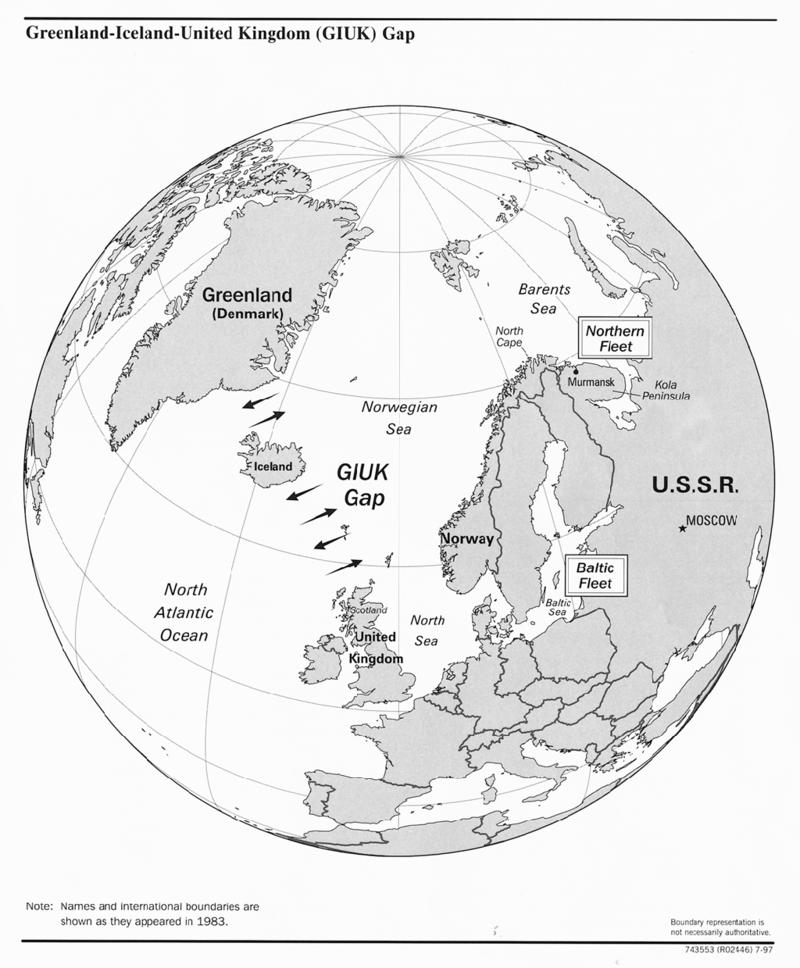
The challenge is a familiar one. For much of the cold war, NATO allies sought to bottle up the Soviet fleet in the Arctic by establishing a picket across the so-called GIUK gap, a transit route between Greenland, Iceland and Britain that was strung with undersea listening posts….The gap is now back in fashion and NATO is reinvesting in anti-submarine capabilities after decades of neglect. America has stepped up flights of P8 submarine hunting aircraft from Iceland, and Britain and Norway are establishing P8 squadrons of their own. The aim is to track and hold at risk Russian nuclear subs as early as possible, because even a single one in the Atlantic could cause problems across a large swathe of ocean.
GIUK (Greenland, Iceland, UK) gap. Image from wikipedia.
But a defensive perimeter may not be enough. A new generation of Russian ship-based missiles could strike NATO ships or territory from far north of the GIUK gap, perhaps even from the safety of home ports. “This technological development represents a dramatically new and challenging threat to NATO forces…. Similar concerns led the Reagan administration to adopt a more offensive naval posture, sending forces above the gap and into the maritime bastion of the Soviet Union.
Excerpts from Naval Strategy: Northern Fights, Economist, May 16, 2020

 Law-In-Action