Tag Archives: China AI

How China Plans to Destroy the U.S. AI Industry

China’s restrictions on rare-earth materials announced on October 9, 2025 would mark a nearly unprecedented export control*** that stands to disrupt the global economy, giving Beijing more leverage in trade negotiations and ratcheting up pressure on the Trump administration to respond.

The rule, put out by China’s Commerce Ministry, is viewed as an escalation in the U.S.-China trade fight because it threatens the supply chain for semiconductors. Chips are the lifeblood of the economy, powering phones, computers and data centers needed to train artificial-intelligence models. The rule also would affect cars, solar panels and the equipment for making chips and other products, limiting the ability of other countries to support their own industries. China produces roughly 90% of the world’s rare-earth materials.

Global companies that sell goods with certain rare-earth materials sourced from China accounting for 0.1% or more of the product’s value would need permission from Beijing, under the new rule. Tech companies will probably find it extremely difficult to show that their chips, the equipment needed to make them and other components fall below the 0.1% threshold, industry experts said. The rules could cause a U.S. recession if implemented aggressively because of how important AI capital spending is to the economy… “It’s an economic equivalent of nuclear war—an intent to destroy the American AI industry,” said Dmitri Alperovitch, co-founder of the Silverado Policy Accelerator think tank.

Excerpt from Amrith Ramkumar,et al., China’s Rare-Earth Escalation Threatens Trade Talks—and the Global Economy, WSJ, Oct. 9, 2025

***The new export controls mark the first time China has applied the foreign direct product rule (FDPR)—a mechanism introduced in 1959 by the United States and long used United States to restrict semiconductor exports to China. The FDPR enables the United States to regulate the sale of foreign-made products if they incorporate U.S. technology, software, or equipment, even when produced by non-U.S. companies abroad. In effect, if U.S. technology appears anywhere in the supply chain, the United States can assert jurisdiction. See CSIS


Out-of-Date: Academic Cooperation

Mr. Trump noted in the summer of 2025  that “the United States is in a race to achieve global dominance in artificial intelligence,” which Joe Biden called “a defining technology of our era.” Universities help drive that race. Meta’s chief AI officer, Alexandr Wang, has argued that the rate of AI progress may be such that “you need to prevent all of our secrets from going over to our adversaries and you need to lock down the labs.”

Thousands of Chinese citizens are working and studying in such labs….In AI specifically, nearly 40% of top-tier researchers at U.S. institutions are of Chinese origin. Beijing is aggressively cultivating American-educated and American-employed researchers via the Thousand Talents program.

Blindly embracing academic cooperation with a geopolitical rival is absurd. Nobody suggests we should train Iranian nuclear physicists or Russian ballistics engineers. The U.S. wouldn’t have been better off collaborating more with Nazi Germany in the 1930s or with the Soviet Union during the Cold War. Why make an exception for a nation dedicated to surpassing the U.S. in emerging technologies?

Excerpt from  Mike Gallagher, Send Harvard’s Chinese Students Home, WSJ, Aug. 19, 2025

The Battle to Block Access to AI

The U.S. is imposing some of its strongest measures yet to limit Chinese advances in artificial intelligence, requiring companies to get government approval to export certain information about their AI models and set up large AI computing facilities overseas.

The rules, in January 2025, are a final push by the Biden administration in a yearslong effort to use export controls to stem China’s advances in chip-making and AI, and they have sparked a backlash from companies including Nvidia. The rules impose caps on how many advanced AI chips can be exported to certain countries and require a license to export the data that underpins the most sophisticated AI systems.

Strict sales restrictions on these chips are already in place for China, Iran and other U.S. adversaries, and the new rules carve out exemptions for a group of 18 close U.S. allies and partners. These include countries such as the U.K., France and Germany, a senior administration official said. But a broad category of more than 120 other countries, including U.S. allies in the Middle East and Asia, are set to face new hurdles in setting up huge AI computing facilities.

While the impact of the rules isn’t yet clear, they threatened to limit sales of AI chips from Nvidia, which has built a large business out of satisfying demand for AI infrastructure in countries such as the United Arab Emirates and Saudi Arabia. Company officials said they expected to bring in almost $10 billion of revenue last year from so-called “sovereign AI,” where countries around the world increasingly see AI computing facilities as national assets.

Under the new rules, companies that produce AI models—the likes of OpenAI and Google—would need export licenses to send the “weights” attached to those models to many foreign countries. Model weights are the secret sauce in advanced AI systems like ChatGPT, a series of digital knobs that fine-tune their performance.

Excerpts from Asa Fitch and Liza Lin U.S. Targets China With New AI Curbs, Overriding Nvidia’s Objections, WSJ, Jan. 13, 2025

The US-China Supercomputer Rivalry

For decades, American and Chinese scientists collaborated on supercomputers, tennis-court-size machines essential to improving artificial intelligence, developing vaccines and predicting hurricanes. But Chinese scientists have become more secretive as the U.S. has tried to hinder China’s technological progress, and they have stopped participating altogether in a prominent international supercomputing forum.

The new secrecy also makes it harder for the U.S. government to answer a question it deems essential to national security: Does the U.S. or China have faster supercomputers? Some academics have taken it upon themselves to hunt for clues about China’s supercomputing progress, scrutinizing research papers and cornering Chinese peers at conferences.

Supercomputers have become central to the U.S.-China technological Cold War because the country with the faster supercomputers can also hold an advantage in developing nuclear weapons and other military technology. “If the other guy can use a supercomputer to simulate and develop a fighter jet or weapon 20% or even 1% better than yours in terms of range, speed and accuracy, it’s going to target you first, and then it’s checkmate,” said Jimmy Goodrich, a senior adviser for technology analysis to Rand Corp., a think tank.

The forum that China recently stopped participating in is called the Top500, which ranks the world’s 500 fastest supercomputers. While the latest ranking, released in June 2024, says the world’s three fastest computers are in the U.S., the reality is probably different. Officially, the fastest computer on the Top500 sits at the Energy Department-sponsored Oak Ridge National Laboratory, in Tennessee. Called Frontier, it is about the size of two tennis courts, cost $600 million to construct and has an electricity bill of about $20 million a year, said Dongarra, who also works at Oak Ridge. It uses tens of thousands of computer chips.

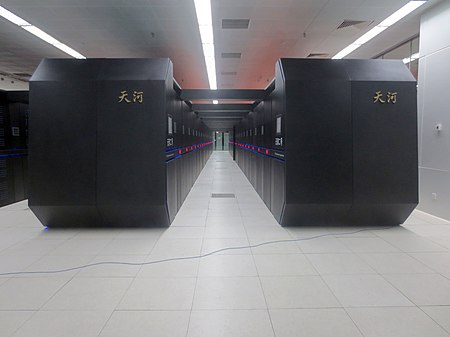
Dongarra doesn’t think Frontier is actually the world’s fastest supercomputer. Scientific papers suggest that certain Chinese machines are better. One has been referred to in state media as a prototype Tianhe-3, after a Chinese term for the Milky Way galaxy, while the other is a model in the Sunway series of supercomputers.

Excerpts from Stu Woo ,US China Rift Hits Supercomputer Ties, WSJ, July 24, 2024

The Under-Our-Noses Nasty Wars

Christopher Wray warned in February 2023 that Beijing’s efforts to covertly plant offensive malware inside U.S. critical infrastructure networks is now at “a scale greater than we’d seen before,” an issue he has deemed a defining national security threat. Citing Volt Typhoon, the name given to the Chinese hacking network that was revealed in 2023 to be lying dormant inside U.S. critical infrastructure, Wray said Beijing-backed actors were pre-positioning malware that could be triggered at any moment to disrupt U.S. critical infrastructure. Officials have grown particularly alarmed at Beijing’s interest in infiltrating U.S. critical infrastructure networks, planting malware inside U.S. computer systems responsible for everything from safe drinking water to aviation traffic so it could detonate, at a moment’s notice, damaging cyberattacks during a conflict.

The Netherlands’ spy agencies said in February 2024 that Chinese hackers had used malware to gain access to a Dutch military network in 2023. The agency, considered to have one of Europe’s top cyber capabilities, said it made the rare disclosure to show the scale of the threat and reduce the stigma of being targeted so allied governments can better pool knowledge.

A report released in February 2024 by agencies including the FBI, the Cybersecurity and Infrastructure Agency and the National Security Agency said Volt Typhoon hackers had maintained access in some U.S. networks for five or more years, and while it targeted only U.S. infrastructure directly, the infiltration was likely to have affected “Five Eyes” allies…

Excerpts from  Joe Parkinson, BI Director Says China Cyberattacks on U.S. Infrastructure Now at Unprecedented Scale, WSJ, Feb. 19, 2024

Why China Lags Behind in Artificial Intelligence

China is two or three years behind America in building foundation models of AI. There are three reasons for this underperformance. The first concerns data. A centralized autocracy should be able to marshal lots of it—the government was, for instance, able to hand over troves of surveillance information on Chinese citizens to firms such as SenseTime or Megvii that, with the help of China’s leading computer-vision labs, then used it to develop top-notch facial-recognition systems.

That advantage has proved less formidable in the context of generative AIs, because foundation models are trained on the voluminous unstructured data of the web. American model-builders benefit from the fact that 56% of all websites are in English, whereas just 1.5% are written in Chinese, according to data from w3Techs, an internet-research site. As Yiqin Fu of Stanford University points out, the Chinese interact with the internet primarily through mobile super-apps like WeChat and Weibo. These are “walled gardens”, so much of their content is not indexed on search engines. This makes that content harder for ai models to suck up. Lack of data may explain why Wu Dao 2.0, a model unveiled in 2021 by the Beijing Academy of Artificial Intelligence, a state-backed outfit, failed to make a splash despite its possibly being computationally more complex than GPT-4.

The second reason for China’s lackluster generative achievements has to do with hardware. In 2022 America imposed export controls on technology that might give China a leg-up in AI. These cover the powerful microprocessors used in the cloud-computing data centrers where foundation models do their learning, and the chipmaking tools that could enable China to build such semiconductors on its own.

That hurt Chinese model-builders. An analysis of 26 big Chinese models by the Centre for the Governance of ai, a British think-tank, found that more than half depended on Nvidia, an American chip designer, for their processing power. Some reports suggest that SMIC, China’s biggest chipmaker, has produced prototypes just a generation or two behind TSMC, the Taiwanese industry leader that manufactures chips for Nvidia. But SMIC can probably mass-produce only chips which TSMC was churning out by the million three or four years ago.

Chinese AI firms are having trouble getting their hands on another American export: know-how. America remains a magnet for the world’s tech talent; two-thirds of ai experts in America who present papers at the main ai conference are foreign-born. Chinese engineers made up 27% of that select group in 2019. Many Chinese AI boffins studied or worked in America before bringing expertise back home. The covid-19 pandemic and rising Sino-American tensions are causing their numbers to dwindle. In the first half of 2022 America granted half as many visas to Chinese students as in the same period in 2019.

The triple shortage—of data, hardware and expertise—has been a hurdle for China. Whether it will hold Chinese ai ambitions back much longer is another matter.

Excerpts from Artificial Intelligence: Model Socialists, Economist,  May 13, 2023, at 49