Tag Archives: climate change and the carbon majors

Emit all the Carbon You Want; But Please! Don’t Greenwash

A French court, October 23, 2025 ruled oil and gas giant TotalEnergies had engaged in “misleading commercial practices” by overstating its climate pledges—the first such ruling worldwide against a major oil company for climate misinformation. The ruling is the first conviction in the world against an oil company, and a great win against greenwashing the act of claiming to be more environmentally responsible than in reality.

Find here a machine-translated pdf of ruling.

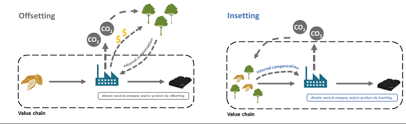
Another Laughingstock: Carbon Offsets

Carbon credits feature prominently in corporate climate strategies and have sparked public debate about their potential to delay companies’ internal decarbonisation. While industry reports claim that credit purchasers decarbonize faster, rigorous evidence is missing. This study (see below) provides an in-depth analysis of 89 multinational companies’ historical emission reductions and climate target ambitions. Based on self-reported environmental data and more than 400 sustainability reports, we find no significant difference between the climate strategies of companies that purchased credits and those that did not. Voluntary offsetting is not a central part of most companies’ climate strategies, and many pass credit costs directly onto their customers. While the companies within our sample retired one-fourth of all carbon credits in 2022, the top five offsetters’ expenditures on voluntary emission offsetting are, on average, only 1 percent relative to their capital expenditures.

Abstract from Niklas Stolz &  Benedict S. Probst, The negligible role of carbon offsetting in corporate climate strategies, Nature Communications,  Sept. 10, 2025

Oil Companies Never Die: the advantage of geothermal energy

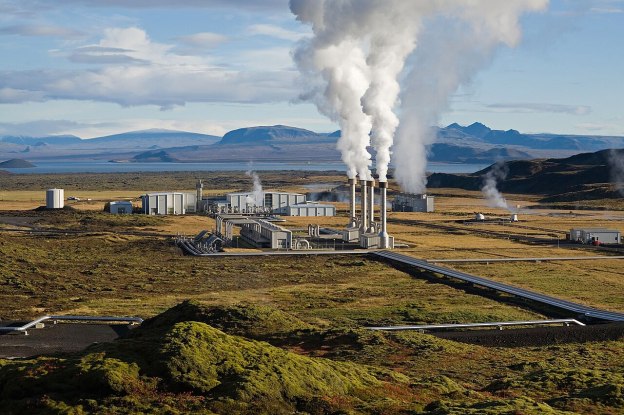
Oil-and-gas companies are accelerating investments in geothermal energy, betting the technologies that fueled the shale revolution can turn the budding industry into a large producer of clean power… Many of these companies are using the same technology employed by frackers, but instead of searching for oil and gas, they are looking for underground heat. The new geothermal industry is the result of a surprising confluence of interests among the oil-and-gas, technology and green power industries. The heat that the drillers find underground can be used to generate a steady, round-the-clock supply of carbon-free electricity, which is coveted by tech companies for their power-hungry data centers. 

Finding pockets of underground heat is relatively easy in places with lots of geothermal activity, including parts of the U.S., Indonesia and New Zealand. When the heat is deeper in the earth, it is more difficult and more expensive to find. Those constraints have kept the sector’s share of U.S. electricity generation at less than 1%. …Oil companies understand subsurface geology, have experience building infrastructure projects and have cash available to deploy. That is why Chevron is joining with other companies and pursuing geothermal pilot projects in Japan, Indonesia and the U.S.

Excerpts from Amrith Ramkumar, Frackers Are Now Drilling for Clean Power, WSJ, Feb. 29, 2024

From Lunatic to Feasible? Getting Rid of Carbon by Storing it into the Earth

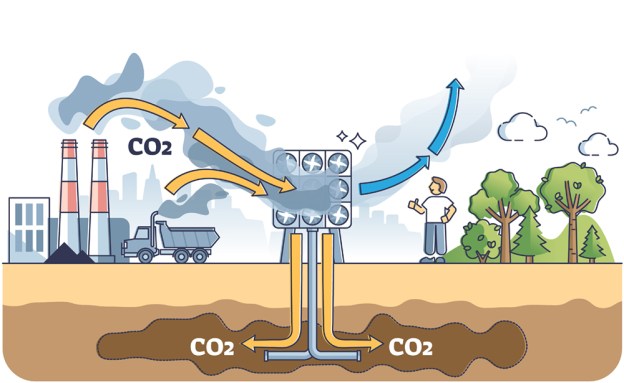
The boom in carbon removal, whether from the air , what is called direct air capture (DAC) or from industrial point sources , what is called carbon capture and storage (CCS), cannot come fast enough. The UN-backed Intergovernmental Panel on Climate Change (IPPC) assumes that if Earth is to have a chance of warming by less than 2°C above pre-industrial levels, renewables, electric vehicles and other emissions reductions are not enough. Carbon Capture and Storage (CCS)and sources of “negative emissions” such as DAC must play a part. The US Department of Energy calculates that America’s climate targets require capturing and storing between 400m and 1.8bn tonsof CO2 annually by 2050, up from 20m tons today. ..

For years DAC and CCS projects were regarded as technically plausible, perhaps, but uneconomical but carbon capture, utilization and storage (CCUS) may attract $150bn in investments globally this decade. A factor behind the recent flurry of carbon-removal activity is government action. One obvious way to promote the industry would be to make carbon polluters pay a high enough fee for every ton of carbon they emit that it would be in their interest to pay carbon removers to mop it all up, either at the source or from the atmosphere….The emerging view among technologists, investors and buyers is that carbon removal will develop like waste management did decades ago—as an initially costly endeavor that needs public support to get off the ground but can in time turn profitable…

Maybe the biggest sign that the carbon-removal business has legs is its embrace by the oil industry. Occidental is keen on DAC. ExxonMobil says it will spend $17bn from 2022 to 2027 on “lower-emissions investments”, with a slug going to CCA…Equinor and Wintershall, a German oil-and-gas firm, have already secured licenses to stash carbon captured from German industry in North Sea sites. Hugo Dijkgraaf, Wintershall’s technology chief, thinks his firm can abate up to 30m tons of CO2 per year by 2040. The idea, he says, is to turn “from an oil-and-gas company into a gas-and-carbon-management company”.

Excerpts from Can Carbon Removal Become a Trillion-Dollar Business?, Economist, May 27, 2023
Who to Blame for Climate Change? the Carbon Majors

 Whether the damage caused by extreme weather events can be linked to human emissions of greenhouse gases is one of the hottest topics in climate science. And that debate leads directly to another: if this link can be established, who bears the responsibility?  Both of these questions are at the center of an inquiry by the Philippine Commission on Human Rights, whose latest hearings took place in London in November 2018. It is the first time a human-rights commission has heard evidence on whether large emitters violate basic human rights by causing climate change

 Where the hearings become more unusual is in investigating the link between the damage caused by climate change and the behaviour of large industrial companies. This is predicated on recent efforts to trace greenhouse-gas emissions back to large corporate and state-owned producers of fossil fuels and cement, dubbed the “carbon majors”. The latest analysis by cdp (formerly the  Carbon Disclosure Project), a non-governmental organisation that works with companies, cities and states to measure their environmental impact, published in 2017, found that 100 of them had produced just over half of emissions since the Industrial Revolution.

The Philippine hearings will come to a close in December in Manila. The commission does not have the power to compensate victims of typhoons or to sanction emitters of carbon dioxide. According to Roberto Cadiz, one of the commissioners, that isn’t even the point. His wish is to open a dialogue about possible solutions to climate change that includes the industrial emitters. So far, however, only one side of the story is being heard. The emitters have declined to participate.

Excerpts from Climate Change: The Blame Game, Economist, Nov. 17, 2018